

Research Activities in Re:ERUA
The European Commission’s support for the production of this publication does not constitute an endorsement of the contents, which reflect the views only of the authors, and the Commission cannot be held responsible for any use which may be made of the information contained therein.
Started in November 2021, the Research component of the European Reform University Alliance – Re:ERUA – aims at developing the research trajectory of the ERUA.
In this page you will find our activities and results to rethink research and innovation from the perspective of responsible R&I and inclusive societal engagement.
This project is funded by the European Union under the Horizon 2020 programme.
Re: ERUA Publications
This report is a research-based deliverable (WP3) in Re:ERUA project aiming to foster societal engagement though Responsible Research and Innovation (RRI) within the European Reform University Alliance (ERUA). Taking the inspiration from existing EU guidelines and the field of RRI, while focusing also on societal engagement and social innovation, it is contributing to the aim of ‘Science with and for Society’ objective of the European Commissions’ Horizon 2020 program.
The finding of the report shows the aim of balancing economic gains and social concerns through RRI is not simple. Subsequently, RRI should also include a democratic and regenerative approach prioritizing social innovation, besides investigating how infrastructure in scientific institutions can support matters of care.
This research-based report contributes to both RRI definitions and to recent discussions of alternative excellence in ERUA by bringing in researchers’ perspectives and disciplinary backgrounds, which inform how ethical concerns and methodologies are developed in their research practices. Also, the analysis concludes that responsibility should be balanced in infrastructural measures to ensure that the connection between outputs of research and its methodological processes are stringent, such as including work conditions, early career staff and stakeholder knowledge sharing and network support. These contributions are central to the strengthening of a reform identity in the alliance.
We believe that we thus provide an approach to responsible research that acknowledges relationality and interdependency, contributing to a (re-)conceptualization of certain aspects of RRI that more explicitly focus on bridging between economic interests and social concerns. This happens amidst calls to transition from understanding of research as efficiency-based indicators and quantifiable outputs towards the creation of responsible and reflective relations with research participants, be it human or more-than-human.
Authors: WP3 team: Assoc. Prof. Katia Dupret, assist. prof. Jennifer Eschweiler, PhD. Anna Umantseva, Student Ronja Hyldkrog – Roskilde University
Dupret et al. 2022. Mapping Innovation and societal engagement – RRI through a care ethics approach
In this context, a publication – in Open Access, of course – has been released, which bundles our experiences in organising and running the events and also addresses “lessons learned”.
Re: ERUA Charters
Re: ERUA Ressources
Here, you will discover comprehensive information about our ongoing efforts in mapping activities and gain insights into the research units and equipment across our alliance.
All the following information will be integrated into the ERUA research portal as soon as possible.
Explore the extensive list of research units within the 5 re:ERUA University alliance and delve into the state-of-the-art equipment housed within these units:
Research & Innovation (Infra)Structures, Resources and Networks
Existing infrastructures and resources sharing assessment and action plan
Following this action plan, we have developed guidelines on infrastructure sharing procedures:
Guidelines on Infrastructure Sharing
Re: ERUA News and Events

Future of Higher Education in Europe: Meeting at SWPS University
Polish universities are increasingly strengthening their collaboration with international centers to create modern, international degree programs. Nearly 40 experts gathered to discuss how to effectively build European University alliances and overcome administrative barriers.
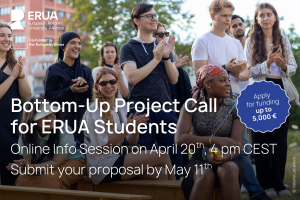
Third Bottom-Up Project Call for ERUA Students
Students across the European Reform University Alliance (ERUA) are invited for a third time to submit ideas for collaborative, student-led initiatives through the Bottom-Up Project Call for Students. The call supports international teams
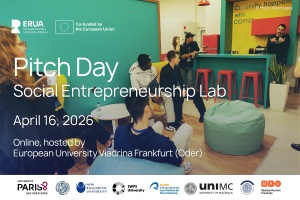
Pitch Day – Social Entrepreneurship Lab
16 April, 12:00 CEST Online (Zoom link will be shared with registered participants) Join us for the Pitch Day of the Social Entrepreneurship Lab, where international student teams present their innovative ideas addressing
The guide for designing 3 ECTS Innovative ERUA Courses is now available!
Within the framework of the Call for Innovative Teaching Initiatives – Round four for the 2026–27 academic year, we are pleased to present a Manual to support academics interested in designing 3 ECTS

Co-funded by the European Union. Views and opinions expressed are however those of the author(s) only and do not necessarily reflect those of the European Union or European Education and Culture Executive Agency (EACEA). Neither the European Union nor the granting authority can be held responsible for them