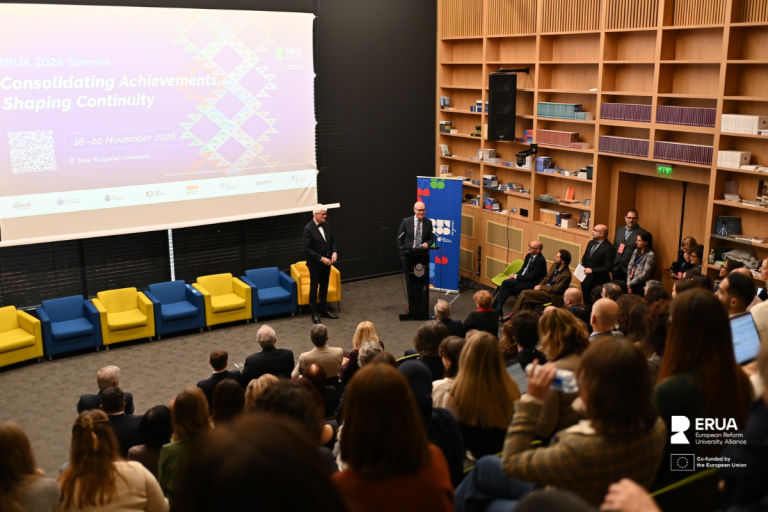
Official Opening Ceremony – 18 November 2026, Sofia
Dear Plamen, dear Eduard, dear colleagues, dear students and friends,
Thank you to New Bulgarian University for welcoming us to Sofia.
It has been a privilege to chair ERUA this past year. We have had successes and disappointments. Rome wasn’t built in a day, and building a European university across eight national systems takes patience.
The world has also become considerably more difficult. War, geopolitical divisions, climate pressures and threats to our digital security challenge assumptions on which we built our cooperation. They make our responsibility to sustain dialogue, defend academic freedom and work across borders all the greater.
This year, we gave ERUA a permanent legal foundation. In May, our eight universities signed the statutes of our international association. We must now give that association the resources and people it needs to work.
We should acknowledge where we have fallen short. Our joint master’s in Forced Migration was approved, but attracted too few enrolments to begin. The appointment of a new Secretary General did not proceed as hoped. We still lack sufficient dedicated staff at the centre.
These setbacks deserve honest discussion and practical answers.
Meanwhile, travelling seminars, joint teaching, research clusters and opportunities for early-career researchers have continued to bring our communities together. Our Student Board has helped students shape the alliance.
I warmly thank the academic colleagues, administrative teams and students whose patient work makes this possible. Our next task is to ensure that what you have built reaches more people and becomes a lasting part of university life.
That brings me back to an idea I have returned to throughout this year: integration from the edges.
Our universities connect islands, border regions, smaller cities and diverse metropolitan communities. The edges are also social and intellectual: places where different traditions meet, where people encounter exclusion, where unfamiliar questions are asked.
This identity must continue to shape how we work and how we lead. Every member must have a meaningful opportunity to propose, to take responsibility and to influence our decisions. The value of a university’s contribution cannot be measured by its size or its proximity to political power.
ERUA must remain a network with many centres.
Earlier this week, I represented the Italian Conference of Rectors at the University of Calabria, where Executive Vice-President Raffaele Fitto addressed the future of Europe’s territories.
His intervention brought us back to Enrico Letta’s report, Much More Than a Market, and its argument that freedom to move must be accompanied by freedom to stay. European integration must give people a real choice about where they build their lives.
Letta also proposed a fifth freedom, encompassing research, innovation and education. For ERUA, these ideas belong together: knowledge should circulate across Europe, and the opportunities it creates should reach all our communities.
Fitto made this territorial challenge concrete. He spoke about inland and rural areas, border regions and islands losing their young people, while major cities face growing pressures. He described work on a European strategy linking infrastructure, public services and economic opportunities, alongside targeted support for vulnerable territories. He placed the right to stay within the discussion of Europe’s next budget.
This is an agenda to which ERUA has much to contribute.
Speaking after him, I stressed the role of European university alliances, using ERUA as my example, and the need for structural funding that allows us to plan beyond the next application.
We rightly encourage students to travel, learn languages and discover other societies. We should also help create conditions in which they can return—or remain—and build fulfilling lives.
A European education should widen your choices about where to live.
Through shared teaching, research and partnerships with local communities, our universities can help make that possible.
As Europe negotiates its 2028–2034 budget and the future of Erasmus+, all alliances must argue for predictable funding and investment in people. We must also show what that support achieves: changes in students’ lives and lasting benefits for our communities.
Dear Eduard, you have my warmest wishes and my full support.
The next chapter belongs to all eight universities. Let us ensure that every member helps to write it, and that Europe’s edges help to shape Europe’s future.
Thank you.
John McCourt
Outgoing President of ERUA | Rector of the University of Macerata