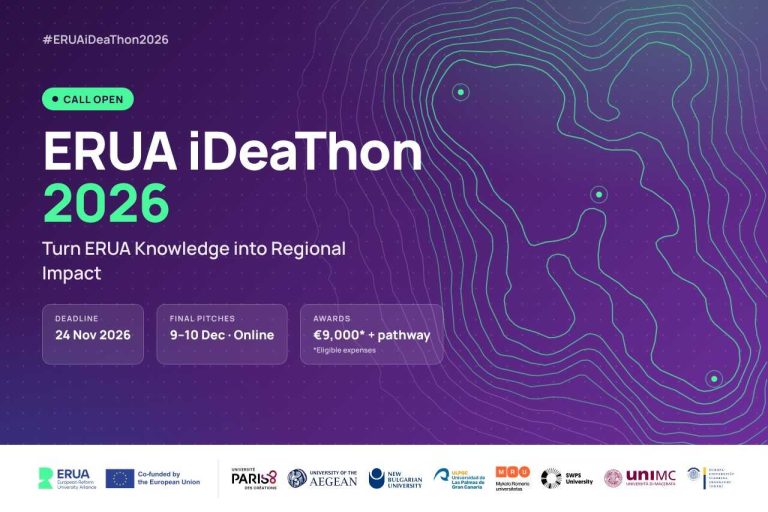
ERUAiDeaThon Website | Terms & Conditions | Apply Now!
Are you ready to turn your ideas into solutions with regional impact?
Join the #ERUAiDeaThon2026, part of the Challenge-to-Impact Initiative: Future Learning and Student Experience, and transform societal challenges into innovative, sustainable solutions!
Interested in participating in the #ERUAiDeaThon2026?
Learn more at the Online capacity-building session 1 (DigiTalk) on Monday, November 2nd, at 16:00 CET:
https://aegean-gr.zoom.us/meeting/register/FgWlR-ADQgOO-PEYUtGlXA
What is the #ERUAiDeaThon2026?
The #ERUAiDeaThon2026 is an online ideathon bringing together students, academic and research staff, and regional stakeholders from across the eight ERUA universities and their regions.
As part of the ERUA Challenge-to-Impact Initiative, the #ERUAiDeaThon2026 invites participants to develop innovative social entrepreneurship ideas that address real societal needs, create social value and contribute to sustainable regional development.
Whether you have an idea already or want to develop a new one, this is your opportunity to collaborate across disciplines and universities, connect academic knowledge with regional needs, and turn your ideas into meaningful impact.
Who can participate?
- Undergraduate, Master’s and PhD students from ERUA universities.
- Academic and research staff from ERUA universities.
- Regional stakeholders, including public authorities, civil society organisations, businesses, social enterprises and ERUA Associated Partners, based in or representing an organisation operating in an ERUA region.
You can apply individually or in a team of up to five members. Academic and research staff and external regional stakeholders must participate in a team that includes at least one ERUA student.
Interdisciplinary teams, cross-university collaboration and partnerships between universities and regional stakeholders are strongly encouraged!
Challenges & Thematic areas
Participants are invited to identify a specific societal challenge within one of ERUA’s five thematic areas:
- Migration, Exile and Refugees
- Democracy and Human Rights, Inclusion and Gender Equality
- Environmental Transition
- Interculturality and Multilingualism
- Arts and Edges
Your starting point can be a challenge identified through research with regional stakeholders across ERUA regions or another societal need in your own region.
We encourage you to draw on academic expertise, local knowledge, the Sustainable Development Goals (SDGs) and ERUA’s shared resources to develop ideas that respond to concrete needs and create lasting social value.
Explore the ERUA Social Entrepreneurship Lab to learn more.
Why participate?
- Turn ideas into impact: Develop solutions to real societal challenges.
- Collaborate across Europe: Connect with students, researchers, educators and regional stakeholders.
- Learn from experts: Receive mentoring and refine your idea with support from the ERUA community.
- Access exciting opportunities: Compete for awards supporting the further development of your idea.
- Take your idea further: Progress towards the ERUA Bootcamp in Las Palmas in 2027 and the ERUA Hackathon 2027 in Lesvos, Greece.
You do not need a finished prototype, a fully developed solution or a business plan. What matters is a clear idea, the societal need it addresses, its potential benefits and a credible path towards sustainability.
Awards & Prizes
The three highest-ranked ideas will receive awards covering their projects’ expenses, funded by the University of Las Palmas de Gran Canaria (ULPGC):
- 1st place: €5,000
- 2nd place: €3,000
- 3rd place: €1,000
The awards are not cash prizes. They cover eligible expenses directly related to developing the winning ideas and strengthening participants’ entrepreneurial skills, including training, professional development, mentoring, consultancy, prototyping, validation and communication.
Additional prizes include:
- A funded trip to the ERUA Bootcamp in Las Palmas in 2027.
- Mentoring for the 10 highest-ranked ideas, helping participants prepare for the ERUA Hackathon 2027.
- Participation of the winning ideas in the ERUA Hackathon 2027 in Lesvos, Greece, in May 2027.
- An e-certificate for all applicants and e-certificates for the winners.
How it works
The ideathon runs online from October to December 2026, in two steps.
- Submit your idea by 24 November 2026, at 23:59 CET. Choose one of ERUA’s five thematic areas, identify a specific societal challenge and submit your proposal through the online application form.
- Application evaluation and selection. The Evaluation Committee will assess submissions against the competition’s evaluation criteria. Selected applicants may be invited to merge similar ideas or form collaborative teams.
- Develop your idea with mentors. Finalists will participate in a second online session with the organisers and mentors to refine their concepts and prepare their pitches.
- Present your idea on 9-10 December 2026. Finalists will present their proposals to the Evaluation Committee.
- Results announced on 11 December 2026.
How to apply
Please visit the #ERUAiDeaThon2026 website and read carefully the Terms & Conditions, before applying.
- Complete the online application form by 24 November 2026, 23:59 CET.
- Submit your application in English and complete all required fields.
- Applicants from ERUA universities must use their university email address. External regional stakeholders should use their organisation’s or personal email address.
- You may participate in up to two applications, either individually or as a team member.
- Each application must address one thematic area and a specific societal challenge.
More information can be found on the official #ERUAiDeaThon2026 website: https://ecos.erua-eui.eu/info/erua-ideathon/ideathon2026/
For any questions, please contact the organising team at erua-challenge2impact@aegean.gr .