Description of the course
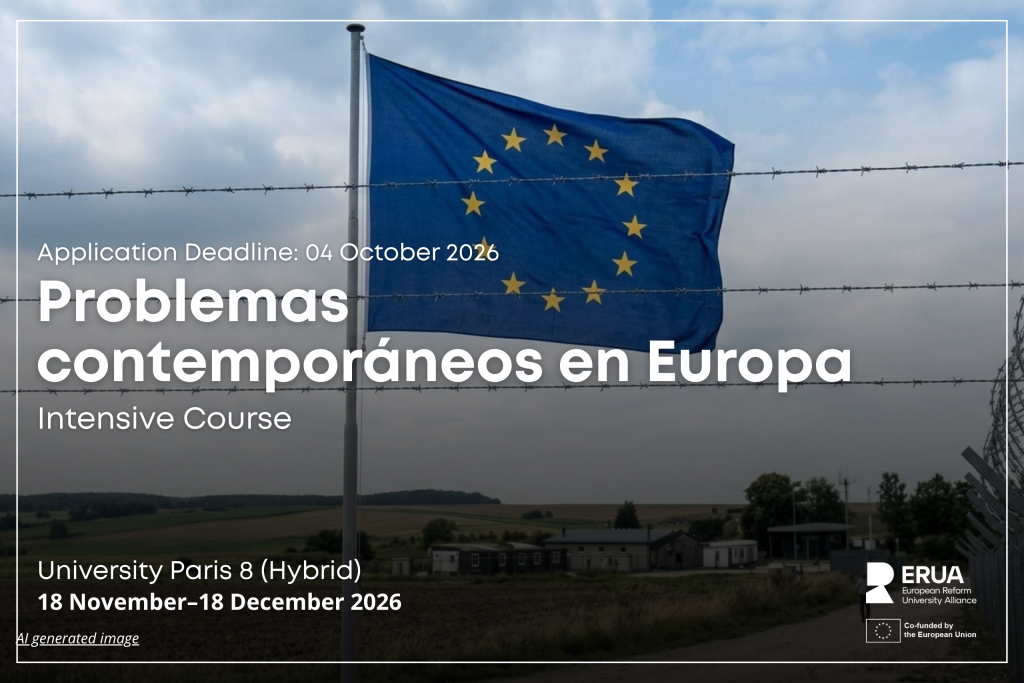
Problemas contemporáneos en Europa is an intensive Master’s course taught in Spanish and organised around three interconnected themes:
- Democracy and the far right
- Migrations
- Ecological transition
The course brings together different perspectives from the social sciences and humanities to examine major contemporary European challenges. The programme combines online learning with an intensive on-site component in France, including academic sessions, group work and guided visits.
The intensive format provides both linguistic and thematic immersion for students and teaching staff. Following a preparatory reading phase, students will work in groups to produce a collective output — such as a video, podcast or online publication — offering a critical analysis of the sessions covered throughout the programme.
The teaching team is composed of academics with recognised expertise in the topics addressed, bringing together existing collaborations as well as new connections between colleagues from different ERUA member universities.
Learning Outcomes
By the end of the course, students will:
- Develop a solid understanding of key contemporary challenges in Europe.
- Analyse issues related to democracy and the far right, migration and ecological transition from different disciplinary perspectives.
- Strengthen their critical thinking and teamwork skills.
- Develop their Spanish-language skills, particularly in comprehension, expression and oral interaction.
- Gain experience of collaborative learning in a multicultural European context.
Why You Should Apply
This course offers a unique opportunity to learn about contemporary Europe from a genuinely European perspective, while strengthening your Spanish-language and collaborative skills.
Working with other students and academics from different ERUA universities will allow you to exchange perspectives and practices in a multicultural environment, and to develop a broader understanding of current European debates.
The course can also be a first step towards future mobility opportunities within ERUA, including study periods and professional internships at other member universities.
Through its combination of academic exchange, collaborative learning and linguistic immersion, the course provides a valuable experience to support your Master’s studies and encourage further European engagement.
Assessement methods
Online group evaluation. Group work will be presented in a virtual session during the initial online phase. The course aims to produce a report (which can be multimedia) covering the course content, focusing analytically on issues in the participating students’ home countries. The report will be evaluated during a virtual session after the onsite phase.
Who can apply
● Master’s students
● Spanish proficiency at B2 level or above
The course is open to 20 ERUA students from partner universities.
How to apply
If you are interested, please submit your application by October 4th to the following address:
https://paris8.moveonfr.com/locallogin/660eb384386d1ea0ce0c5ad8/eng
Your application should include:
- Cover letter
- language certificate
If your application is accepted, you and your ERUA local team will be notified the 19 of october and if you are selected they will inform you about travel and accommodation funding.
If you have any other administrative questions about the course, please contact your local ERUA team at your university or Paris 8 local team (erua.eui@univ-paris8.fr).
Provisional Programme
Jueves 3 de diciembre
Democracia y extrema derecha
09h00-10h30:
Antonio Ramos (UP8) : Réception des étudiant.es, organisation des groupes, méthodologie de travail.
11h00-12h30:
Juan Manuel Santana (ULPGC) La extrema derecha y el combate por la historia.
14h00-15h00:
Alexandra Palau (UBE): Extrema derecha y polarización afectiva. Estrategias de comunicación en España y Francia.
15h30-16h30:
Custodio Velasco (US): La construcción de la memoria de la Unión Europea.
A partir de 17h00 :
Visita cultural.
Viernes 4 de diciembre
Migraciones
09h00-10h00 :
Amalia Barchiesi (UniMC): El lenguaje de la intolerancia sobre las migraciones en España e Italia.
10h30-11h30 :
Lucas Pérez (ULPGC): Las migraciones en la UE en el año del Pacto de Migraciones y asilo: un análisis desde la ultraperiferia europea.
12h30-13h30 :
Paola García (UP8): Dinámicas y desafíos de las migraciones latinoamericanas actuales en Francia.
13h45-14h45:
Sònia Parella (UAB) : Fronteras internas. La gestión de la movilidad en la frontera francoespañola desde un enfoque de derechos y antirracista.
A partir de 15h30:
Visita cultural
Sábado 5 de diciembre
Transición ecológica
10h00-11h00:
Maricruz Arcos (US) : La NEB o cómo alcanzar el modelo social europeo a través del Green Deal
11h30-12h30:
Eduardo Salazar (UMU): Los derechos de la Naturaleza y el Mar Menor. Una pequeña revolución que cuestiona el Derecho Ambiental.
14h00-15h00:
[A confirmar]: Los desafíos de la Agenda 2030 en la UE.
À partir de 16h00 :
Visita cultural.