
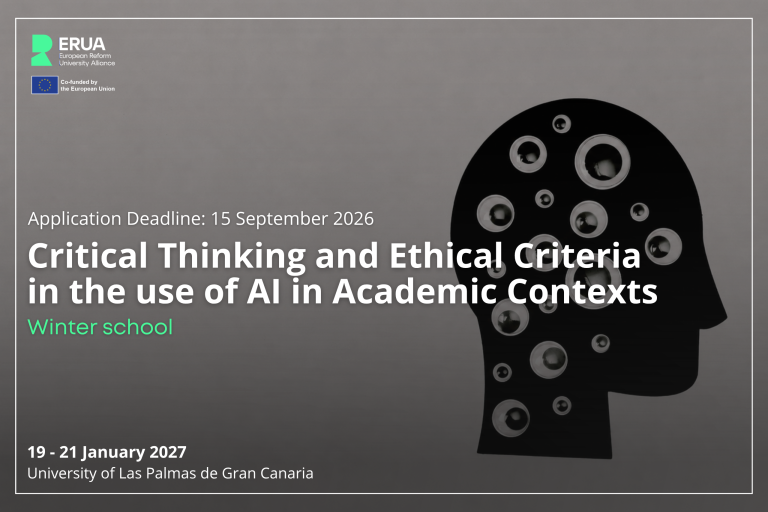
The University of Las Palmas de Gran Canaria is organising the Winter School ‘Critical Thinking and Ethical Criteria in the Use of AI in Academic Contexts’, with the aim of addressing the ethical, critical and responsible use of artificial intelligence in the university setting. The programme will combine an online preparatory phase, an intensive in-person component at ULPGC, and an online final phase of reflection and evaluation.
The course takes a practical and collaborative approach, in which students will work in international teams to develop a guide containing recommendations on the ethical use of artificial intelligence in academic contexts, which will subsequently be published as an Open Educational Resource (OER).
Course description
The course will be delivered in a hybrid format across three phases:
- Online preparatory phase (November–December 2026): introductory training, reading, teamwork and the drafting of a preliminary proposal.
- Intensive in person phase (19–21 January 2027): three days of collaborative work at the ULPGC to analyse real-life cases, discuss ethical dilemmas and design the guide to good practice.
- Consolidation phase (February 2027): implementation of the proposals developed, review of the guide and preparation of a final individual reflection.
Course content
Throughout the programme, students will work on issues relating to:
- Critical thinking applied to the use of artificial intelligence tools.
- Ethical principles in the use of AI in academic settings.
- Academic integrity, biases and the reliability of AI systems.
- The collaborative design of recommendations for the responsible use of artificial intelligence.
- The validation and dissemination of good practice through open educational resources.
Methodology and learning outcomes
The course combines collaborative learning, work based on real-life cases, structured discussions and the co-creation of educational resources in international teams.
Participation in this course will enable students to:
- Critically analyse the use of artificial intelligence in academic contexts.
- Identify ethical risks, biases and issues relating to academic integrity.
- Apply ethical principles to assess the responsible use of AI tools.
- Work in international and interdisciplinary teams.
- Design evidence-based recommendations for the ethical use of artificial intelligence.
- Communicate and defend proposals based on arguments and evidence.
- Reflect on the impact of AI on higher education and on their own academic practice.
Assessment will be continuous and based on the completion of the individual and group activities planned during the three phases of the course. To pass the course, students must:
- Design an initial individual proposal.
- Participate actively in face-to-face activities and collaborative work.
- Contribute to the development of a guide containing recommendations for the ethical and critical use of artificial intelligence in academic contexts.
- Submit a final self-assessment and reflection report.
Upon completion of the course, participants will receive 3 ECTS.
Target audience
The programme is aimed at final-year undergraduate and postgraduate students at ERUA universities.
The course is specifically designed for students in the following fields:
- Education
- Philology, Modern Languages and Translation
- Engineering
- Environmental Sciences and Sustainability
- Social Sciences
- Humanities
- Other related degree programmes
No prior technical knowledge of artificial intelligence is required, although a sufficient level of English to participate in academic discussions is recommended, as well as an interest in education, innovation, sustainability or the ethics of AI.
Registration
Participation in this course requires a two-step registration process:
To register for this activity, please send the following documents to eruatec2@ulpgc.es:
- Curriculum vitae.
- Letter of motivation (300–400 words) explaining your interest in participating in the course and in topics related to artificial intelligence, education, communication, sustainability or ethical innovation.
- Certificate of English language proficiency
The application deadline is 15 September 2026.
More info
For any academic enquiries, please contact the course coordinator, Pedro M. Hernández Castellano, by email at pedro.hernandez@ulpgc.es.
For enquiries regarding participation, please contact the local ERUA team at erua@ulpgc.es.