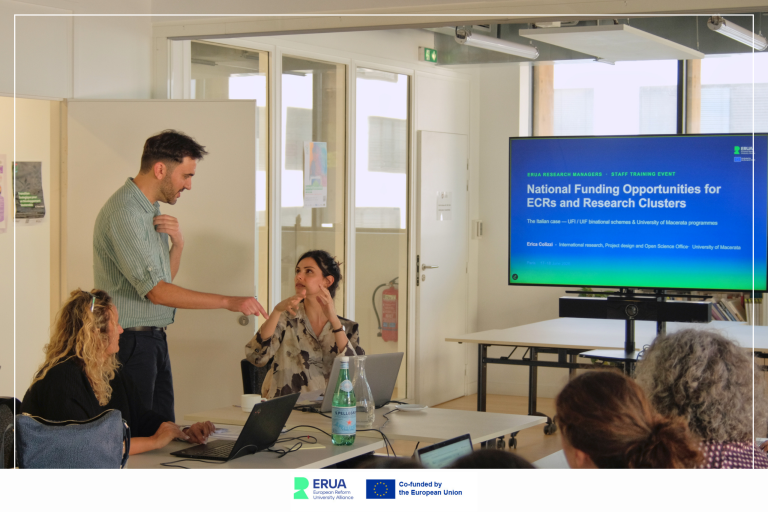
Research managers and research support professionals from across the European Reform University Alliance met at Université Paris 8 on 17 and 18 June 2026 for a two day staff training event and an in person meeting of the ERUA Research Support Network.
Hosted at Campus Condorcet in Aubervilliers, the event provided a space for participants to exchange information on European and national research funding opportunities, discuss the needs of ERUA research communities and early career researchers, and define future priorities for research support cooperation within the Alliance.
Supporting ERUA research clusters and early career researchers
The first day opened with a welcome session and an introduction to the objectives of the event.
The morning discussions focused on the characteristics and specific needs of the ERUA Research Clusters, as well as the forms of support that could help them develop new collaborative initiatives. Participants discussed the role of seed funding in the preparation of joint project proposals and considered how future support schemes could respond more effectively to the needs of researchers across the Alliance.
Particular attention was also given to early career researchers. The session examined existing funding and training opportunities, while identifying areas in which further support may be required. These included access to mobility, collaborative research opportunities, proposal development, teaching initiatives and participation in international research networks.
Sharing national funding opportunities across the Alliance
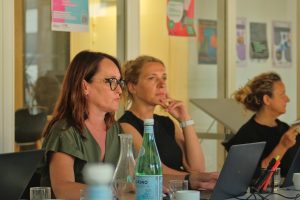
A major part of the first day was dedicated to national research funding systems and to funding opportunities supporting bilateral and trilateral cooperation between the countries of ERUA partner universities.
Representatives from ERUA member universities presented the main characteristics of their national research funding environments, including key funding bodies, available schemes and opportunities relevant to international collaborative projects.
The presentations also explored funding instruments available to early career researchers, including opportunities that may be accessible to researchers based in other countries.
The sessions gave participants an opportunity to compare different national systems, identify potential funding pathways and reflect on how this information could be shared more widely with researchers across ERUA.
The first day concluded with a social dinner, offering further opportunities for informal discussion and networking.

Recent developments in European research funding
The second day began with a session on recent developments and emerging priorities in European research funding.
Participants discussed current developments in European funding programmes, including updates related to the European Research Council and other relevant initiatives. The session helped research support professionals consider how changes in the European funding environment may affect researchers and institutions within the Alliance.
A further discussion focused on how the information collected on national funding opportunities could be transformed into a practical and accessible resource for members of the Research Support Network and the wider ERUA research community.
The objective is to make funding information easier to access and to strengthen the capacity of researchers to identify suitable national and international opportunities.
From research to impact
The programme also included Research Impact Lab presentation entitled “From Research to Impact: Co Creating New Opportunities for ERUA.”
The session encouraged participants to reflect on how ERUA can strengthen the social, academic and institutional impact of collaborative research. It also created space for the joint development of ideas that can support researchers in connecting their work with broader communities, institutions and policy environments.
Defining future priorities for the Research Support Network
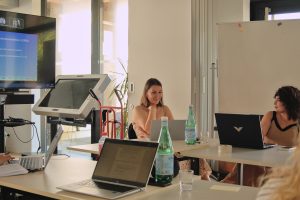
The event concluded with the regular in person meeting of the ERUA Research Support Network.
Participants reviewed the activities undertaken since the previous in person meeting in Macerata and discussed strategic priorities for the 2026 and 2027 period.
The discussion covered several areas of future cooperation:
- Developing shared funding pipelines
- Improving the dissemination of research funding opportunities
- Strengthening mentoring initiatives
- Organising workshops and staff training activities
- Increasing the participation of early career researchers
- Supporting closer cooperation among research managers across ERUA institutions
The Paris meeting demonstrated the importance of regular exchange between research support teams within the Alliance. By sharing knowledge of national and European funding systems, identifying common challenges and developing practical forms of cooperation, the Research Support Network continues to strengthen the environment available to ERUA researchers.
The event also reaffirmed the Alliance’s commitment to supporting early career researchers and creating more inclusive, accessible and collaborative research opportunities across its member universities.