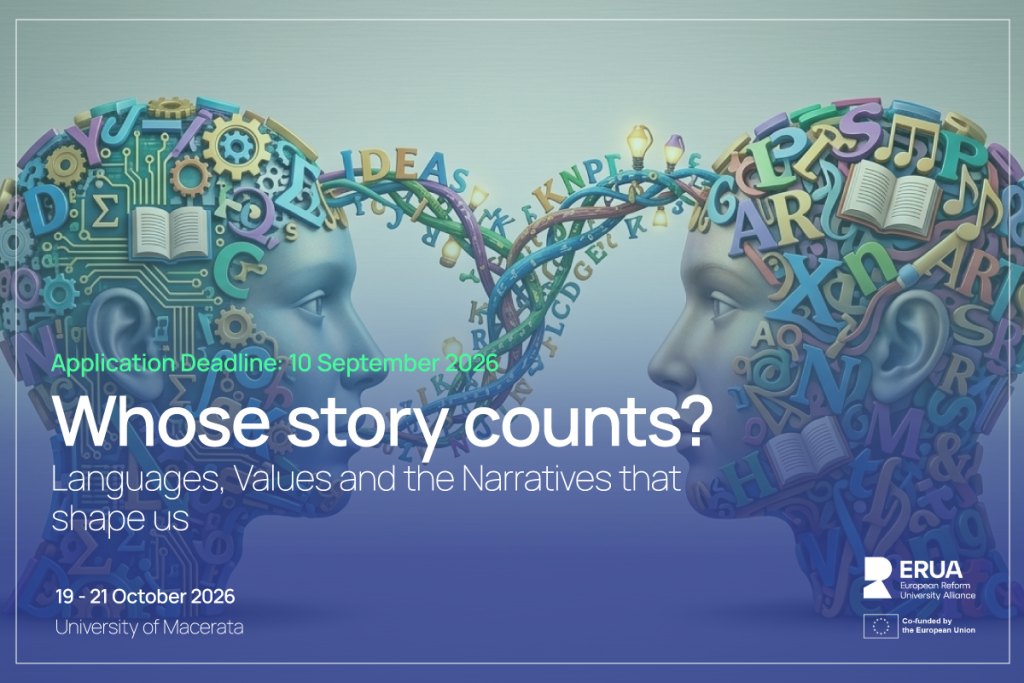
Unimc Invites students of the European Reform University Alliance (ERUA) to participate in the Intensive Course “Whose Story Counts? Languages, Values, and the Narratives that Shape Us”.
Professors Edith Cognigni and Michela Meschini will be coordinating the course, which will take place in three phases:
Phase 1 – Online preparatory phase (1 October 2026 – to be confirmed):
One synchronous online introductory meeting (2 hours), before the on-site activities, combined with asynchronous flipped preparation based on digital materials, short video lectures, reflection prompts, and a preparatory task. Before arrival, students will also meet online in small groups to choose and discuss one authentic example from their own educational or institutional context (e.g. media headline, public slogan, university communication text, language policy statement, social media campaign…), in a language of their choice, accompanied by a short reflection on how language and narration may contribute to inclusion, exclusion, recognition, or power.
Phase 2 – On-site intensive module (19-21 October 2026):
Three consecutive intensive days (approximately 7 hours per day of guided activities), combining input sessions and interactive debriefs with invited speakers, case-study analysis, collaborative group work, student project labs, and final presentations. Optional participation in local guided tours and visits.
Phase 3 – Consolidation and reflective phase (1st week of November 2026):
Following the intensive phase, student groups will revise and refine their collaborative outputs on the basis of the feedback received during the final peer-learning session. Students will also complete a short critical reflection task aimed at consolidating learning outcomes and reflecting on the themes explored during the module, with particular attention to language, narratives, participation, and inclusion in educational and institutional contexts.
Description of the course
The course aims to explore the relationship between language, narratives, power, and social participation in contemporary western societies, with particular attention to educational contexts, multi/plurilingualism, intercultural communication, and public discourse.
The course combines input sessions, interactive workshops, collaborative work, and student-led activities.
The on-site programme is organised around three thematic modules:
- Language, Power and Belonging : This module explores the relationship between language, participation, recognition, and belonging in contemporary western societies. Students will analyse how language practices and public discourses shape access to participation and social legitimacy in educational and institutional contexts. The module draws on the complementary perspectives of Applied Linguistics and Sociolinguistics, focusing on heritage languages, multilingualism, language education as means to foster equality, diversity and inclusion.
- Stories, Voices and Recognition: This module focuses on lived experience, stories, and social recognition, examining how public narratives contribute to cultural and social inclusion and participation, or conversely undermine them. The module draws on the complementary perspectives of narrative studies and social sciences.
- From Reflection to Action: Students work in international and interdisciplinary groups to develop collaborative outputs inspired by the input sessions. Possible collaborative projects may include policy briefs, communication campaigns, inclusive language toolkits, podcast or social media contents, and narrative-based educational activities. The final session is dedicated to project refinement, peer-learning presentations, discussion, and feedback.
Students are expected to actively contribute to discussions and collaborative activities throughout the course.
Learning outcomes
By the end of the intensive module, students will be able to:
- Analyse the relationship between language, narrative, and power in educational and institutional contexts.
- Recognise discursive mechanisms of inclusion, exclusion, and belonging.
- Critically evaluate public discourses, institutional communication, and dominant narratives in contemporary societies.
- Work effectively and collaboratively in multicultural and multilingual teams.
- Design educational or communicative responses that promote equality, inclusion, participation, and recognition.
- Apply critical analytical tools to discourses and narratives in real social and institutional contexts.
Assessment methods
Assessment will be based on active participation throughout all phases of the module and on the successful completion of the required individual and collaborative activities, including:
- participation in the online preparatory phase and completion of the preparatory student task;
- active engagement in interactive seminars, workshops, and collaborative discussions during the on-site intensive phase;
- contribution to group work, student project labs, and final presentations;
- completion of collaborative outputs.
Who can apply?
The course is open to 3 students per each ERUA University.
The intensive module is open to Bachelor’s (3rd year) and Master’s students from different disciplinary backgrounds in the humanities and social sciences, particularly language and linguistics studies, education, communication, literary studies, intercultural studies, and related fields.
No specialised prior knowledge is required, but students should have an interest in languages, narratives, multilingualism, intercultural communication, and contemporary public discourse. As all activities will be conducted mainly in English and involve collaborative group work, a minimum B2 level of English is recommended.
How to apply
Students can apply using the following application form until 10th September 2026: https://docs.google.com/forms/d/e/1FAIpQLSd7rK04z5O7b7iS50LtmUTbwQcjV6_Ju8fFVdHu4ZhZcYZnaQ/viewform?usp=publish-editor
The following documents will be required for the application:
- a short motivation statement (1 page max) outlining the applicant’s interest in the themes of the module and any relevant academic, professional, or intercultural experience;
- proof of English language proficiency at minimum B2 CEFR level (certificate or equivalent documentation).
Selection will take into account motivation, diversity of academic backgrounds, and interest in interdisciplinary and collaborative learning.
If you have any other administrative questions about the course, please contact your local ERUA team at your university or Unimc local team: tobia.ciarrocchi@unimc.it