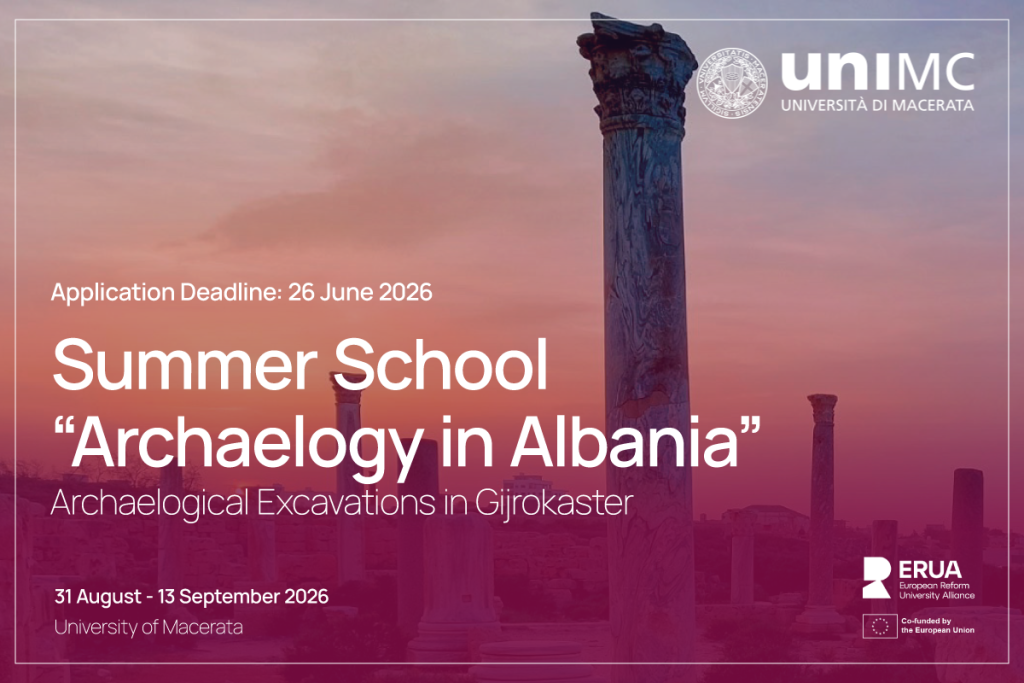
Unimc Invites students of the European Reform University Alliance (ERUA) to participate in the Summer School “Archaeology in Albania”. The course will take place on-site in Gijrokaster (Albania), where the University of Macerata carried out archaeological excavations since 2006. Professor Roberto Perna will be holding the course, which will take place from 31 August to 13 September 2026.
Description of the course
The course aims to give students advanced competences in archaeological fiedlword methodology with a focus on stratigraphic excavation practices.
The course will be carried out by a combination of academic staff and professional archaeologists, ensuring a balance of theoretical and applied knowledge. Methods include:
- Introductory lectures on the historical and archaeological background of the site.
Guest Lecture: Marie-Pierre Dausse (University Paris 8). - Field-based training through practical excavation sessions, where students directly apply excavation and documentation techniques.
- Workshops and laboratory exercises designed to familiarize participants with the study, classification, and cataloguing of archaeological materials.
- Hands-on training in survey techniques, including drawing, digital surveying (total station), and processing of data through CAD and orthorectification.
- Supervised group work, encouraging peer-to-peer learning and critical reflection.
The combination of lectures, guided practice, and laboratory analysis ensures that students integrate theoretical principles with practical skills, preparing them for both professional archaeological practice and further academic research.
Learning outcomes
Through participation, students will develop advanced competences in:
- Archaeological fieldwork methodology, with a focus on stratigraphic excavation practices.
- Documentation techniques, including written recording (US records), graphic representation (plans, sections, hand-drawn sketches), and digital methods (total station, orthorectification, CAD).
- Photographic documentation, both for recording excavation phases and cataloging artifacts.
- Analytical and cataloguing skills, particularly the classification, documentation, and inventory of major categories of archaeological finds.
- Critical interpretation, enhancing their ability to connect field data with broader historical and cultural questions.
By the end of the course, students will have gained a comprehensive set of transferable skills: teamwork and collaboration in excavation units, problem-solving in field conditions, accuracy in documentation, and the ability to reflect on methodological choices.
Assessment methods
Active participation, Final report
Who can apply
Students joining this initiative will bring with them a general background in archaeology, ancient history, and cultural heritage studies, as well as introductory knowledge of excavation principles acquired in previous coursework. It might be helpful if they are already familiar with the basics of archaeological interpretation and the cultural-historical context of ancient Mediterranean civilization.
Up to 7 (one or more per university depending on the whole number of enrollments).
How to apply
If you are interested, please submit your academic CV and cover letter by 26 June by completing the survey at the following link.: https://docs.google.com/forms/d/e/1FAIpQLSc1AZ3eNqReltbBUYv10T0mtLN0_bnIu6vn4O1Gk8zoDlL4gQ/viewform?usp=dialog
If you have any other administrative questions about the course, please contact your local ERUA team at your university or Unimc local team (tobia.ciarrocchi@unimc.it).