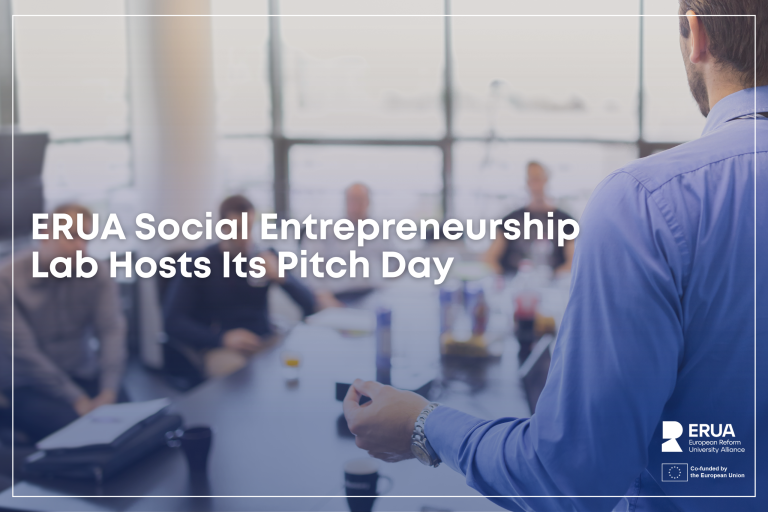
The ERUA Social Entrepreneurship Lab Pitch Day brought together students, academics, entrepreneurs, and associated partners from across Europe to showcase innovative solutions to pressing societal challenges. Organised within the framework of Work Package 6, the initiative reflects ERUA’s commitment to fostering social entrepreneurship through collaborative, hands-on, and impact-driven learning experiences.
The event gathered more than 79 participants, reflecting the growing interest in collaborative international initiatives focused on social innovation and entrepreneurship. The Social Entrepreneurship Lab is part of ERUA’s efforts to foster sustainable solutions to real social challenges, supporting students, entrepreneurs, and changemakers in developing impactful ideas.
Before reaching the Pitch Day, participants took part in a series of online input sessions designed to support the development of their projects. These sessions addressed topics such as social innovation, business model design, sustainability, pitching strategies, and impact measurement, equipping students with practical tools to transform ideas into viable initiatives.
Over the past months, international teams have worked collaboratively to identify current societal challenges and design innovative solutions to address them. In total, 189 applications were received, leading to the formation of 23 teams, of which 15 social business ideas were ultimately developed and presented.
The event consisted of a public presentation of the projects based on social entrepreneurship plans. Each team had five minutes to present their initiative, followed by a short Q&A session. The proposals were evaluated by an international and multidisciplinary panel that brought together representatives from ERUA universities and associated partner organisations, combining expertise in innovation ecosystems, social enterprise development, research, entrepreneurship mentoring, tourism and regional development, fundraising, communication, and impact-driven project management. Projects were evaluated according to innovation and relevance, impact measurement, feasibility, and sustainability, assessing both the social value of the ideas and their long-term viability.
The initiatives addressed key challenges at both European and local levels, including ecological transition, social inclusion, migration, access to culture, and democratic participation, reflecting the interdisciplinary and international nature of the programme. Examples included projects focused on migrant integration, community wellbeing, sustainable development, and improving access to opportunities for underrepresented groups.
Following the presentations, the evaluation committee convened to assess the proposals, selecting three winning teams: “Second Chance” (Lin Lelchuk, Gabriela Zlatanova, Kristin Ivanova – NBU), “Mindcross” (Uma Hajdo, Mariia Nef, Dąbrówka Stuglik – SWPS), and “Tacho BG” (Teosveta Velkova, Adelina Stankova, Radostina Dzhambova, Melin Veli – NBU).
The winning projects stood out for their strong social relevance, innovative approaches, and potential for sustainable impact. The winners received the opportunity to further develop their ideas during an upcoming international event to be held in Paris.
This Pitch Day represents an important milestone within the Social Entrepreneurship Lab learning pathway, which combines training, collaborative work, and practical application. Beyond the competition itself, the Social Entrepreneurship Lab has become a space for experimentation, intercultural collaboration, and practical learning. Students not only developed entrepreneurial competences, but also strengthened skills such as teamwork, critical thinking, communication, and problem-solving in international environments.
The initiative will continue in future editions, consolidating its role as a key platform for promoting social entrepreneurship within ERUA.