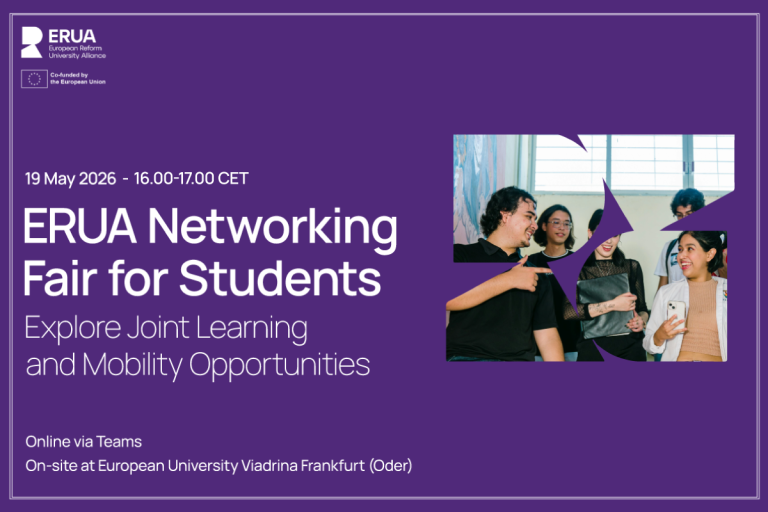
On 19 May 2026, ERUA students are invited to take part in the Annual Networking Fair for Students, an event dedicated to networking, exchange and discovery of the Alliance’s educational opportunities.
The fair will take place from 16:00 to 17:00 CEST in the framework of the intensive course “The European University as a Learning Organization”, organised by European University Viadrina.
The Annual Networking Fair is an important opportunity for students from across the ERUA Alliance to connect with one another and gain a deeper understanding of current and future joint teaching programmes, as well as the wide range of mobility and training opportunities available within the Alliance.
The event will open with a presentation focusing on ERUA educational initiatives, offering participants an overview of the learning opportunities developed through cooperation among partner universities. This will be followed by a student experience-sharing session, where participants will reflect on their involvement in ERUA educational and training activities.
The fair will conclude with an open discussion and Q&A session, giving students the opportunity to ask questions, exchange ideas and learn more about how they can take part in ERUA’s academic and mobility pathways.
By bringing together students, educators and programme representatives, the Annual Networking Fair aims to strengthen the ERUA learning community and support students in making the most of the Alliance’s collaborative educational offer.
Event details
Date: 19 May 2026
Time: 16:00–17:00 CEST
Format: Online via this Teams link and on site in Room GD03, Gräfin-Dönhoff Building, Europaplatz 1, 15230 Frankfurt (Oder).
Framework: Intensive course “The European University as a Learning Organization” organised by European University Viadrina