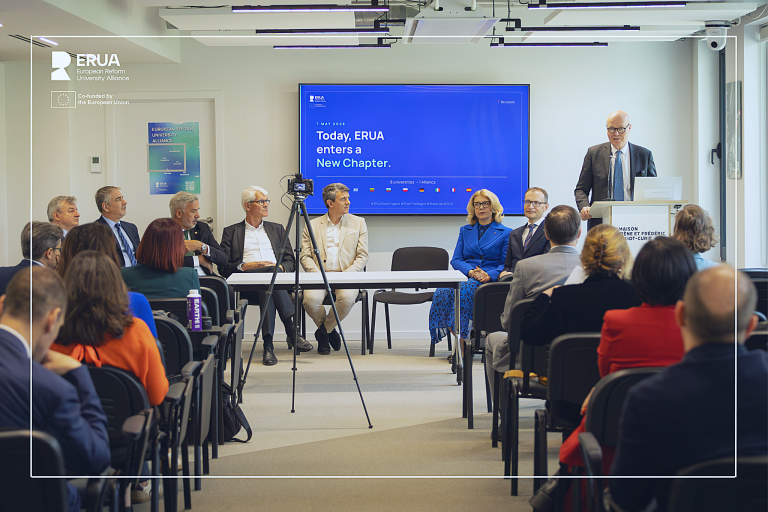
Speech by ERUA President John McCourt
at the signing ceremony of the ERUA Legal Entity
9 MAY 2026 | BRUSSELS
Distinguished guests,
Members of the European Parliament,
Excellencies,
Dear Rectors, Dear colleagues, dear students,
It is a great pleasure and a real honour to welcome you today on behalf of the eight rectors of the European Reform University Alliance: the University of Paris 8 Vincennes-Saint-Denis, the University of the Aegean, New Bulgarian University, SWPS University, Mykolas Romeris University, the University of Las Palmas de Gran Canaria, the European University Viadrina Frankfurt (Oder), and my own university, the University of Macerata.
Today we are doing something simple in form, but very significant in substance. We are signing a document. But, in truth, we are doing much more than that. We are giving a permanent institutional shape to a shared vision
Until now, ERUA has been a project: a very successful, ambitious, demanding and inspiring project. From today, ERUA also becomes a legal entity. It becomes an institution capable of lasting beyond project cycles, beyond individual mandates, beyond temporary frameworks.
We are entering into a sort of marriage between our institutions. Should anyone know of any rightful impediments to this union, now is the time to speak!
What we are doing today matters. It matters because European cooperation in higher education cannot depend only on goodwill, enthusiasm and temporary arrangements. Those are essential, of course. But if we want to innovate seriously, if we want to build common programmes, share teaching, develop joint research, support mobility, and create real opportunities for our students and staff, then we need instruments that are stable, agile and credible.
Each of our eight universities works within its own national system. We come from eight countries, eight institutional cultures, eight regulatory frameworks. Those frameworks are not always aligned. Sometimes they make cooperation slower than it should be. Sometimes they make innovation more difficult than it ought to be.
The legal entity we are creating today is a practical answer to that challenge.
Eight countries. Eight universities. Eight national systems.
One European instrument, built to cross borders, to act with flexibility, and to move with the speed that our time requires.
I am particularly proud that this important step is being taken during the presidency held by the University of Macerata. For us, this is both an honour and a responsibility.
The goal is not to weaken our individual universities. On the contrary, it is to strengthen them. We are stronger together because we become more capable individually: more open, more connected, more innovative, more attractive to students, researchers, professors and administrative staff.
Through ERUA, we want to share more ideas and more good practices. We want to build more courses together — long and short, in person and online. We want to open new spaces for students to learn across borders, for researchers to work across disciplines, and for administrative staff to develop new forms of professionalism that respond to the challenges and potential of this age, in which the instruments offered by artificial intelligence will be hugely influential. But ERUA is not only an administrative framework. It is also a political and intellectual statement.
We are universities rooted in the social sciences, the humanities and the arts. We believe that Europe needs technological innovation, but also social imagination. It needs competitiveness, but also cohesion. It needs skills, but also critical thinking. It needs growth, but also democratic resilience.
Many of our universities are located away from the traditional centres of European power. We are often on the edges of Europe, in territories where social, economic, demographic and migratory challenges are felt early and intensely.
But the edges of Europe are not marginal. They are laboratories of the future. Europe is stronger when its territories are stronger.
Europe is more democratic when its universities are rooted in their communities. Europe is more resilient when knowledge is shared, when young people are mobile, when institutions cooperate, and when education remains a public good.
This is why the European Universities Alliances matter so much. They are one of the most promising developments of the wider Erasmus+ story — a story that remains one of the European Union’s great successes. Erasmus has changed lives, opened minds, created friendships, built trust, and made Europe real for generations of students.
We are deeply grateful for the European funding that has made this possible. But gratitude must also come with responsibility. At this moment, as Europe prepares the next generation of programmes, including FP10 and the future Erasmus+ framework, we must say clearly that investment in higher education, research and mobility is not a cost.
It is a strategic investment in Europe’s future.
As ERUA we hope that Europe will continue to invest strong and dedicated funding for research, education and mobility, including the projected €220 billion for FP10 and €60 billion for Erasmus+, so that Europe can strengthen its knowledge base, attract and retain talent, support skills development, and reinforce democratic and social cohesion. Weakening the legal basis for the inclusion of higher education and the European Universities Alliances in future European competitiveness instruments would significantly limit the sector’s future opportunities.
European alliances are not decorative. They are not symbolic add-ons. They are infrastructure for the Europe of tomorrow. They help build a knowledge-based economy. They help develop skills for a changing world. They help connect territories. They help strengthen democracy. They help make Europe more cohesive, more competitive and more humane.
Today’s signing is therefore not an end point. It is a beginning. It is the beginning of a new phase in which ERUA can act with greater confidence, greater continuity and greater impact.
In the joint statement we sign today, we say that ERUA’s new legal entity gives permanent institutional form to the work we have developed together and strengthens our capacity to act jointly over time. That is exactly the spirit of this moment.
We are building a European instrument from the bottom up, from our universities, from our territories, from the edges of Europe — but with the ambition to have an impact at the centre of Europe’s future.
For our students. For our researchers and professors. For our administrative staff.
For our communities and our territories. For future generations.
Thank you all for being here, and thank you to my fellow rectors — my colleagues and friends — for the trust, the courage and the commitment that have brought us to this important day.
John McCourt
President, ERUA and Magnifico Rettore, Università di Macerata