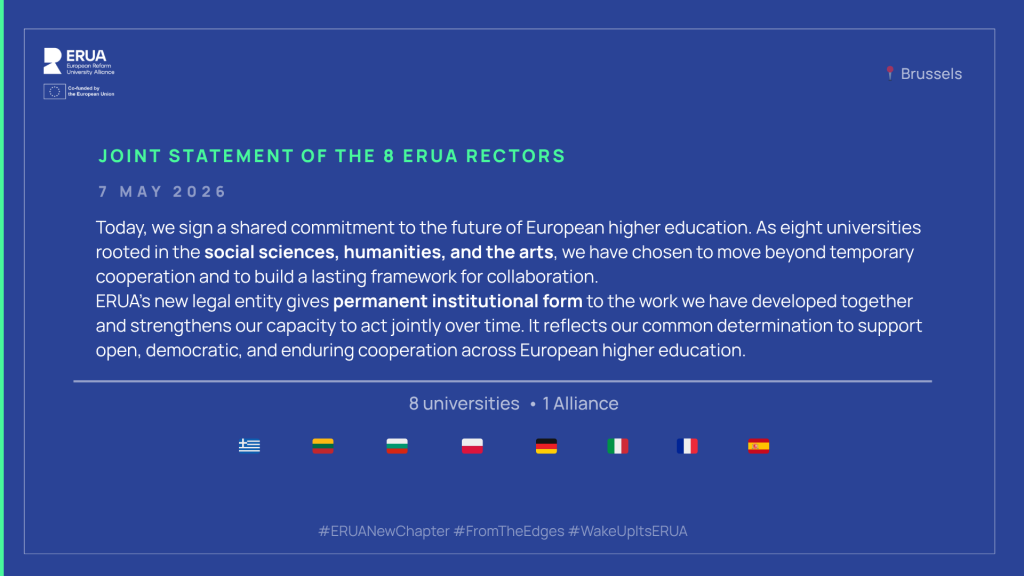

The European Reform University Alliance (ERUA) today formally signs the statutes of the new international non-profit association in Brussels. This act formally establishes ERUA as a legal entity, marking a decisive step in its evolution from project-based collaboration to a permanent institutional alliance of European universities.
The agreement, endorsed by the eight rectors under the leadership of Professor John McCourt (University of Macerata) and Arnaud Laimé (Université Paris 8), marks a turning point in the history of the alliance.
What changes now
Until today, ERUA operated as a project-based network — a form of cooperation made possible through European funding cycles and renewed through successive applications. Effective and ambitious, but structurally temporary.
With the creation of a legal entity, this changes fundamentally. ERUA now exists as a permanent institution in its own right, with its own legal standing, governance structure, and capacity to act. This means the alliance can sign agreements, hold assets, employ staff, and take on long-term commitments independently — just as any established institution would.
In practical terms, it means that the cooperation between our eight universities is no longer contingent on any single funding cycle. The relationships, the shared programmes, the joint research, and the common vision we have built together now rest on a durable legal foundation.
“This is a defining moment for ERUA. Today’s signature is not simply a formal act. It marks the point at which a shared ambition becomes a lasting institutional reality. By creating a permanent legal framework, we are strengthening our capacity to act together across borders, to invest in long-term cooperation, and to build a European academic space that is inclusive, democratic, and responsive to society.”
— Professor John McCourt, Rector of the University of Macerata and Chair of the ERUA Board of Rectors
Why it matters
For students, today’s signing means greater continuity in joint programmes and mobility opportunities. For researchers, a more stable platform for cross-border collaboration. For staff, clearer structures and a stronger collective voice in European higher education policy.
ERUA was founded on the belief that universities rooted in the social sciences, humanities, and the arts have a distinctive contribution to make to Europe — to its democratic life, its cultural diversity, and its capacity for critical thinking. What we sign today ensures that this contribution can be sustained, developed, and deepened over time.
The eight universities enter this new phase united by a common purpose and a permanent institutional commitment to one another.
The eight signatory universities are:
- Université Paris 8 (France)
- University of Macerata (Italy)
- Mykolas Romeris University (Lithuania)
- University of the Aegean (Greece)
- New Bulgarian University (Bulgaria)
- SWPS University (Poland)
- University of Las Palmas de Gran Canaria (Spain)
- European University Viadrina Frankfurt (Oder) (Germany)