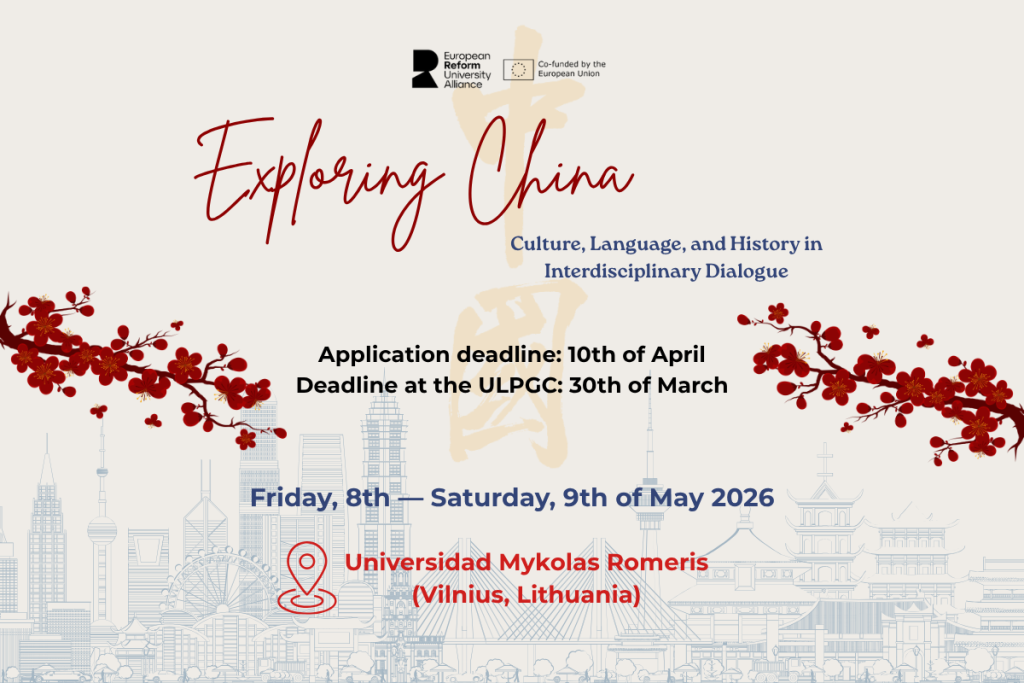
From the 8th to the 9th of May 2026, Mykolas Romeris University will host an intensive on-site course composed of various workshops and lectures (approx. 8 hours per day), integrating perspectives from politics, history, philosophy, philology and Asian studies. In line with ERUA’s thematic priorities, the project will also explore issues such as feminism, culture, art and migration in Chinese contexts.
Regarding the provisional structure of the course, the programme includes lectures and workshops on both days, as well as a roundtable discussion on the second day. The plan is to hold a workshop after every two talks.
The call is open to all current students from ERUA universities across various disciplines. However, only 30 spots are available. Participants will be selected by the ULPGC organising core team and academic supervisors.
Learning Outcomes
By the end of the course, students will be able to:
- exchange and critically discuss diverse perspectives on China within an intercultural learning environment
- analyse the political, cultural, and historical relationships between their own country and China
- acquire and present knowledge of China’s history, politics, philosophy, and cultural traditions
- critically reflect on their own prior knowledge, assumptions, and stereotypes about China
- creatively apply newly acquired knowledge through theatre-based practices and introductory Chinese calligraphy and Chinese paper cutting techniques
- discuss and compare linguistic features and historical influences of Chinese, Japanese, and Korean, recognising both shared elements and key differences
- collaborate effectively in small groups to complete creative and analytical tasks
- develop and demonstrate communication, intercultural dialogue, and creative expression skills
List of Possible Topics:
- Migration and diaspora
- Film and television
- Chinese traditional medicine and feng shui
- Linguistics
- Literature
- Culture
- Philosophy
- Politics
- History
- Feminism, gender and/or LGBTQ+ studies
- Innovative teaching methodologies
- Traditional arts (e.g., Chinese calligraphy, Chinese paper-cutting)
- Contemporary arts
Application process for lecturers, workshop coordinators and roundtable chairs
If you want to apply to be a lecturer, a workshop coordinator and potential roundtable participant, follow the next steps.
Before you start your application process, please prepare the following documents:
- Curriculum Vitae (max. 2 pages, format A4, .pdf)
- Lecture or workshop proposal (max. 400-500 words, format A4, .pdf). The document should include the following: the title, the main points, the theoretical framework, the methodologies used, and 3-5 keywords
- If you are applying for the role of workshop coordinator, it is essential to include a detailed description of how the workshop would be conducted. This should include information on whether the workshop requires teamwork, whether the class will be divided into groups or pairs, or if it will be a whole-class activity, apart from main points, theoretical framework, methodologies and 3-5 keywords.
- (Optional) If your proposal is based on existing work, you can attach your original slides in PDF format here. Please note that these would not be the final version to be used at the event; they would be just for reference
As a speaker or workshop coordinator, your participation involves the following commitments:
- Deliver a session. Present a lecture or workshop with a total duration of 50-60 minutes. This time slot includes both your presentation and the subsequent discussion/Q&A/applied practice. “Applied practice” refers to hand-on activities where participants actively apply concepts learned during the session.
- Choose your format. You may structure your session in one of three ways:
- Balanced: 30 minutes of content + 30 minutes of Q&A, discussion or applied practice
- Presentation-Focused: Approximately 45 minutes of content + 10-15 minutes of Q&A, discussion or applied practice
- Participatory Format: the audience is involved throughout the entire session (e.g., interactive exercises, polls, or group activities woven into the presentation)
- Attend other sessions. You are expected to attend the remaining sessions of the event. This fosters a collaborative environment and allows all participants to network and learn from one another.
- All sessions should preferably be delivered in English. On-site translation was considered, but it is not feasible due to a lack of specialised equipment. If you require assistance and it is available, volunteer students may be able to help translate your materials into English.
- If selected, slides or handouts must be submitted to exploringchina@ulpgc.es by April 21 so they can be reviewed in time by the ULPGC organising team. Presentations are not required to follow the ERUA colour scheme. However, inclusion of the official ERUA logos is mandatory. Logos are available for download via this OneDrive folder.
To apply to be a lecturer, a workshop coordinator and/or be part of the roundtable (topic to be decided), please follow this link and fill in the application form: https://forms.gle/pY4Lb4BjDxp9BF346
Application process for other participants (active attendees)
If you want to apply to participate as a student who wants to learn new things and who is interested in Chinese language and culture, but does not want to be a lecturer or a workshop coordinator, follow the next steps.
Before you start your application process, please prepare the following documents:
- Curriculum Vitae (max. 2 pages, format A4, .pdf)
- Motivational letter (between 250-500 words, format A4, .pdf)
To apply as an active attendee, please follow this link and fill in the application form: https://forms.gle/Et4xKqLXdDy6RgLK9
You are also expected to attend all sessions of the event.
Application deadline: 10 April 2026.
By the 13th of April the names will be transmitted to each university and participants will be informed of their selection.
Recognition
Each participant will receive a certificate signed by the academics involved after successful completion. Those who were lecturers, workshop monitors and roundtable chairs will be given a certificate further demonstrating their role.
Questions? Reach out anytime at exploringchina@ulpgc.es! We usually respond within 2-3 business days.
Funding
ERUA students can receive travelling and accommodation funding from their home universities! For more information related to traveling and funding opportunities contact your local ERUA coordinator.