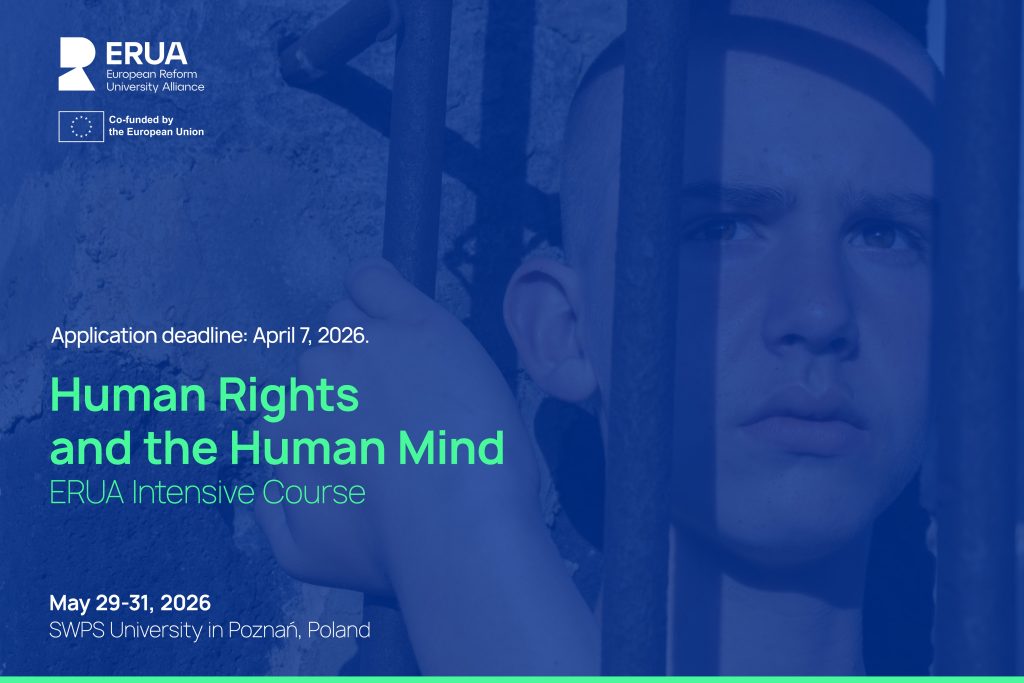
Dates: May 29-31, 2026
Place: SWPS University in Poznań, Poland
SWPS University and ERUA invite Master’s and Bachelor’s level student to participate in an Intensive Course “Human Rights and the Human Mind: Interdisciplinary Perspectives on Law, Psychology and Responsibility”, which will take place in Poznań, Poland, May 29-31, 2026.
About the program
This course explores the intersection of human rights, law, and psychology, with a particular focus on how legal systems address human behavior, mental capacity, trauma, and responsibility in contemporary societies. It is is built on the premise that effective and fair legal systems must account for human psychological complexity, including trauma, mental health conditions, and structural vulnerability. The program actively promotes the core values of human rights, social inclusion, and gender equality through both its content and teaching methods.
Through interactive workshops, case-based analysis, and interdisciplinary simulations, students work with real and hypothetical scenarios involving legal accountability, psychological harm, and ethical boundaries in legal practice. The program emphasizes practical skills, critical thinking, and dialogue rather than traditional lecture-based teaching.
What will you learn?
The course will focus on the three main components:
Human Rights – Main Focus of the Course
Through practical workshops, based on case law of the European Court of Human Rights and relevant UN instruments, we will examine how international and European human rights standards apply in situations involving psychosocial vulnerability. To do this, we will apply the norms of human rights to actual legal dilemmas rather than discuss examples in abstraction. We will analyze key legal concepts, such as:
- The right to mental integrity
- The right to freedom from inhuman or degrading treatment
- Procedural fairness
- Safeguards in detention and family proceedings
Social Inclusion – Through Legal and Psychological Lenses
We will explore how legal and psychological assessments of capacity and responsibility may either promote inclusion or contribute to exclusion and stigma. We will use interactive group work and simulations that are designed to foster empathy, interdisciplinary understanding, and inclusive dialogue among participants from different academic backgrounds. The program will address the following issues:
- Risks of marginalization of persons with mental health conditions
- The role of procedural accommodations and supported decision-making
- Challenges of communication and bias in legal practice
Gender Equality – Integrated Perspective
The structure of the course promotes balanced participation and awareness of how gender dynamics intersect with mental health and human rights in legal procedures. We apply the following methods in our approach:
- Analysis of gendered patterns of vulnerability in criminal and family law contexts
- Case studies involving domestic violence, coercive control, and institutional interventions
- Critical reflection on how gender bias may affect credibility assessments and evaluations of responsibility
Learning Outcomes
By the end of the course, you will be able to:
- Explain the key international and European human rights standards related to mental integrity, legal capacity, and protection from inhuman or degrading treatment
- Identify legal and ethical challenges arising at the intersection of law and psychology, particularly in cases involving trauma, coercion, or diminished responsibility
- Analyze real and hypothetical case studies using combined legal reasoning and psychological insight
- Critically reflect on the role of law in responding to (or overlooking) mental health and psychosocial vulnerability
- Collaborate across disciplines in an inclusive and respectful manner when addressing complex legal and ethical problems
- Produce a group-based practical outcome (e.g., a legal memo, policy proposal, or a case strategy), by applying course knowledge to a concrete human rights issue
Application Process
Before you start your application process, please prepare the following documents:
- Curriculum Vitae (max. 2 pages, format A4, .pdf)
- Cover letter: tell us about yourself and your motivation for participating in this course
- CEFR B2 English proficiency certificate
Application deadline: April 7, 2026.
To apply, follow this link and fill in the application form: https://english.swps.pl/we-the-university/our-news-and-events/conferences-and-seminars/35087-human-rights-and-the-human-mind
Funding
Students from ERUA partner universities, other than SWPS University, who are accepted to the program by SWPS University, can apply for travel and accommodation funding at their home university’s ERUA Office.
Organizers
- SWPS University
- European Reform University Alliance
The project is co-funded by the European Union.