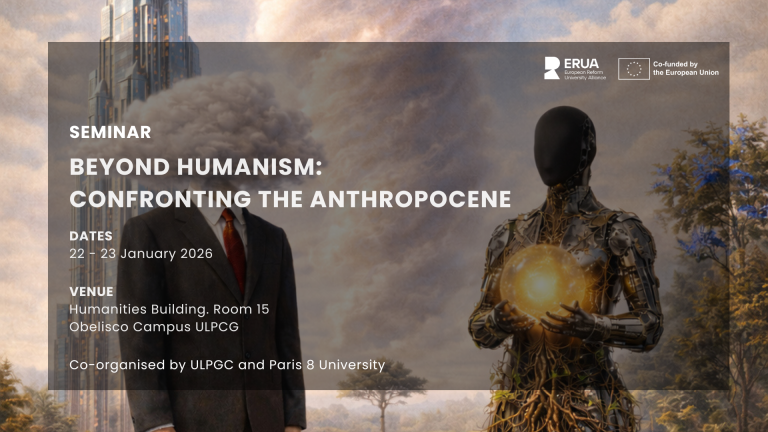
This interdisciplinary seminar addresses the profound changes that characterise the Anthropocene era, marked by the intersection of ecological crises, technological acceleration and transformations in collective ways of life. Starting from the post-pandemic context, the seminar proposes a critical reflection on the limits of classical humanist frameworks for understanding contemporary challenges related to subjectivity, well-being, and the relationship between the human and the non-human.
Co-organised by the Universidad de Las Palmas de Gran Canaria and Université Paris 8, and developed within the framework of ERUA’s research cluster “Confronting Crises: Beyond Forms of Humanism”, the seminar brings together approaches from philosophy, ethics, cultural studies, critical theory, art and technology studies. Through posthumanist and non-anthropocentric perspectives, it explores new ways of thinking about agency, collective responsibility and sustainability in a world shaped by planetary boundaries.
Content
The seminar is structured around two main themes. On the one hand, it examines the reconfiguration of subjectivity in the digital age, analysing how contemporary technologies transform notions of autonomy, identity and action. On the other hand, it proposes a redefinition of well-being that takes into account the interdependence between human beings, technological environments and ecosystems, moving beyond an individual and exclusively human conception of well-being.
From an ethical, epistemological and aesthetic perspective, the course pays special attention to care practices and the uses of artificial intelligence, with the aim of imagining technological models that are non-instrumental, non-dehumanising and environmentally sustainable. It will encourage critical reflection on collective digital practices that contribute to fairer forms of coexistence and the creation of habitable environments in the context of the Anthropocene.
Methodology
The course will combine theoretical sessions with guided discussions, case studies, artistic materials and collective reflection exercises. Interdisciplinary exchange and dialogue between participants from different academic and cultural backgrounds will be encouraged, in line with ERUA’s collaborative approach.
Learning outcomes
By the end of the seminar, participants will be able to:
• Critically analyse the limits of classical humanism in the context of the Anthropocene.
• Understand post-humanist approaches applied to subjectivity, well-being and technology.
• Reflect on well-being from a relational and more-than-human perspective.
• Critically evaluate the ethical and ecological impact of digital technologies and artificial intelligence.
• Develop an interdisciplinary view of contemporary crises and collective care practices.
Who can apply?
The course is aimed at undergraduate, master’s and doctoral students, as well as researchers, particularly in areas such as philosophy, humanities, social sciences, cultural studies, art, technology studies and related disciplines.
No prior technical knowledge is required, but an interest in critical thinking, ecological issues and contemporary debates on technology and society is essential.
Dates
From January 22 to 23, 2026

Language
English

Venue
Humanities Building. Room 15. Obelisco Campus. ULPCG

Contact
If you have any questions about the seminar, please contact:
• ULPGC local team: eruapm@ulpgc.es
• Paris 8 local team erua.eui@univ-paris8.fr