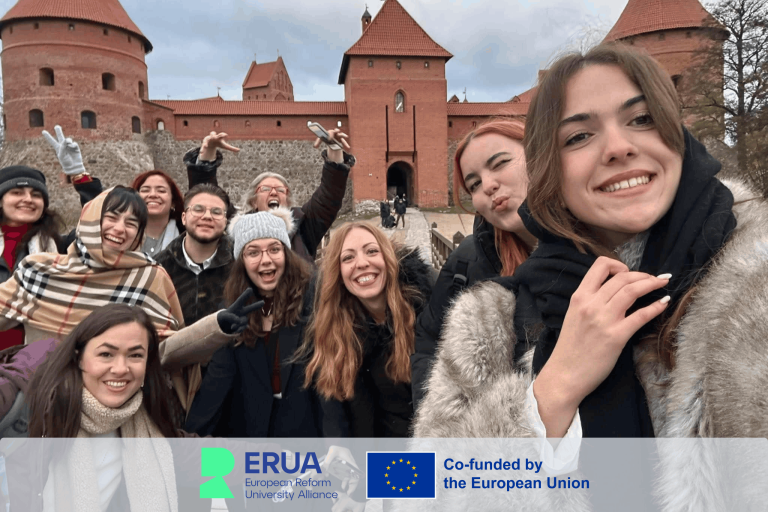
The University of the Aegean (UAegean) and Mykolas Romeris University (MRU) reflect on the successful ERUA Travelling Seminar “Cultural and Musical Practices as Agents of Social Inclusion: A Multidisciplinary Approach to Early Childhood and Lifelong Education within the ERUA Framework”, held in Vilnius, Lithuania, from October 26 to 30, 2026.
The seminar brought together students from UAegean’s Department of Preschool Education and Educational Design with the academic community of MRU and early childhood education professionals, exploring how music and cultural practices can foster communication, participation, and social inclusion.
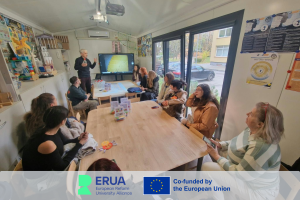
Organised by Dr Maria Argyriou, Laboratory Teaching Staff member at UAegean’s Department of Preschool Education and Educational Design, the seminar also included an online virtual mobility meeting on October 19, 2026, preceding the in-person programme. The initiative took place within the framework of the European Reform University Alliance, strengthening the ongoing collaboration between the two universities through the Arts@Matter ERUA research cluster.
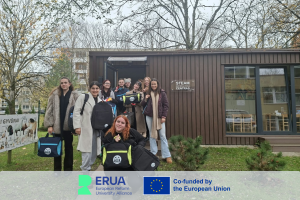
The academic host at MRU was Associate Professor Dr Tomas Butvilas, whose expertise in Social Pedagogy provided the foundation for discussions on social inclusion, lifelong education, and the applications of artificial intelligence in social research. Dr Neringa Kurapkaitienė further contributed to the programme with a teaching session on volunteer organisation, connecting volunteering with practical engagement and active social participation.
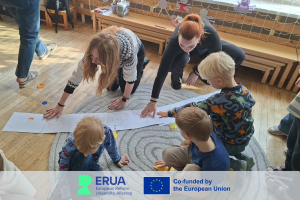
One of the highlights of the seminar was the visit to Jurginėlis Kindergarten in Vilnius, under the direction of Professor Dr Sergejus Neifachas. The encounter with the kindergarten’s educational environment offered valuable opportunities for observation and the exchange of pedagogical approaches, connecting university-based learning with the everyday experiences of young children and educators.
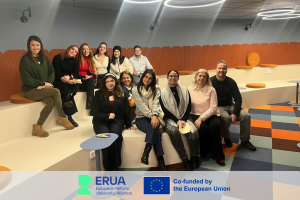
The research component, guided by Dr Maria Argyriou, introduced participants to an observation protocol for musical inclusion and focused recording tools. A central question throughout the activities was how singing, rhythm, and movement can create opportunities for communication and active participation, even when children and visitors do not share the same spoken language.
Through a combination of research and educational workshops, participants connected observation with the interpretation of collected material and critical reflection. Particular attention was given to identifying indicators of children’s active engagement and flow experiences, moments of deep absorption in an activity, as well as designing inclusive music-and-movement activities. The observations gathered during the seminar provide a basis for further analysis and can inform the education and training of future teachers.
The week concluded with a joint discussion, reflection on the experience, and exploration of opportunities for future collaboration. By bringing together social pedagogy, the arts, and music education, the seminar highlighted the potential of international academic mobility to connect research with educational practice, creating opportunities for shared learning among students, academics, and educators.
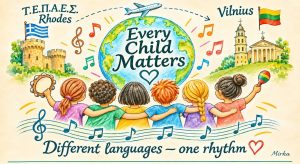
The seminar’s visual identity was captured in a poster designed by Mirka Strataki, a fourth-year student at UAegean’s Department of Preschool Education and Educational Design. Bearing the message “Every Child Matters-Different Languages, One Rhythm”, the poster reflects the initiative’s shared educational vision: creating inclusive environments where every child has the space to express themselves, communicate, and participate.