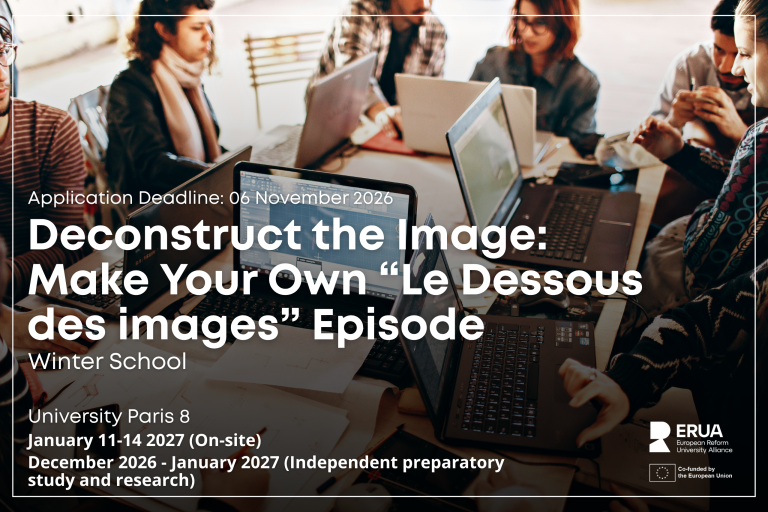
COURSE DATES: Asynchronous work : December 2026 – January 2027: Independent preparatory study and research (21 hours).
In person activities : January 11–14, 2027, University Paris 8. Daily schedule features 18 hours total of in-class contact time plus 9 hours of collaborative group homework spread over the 4 days.
Post-January Workshop: Autonomous final project. Refinement and essay writing (24 hours).
APPLICATION DEADLINE: Novembre 6th 2027
LANGUAGE : French and English (primary working languages); Spanish is specifically integrated during the multilingual audio description scriptwriting and interview phases.
STUDY LEVEL: Master (first year) or equivalent university track
NUMBER OF ECTS: 3
Description of the winter school
This Winter School is designed as a media production lab, immersing students in the work of a journalism editorial team and audiovisual production unit. Drawing on the editorial approach and critical methodology of ARTE’s programme Le Dessous des images, students analyse media content through the ERUA thematic pillars of “Interculturality & Multilingualism” and “Migrations, Exile & Refugees.” The curriculum combines Project-Based Learning (PBL) with interdisciplinary collaboration and is structured around three complementary modules:
- Module 1: Image Verification & Sourcing (Phase 1: Remote; Phase 2: On-site, Day 1) Students explore investigative methods, reverse-image searches and contextual analysis to trace the origins and circulation of images. They reconstruct an image’s provenance to assess its authenticity, reliability and potential use in geopolitical manipulation.
- Module 2: Scriptwriting, Voice Coaching & Interviewing (Phase 2: On-site, Days 2–3) Working in teams, students develop a standard two-column audiovisual script combining narration with visual and graphic directions, including on-screen annotations and editing instructions. They also receive voice coaching for narration and prepare concise, professional radio interview questions for academic experts.
- Module 3: Inclusive Media Production & Audio Description (Phase 2: On-site, Days 3–4; Phase 3: Remote) Students explore accessibility principles and inclusive media practices, adapting their productions into multilingual audio description (AD) tracks for blind and visually impaired audiences. They learn to assemble and mix multiple audio layers, combining narration, interview recordings and royalty-free background music using professional equipment.
Learning outcomes
- Advanced Media Literacy & Critical Thinking: Ability to critically assess digital media using fact-checking methods. Students learn to identify the authorship and origin of images, examine the contexts in which they are shared, and recognise potential media manipulation, distortion and propaganda.
- Audiovisual Production Skills: Practical knowledge of audio recording equipment, such as Zoom H5 recorders, as well as vocal projection, professional narration, audio editing and the synchronisation of multiple audio tracks.
- Public Speaking & Communication: Ability to communicate clearly and confidently in French and English, adapt speaking pace to different situations, listen actively and conduct short, professional interviews in the field.
- Civic Awareness & Inclusive Design: Understanding of accessibility principles through the practical application of multilingual audio description guidelines, fostering empathy and the development of creative strategies for making visual media accessible to diverse audiences.
Assessment methods
The 3 ECTS credits are awarded based on students’ performance. Active attendance is mandatory but does not, on its own, guarantee the award of credits.
Assessment is divided equally between two components:
- Group Assessment (50%): Production of an 8-minute multimedia episode combining synchronised slides, analytical narration, an expert interview and a professionally mixed audio track.
- Individual Assessment (50%): Submission of a digital learning portfolio including an image fact-checking sheet completed before the workshop, a personal project logbook documenting the student’s progress, and a final critical essay of 1,500 words.
Why You Should Apply?
Step into the shoes of an investigative media production team with Paris 8 University’s Winter School, inspired by ARTE’s Le Dessous des images. Designed for ERUA Master’s students, this hands-on 3-ECTS program lets you tackle critical global issues like migration and interculturality while mastering image verification, scriptwriting, audio production, and expert interviewing. Working in an international team across French, English, and Spanish, you won’t just learn to deconstruct media manipulation—you will also put civic engagement into action by creating inclusive, multilingual audio descriptions for visually impaired audiences. Join us to sharpen your critical literacy, build a professional multimedia portfolio, and collaborate with peers across Europe!
Who can apply?
Students enrolled in a Master 1 or equivalent university track within languages, humanities, media, communication, journalism, or migration studies.
A minimum C1 level in both written and oral production is required for French (the primary language of instruction), alongside a functional baseline knowledge (B2) of English or Spanish to actively participate in the multilingual audio description workshops.
Prerequisite Skills:
Students should have foundational analytical skills in the humanities or languages, the ability to synthesise and interpret written material, basic digital literacy, and an awareness of intercultural issues and broader societal challenges.
How to apply?
If you are interested, please submit your application by november 6th to the following address: https://paris8.moveonfr.com/locallogin/660eb384386d1ea0ce0c5ad8/eng
Your application should include:
- CV (maximum 1 page)
- Cover letter (maximum 1 page) specifying the student’s study field, linguistic background (French, English, or Spanish proficiency levels), and an explanation of how the Winter School themes (Media Literacy, Interculturality, Multilinguism, Migrations) align with their ongoing studies or professional goals. No AI-generated letters, please!
If your application is accepted, your ERUA local team will be notified on November 16th, and if selected, they will inform you about travel and accommodation funding.
Organizing professors:
- Claire Bourhis-Mariotti (Full Professor of African American History)
- Stéphanie Masson (Professional Radio Presenter, Producer & Scriptwriter)
- Romain Baujard (Director, Sound Engineer & Editor)
This Winter school is organized in collaboration with ARTE Campus media and with the contribution from professors from NBU (Justine Toms) and UAegean (Panagiotis Grigoriou)