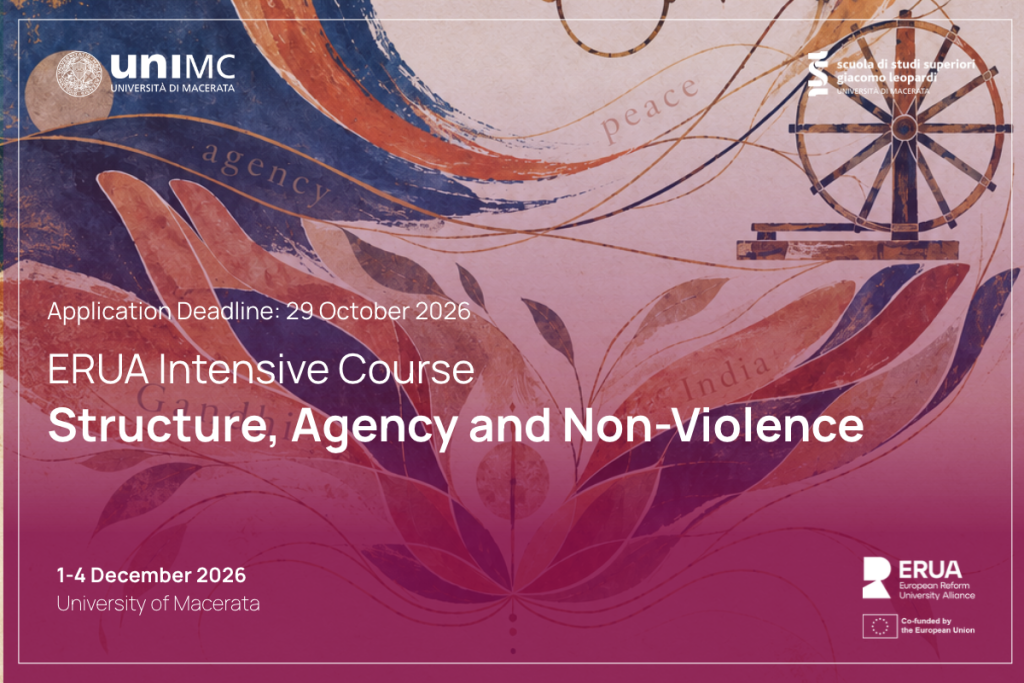
UniMC – SCHOOL OF ADVANCED STUDIES “GIACOMO LEOPARDI” Invites students of the European Reform University Alliance (ERUA) to participate in the Intensive Course “Structure, Agency and Non-Violence” that will take place in Macerata from 1 to 4 December 2026.
The Course will be held by Prof. Ramakrishnan Krishnaswamy – O.P. Jindal Global University, Jindal School of Liberal Arts and Humanities (JSLH).
Description of the course
The course explores the different ways in which socio-political authority is constituted through structures of power. Considering the interaction between structure and agency in today’s world, ideas from Foucault, Anthony Giddens, Margaret Archer, among others are considered and also the reach of digital frameworks in today’s world discussed. The aim is to develop a new theory of non-violence which helps us understand the human self in a radically new perspective. The idea here is that the self when it acts in a non-violent way is able to unlock certain features of its underlying nature which in turn opens up a new space for agential freedom. This theory has further consequences for how we make sense of authority and obedience.
The course will be using Gandhi’s ideas of non-violence to motivate the discussion.
This course aims to foster in students an interest in non-violence, Gandhian ideas of the self and freedom. The students can also get a peak into some aspects of Indian philosophy.
Over the span of four sessions, the course will address the following topics:
- Gandhian views of non-violence
- Political debates around the scope and limits of agency
- Authority and Obedience
Methods
The course combines two frontal (lecture-style) lessons with interactive learning activities (1 lesson for collective reconstruction, restitution and brainstorming + 1 session of close-reading). Each student will be encouraged to develop intercultural sensitivity and to apply an interdisciplinary perspective in order to broaden their interpretive framework. Materials will be proposed in advance for fostering the collective discussion and brainstorming.
Learning outcomes
By the end of the course, students will be able to:
- Understand and explain key concepts in the area of democracy & human rights
- Recognize different theoretical approach and be aware of the debate within the field
- Appreciate Indian philosophy and develop an intercultural attitude
- Develop and discuss critical reflections on the topic, demonstrating original thinking, interdisciplinary awareness and intercultural sensitivity
Assessment methods
- Final test
- Final discussion on the topics of the course
Who can apply?
The course is open to 14 students (2 for each of the 7 institutions) with the possibility of taking advantage of places not used by other partner universities.
The course is open to Bachelor and Master students with a solid interest in intercultural and a cross-disciplinary practices.
How to apply
Students can apply by completing the online application form by 29 October 2026: https://docs.google.com/forms/d/e/1FAIpQLSdsL5rUOauPknCkOSaMU9okBmxah30IBqKFMyW6_W-2eCPQdg/viewform?usp=publish-editor
The following documents will be required for the application:
- Academic CV
- Cover