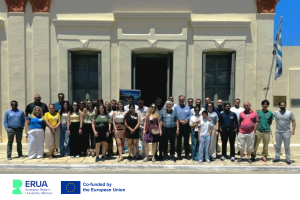
This summer, the University of the Aegean hosted two ERUA summer schools on Samos, bringing together students, researchers, academics, and international experts around two STEM fields: digital governance and the mathematics of computation.
The OpenGov 2026 Summer School ran in July, followed by the Summer School in Combinatorics and Computer Science in August. Both programmes gave participants a chance to connect with an international academic community, and coordinators the opportunity to build new links across ERUA and beyond.
Learning by doing
Organised by the Department of Information and Communication Systems Engineering of the University of the Aegean under the scientific supervision and coordination of Professor Yannis Charalabidis, OpenGov 2026 brought participants into direct contact with some of the most pressing questions in digital governance.
Through discussions, exchanges with international experts, and activities such as the OpenGov2026 Ideathon, participants worked on real-world problems, testing ideas and developing solutions using data and emerging technologies. The wider Samos community was also part of the experience: the international group the programme brought to the island gave participants and local stakeholders a chance to connect. Themistoklis Papatheofanous, Mayor of West Samos, highlighted the importance of cooperation between the University and the local community, describing it as an important condition for the island’s development.

A different kind of challenge
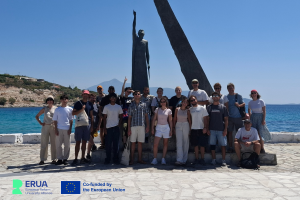
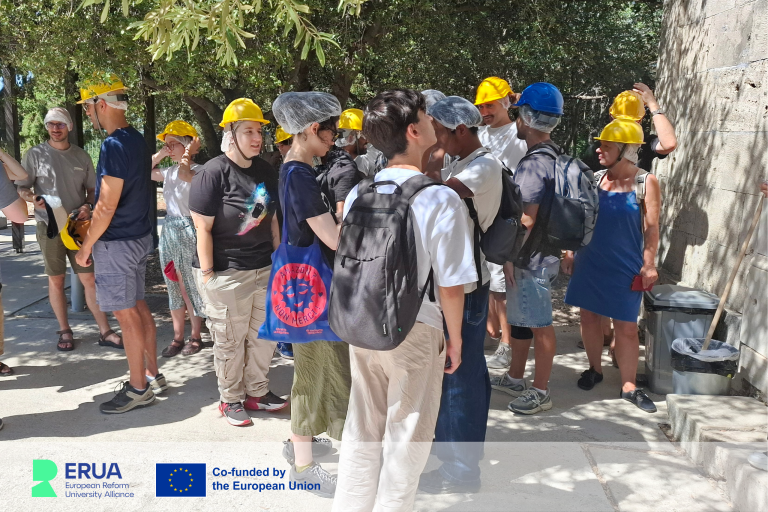
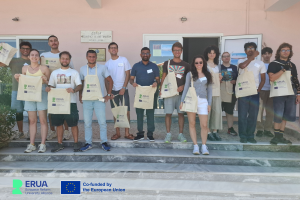
In August, Samos hosted another group of ERUA students and academics for the Summer School in Combinatorics and Computer Science, organised by the Department of Mathematics of the University of the Aegean and Paris 8 University, with Vasilis Metaftsis and Efstratios Prasidis leading the organising committee.
The programme went beyond lectures and presentations. Students worked through challenging problems, discussed possible solutions, and interacted directly with academics. Rather than simply absorbing mathematical concepts, participants were encouraged to question and experiment with them and develop their own approaches. The result was an intensive academic experience that also left room for informal conversations between students and researchers from different institutions.
More than a classroom
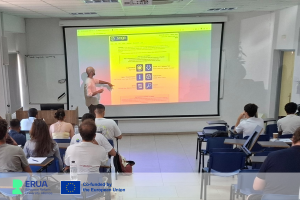
Students learned from experts and from one another, coordinators strengthened links between institutions, and the ERUA community’s presence on Samos became a hub for international academic exchange.
From the questions raised by AI to the mathematical foundations of computation, the two programmes showed the range of work that ERUA partner universities can bring together and a great example of what higher education looks like when it responds directly to challenges and needs shaping today’s world.