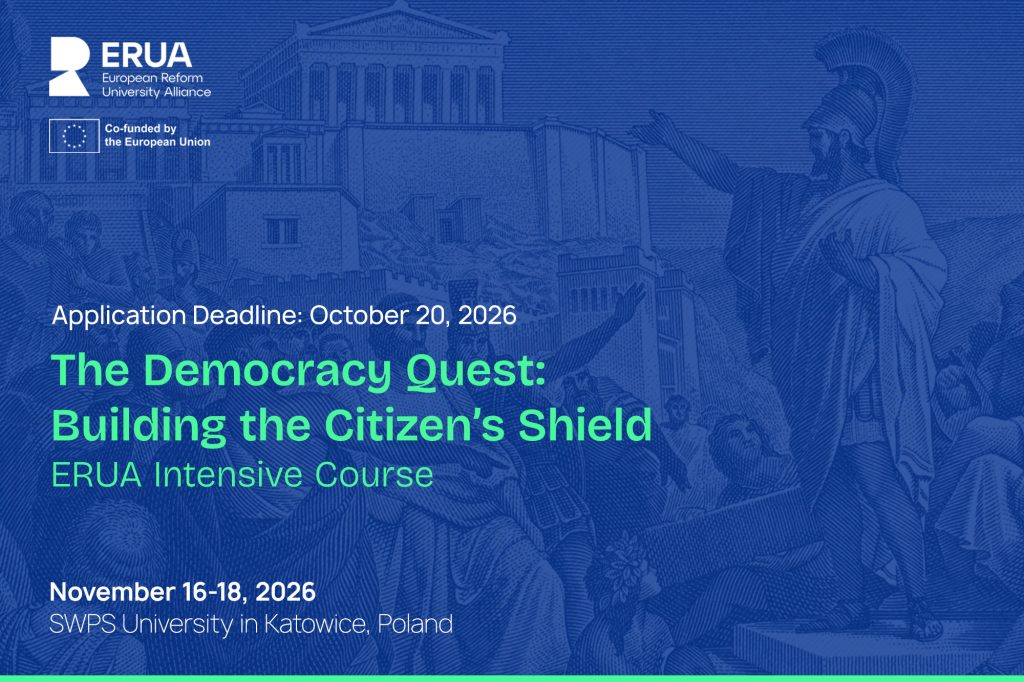
Date: November 16-18, 2026
Place: SWPS University in Katowice, Poland
About the program
This three-day simulation course demonstrates how democratic tools have evolved from ancient assemblies to the modern structures of the European Union.
Working in groups, you will step into the different roles of representatives from various political systems to jointly resolve social and political conflicts using the rules of each respective era. Each day will transport you to a different period in history, such as the:
- Athenian democracy
- Roman Republic
- Scandinavian Thing
- 18th- and 19th-century European monarchies
- Contemporary European Union.
During the course, you will debate, vote, draft a mini-constitution, and negotiate shared solutions to modern crises, such as human rights and LGBTQ+ rights.
The course develops critical thinking, debate, negotiation, and collaboration skills while encouraging reflection on the limitations of democracy and the importance of inclusivity. Through a system where students earn “Influence Points” and “Humanity Tokens,” the course illustrates that effective governance requires not only political influence, but also responsibility, empathy, and respect for human dignity.
What will you learn?
By the end of the course, you will be able to:
- Analyze the Non-Linear Evolution of Democracy: Evaluate how democratic tools have changed from local, isolated assemblies to complex, international parliamentary structures.
- Practice Collaborative Problem-Solving: Use “Influence Points” and “Humanity Tokens” to demonstrate that successful governance requires a balance between political efficacy and ethical integrity.
- Exercise Critical Citizenship: Question current democratic deficits and propose innovative, student-oriented solutions to bridge the gap between policy and human rights.
- Engage in Humanist Advocacy: Argue for the protection of human rights as a universal constant, regardless of the historical era or political system being simulated.
Application Process
Before you start your application process, please prepare the following documents:
- Curriculum Vitae (max. 1 page)
- Cover letter describing why you would like to participate in the course and what is your interest in democracy and civic participation (max. 1 page)
- CEFR B2 or higher English proficiency — we accept all types of official certificates
Application deadline: October 20, 2026, by midnight (CEST).
To apply, follow this link and fill in the application form.
Funding
Students from ERUA partner universities, other than SWPS University, who are accepted to the program by SWPS University, can apply for travel and accommodation funding at their home university’s ERUA Office.
Funding sources
The project is co-funded by the European Union.
Contact
SWPS University Office for International Cooperation: erua@swps.edu.pl