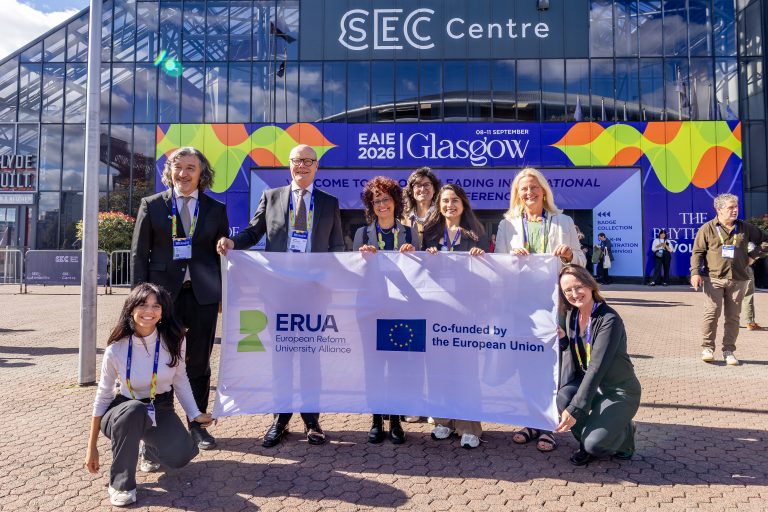
One year after making its debut as an exhibitor at EAIE in Gothenburg, the European Reform University Alliance (ERUA) returned to the EAIE Conference – this time in Glasgow – with more to share, more connections to build, and a growing body of achievements demonstrating what reform can look like in practice.
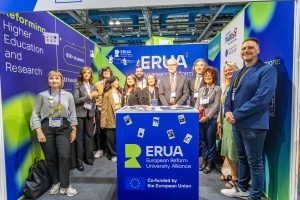
From 8 to 11 September, ERUA joined colleagues from across the international higher education community at the SEC Centre, bringing together higher education leaders, academics and communication specialists from across its partner universities. At our Stand, conversations centred on a shared question: how can European universities work together to build a more open, inclusive, innovative and socially engaged future?
From a first appearance to a growing presence
EAIE 2025 in Gothenburg marked an important milestone for ERUA: its first-ever exhibition booth and an opportunity to introduce the Alliance’s reform-driven philosophy to the wider international education community.
A year later, the return to EAIE reflected how much has developed since that first appearance. In Glasgow, ERUA was able to share not only its vision, but also the concrete progress made across the Alliance – from new forms of academic cooperation and mobility to student-led initiatives, research collaboration and stronger structures for long-term cooperation.
A year of transformation
2026 has been a particularly significant year for ERUA.
In May, the Alliance formally established itself as a permanent international non-profit association. The creation of a legal entity marked a decisive transition: from a project-based collaboration supported through successive European funding cycles towards a permanent institutional alliance of European universities.
This new chapter was strongly reflected in ERUA’s presence at EAIE.
The Alliance can now point to a growing portfolio of concrete achievements. Innovative teaching opportunities have expanded across the network, with dozens of winter schools, summer schools, travelling seminars and intensive courses connecting students and academics across borders.
Mobility has also continued to grow and academic integration is moving forward. ERUA has developed a framework for joint degrees, with new programmes in areas including Forced Migration, Human Rights and Technology, and Psychology of Climate Action opening the way towards deeper forms of European academic cooperation.
These developments give new meaning to ERUA’s presence at EAIE: the Alliance was not only presenting what it believes in, but demonstrating what it is already building.
Building connections across Europe
EAIE has always been about connections: between institutions, people, ideas and cultures. For ERUA, this is particularly important.

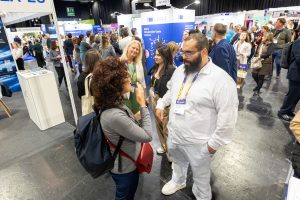
In Glasgow, the Alliance had the opportunity to reconnect with colleagues and partners, exchange experiences with fellow European University Alliances, and develop new relationships across the international higher education community.
These conversations also take place within a changing European context.
 With European University Alliances entering a more mature phase, questions around sustainability, long-term cooperation, mobility, joint degrees, student engagement and institutional transformation are becoming increasingly important.
ERUA’s experience offers one perspective on how alliances can respond: by embracing diversity rather than seeking uniformity, by connecting disciplines and institutions, and by treating reform as an ongoing process rather than a fixed destination.
Reform in practice
The theme that connected ERUA’s presence in Gothenburg and Glasgow was reform.
Last year, ERUA presented its three guiding priorities: reform at the core of the university, breaking boundaries between disciplines, and contributing to a more human-centred Europe.
This year, those ideas were accompanied by a growing body of practice.
ERUA is developing new educational formats, strengthening mobility, supporting early-career researchers, connecting research with societal challenges and creating opportunities for students to initiate and shape projects of their own.
Its work in social entrepreneurship is one example of this approach. The Alliance has developed an online course bringing students and lecturers together around social innovation and entrepreneurship, connecting education with real societal challenges.
Across these activities, the same principle remains visible: universities can be spaces for experimentation, participation and transformation.
Looking beyond Glasgow
As EAIE 2026 comes to a close, ERUA leaves Glasgow with new conversations, renewed partnerships and a stronger sense of collective momentum.
The next chapter is already taking shape – through new joint degrees, expanding mobility opportunities, student-led projects, research cooperation, social innovation initiatives and the continued development of ERUA as a permanent European alliance.
Reform is something we build together – through people, ideas, partnerships and the courage to keep changing.