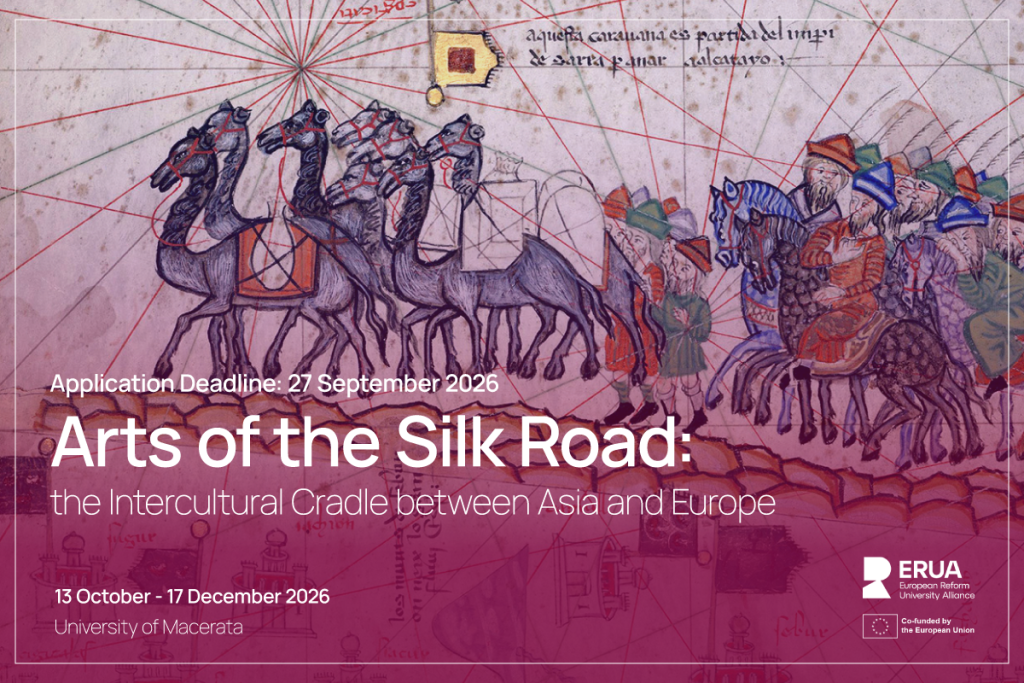
Unimc Invites students of the European Reform University Alliance (ERUA) to participate in the Semester Course “Arts of the Silk Road: the Intercultural Cradle between Asia and Europe” The course will be taught entirely by Professor Chiara Gasparini from the University of Oregon, in her capacity as a Visiting Professor at the University of Macerata. Professor Ambrogio will coordinate the course and hold co-teaching sessions with his colleague, for whom he serves as Faculty Advisor at the university.
Description of the course
This course examines cross-cultural artistic encounters between East and West through comparative, thematic sessions. It considers artistic production and consumption across various regions and social contexts in pre-modern Eurasia and the early modern Americas. It discusses a broad range of media, including sculptures, paintings, architectural elements, and textiles, related to (but not limited to) nomadic peoples, diasporas and migrations, religions, urban settlements, trade, and slavery along the so-called Silk Road during the premodern period, and beyond towards the Americas in the early modern period.
• The material will be presented through PowerPoint slides.
• The course includes selected readings, docu-films, and artworks to facilitate understanding of the topics and themes.
• There will be an initial workshop on “Maps as artworks” with a related assignment to compare ancient maps with Google maps, in order to trace and understand the evolution of borders and frontiers across Eurasia and the ancient Silk Road network, and a final project (either a digital portfolio of objects, a poster, or the creation of a detailed StoryMap) on a topic selected by the students.
SCHEDULE
WEEK 1
13 October (9:00-11:00 CET): Introduction to the Silk Road
15 October (15:00-17:00 CET): The Art of Mapping
WEEK 2
27 October (9:00-11:00 CET): Nomadic Art
29 October (15:00-17:00 CET): Development of Buddhist Art
WEEK 3
10 November (9:00-11:00 CET): The Tarim Basin
12 November (15:00-17:00 CET): The Sogdians
WEEK 4
24 November (9:00-11:00 CET): The Mongol Period
26 November (15:00-17:00 CET): The Realms of Existence along the Silk Road
WEEK 5
15 December (9:00-11:00 CET): The Silk Road to the Americas
17 December (15:00-17:00 CET): Final Presentations
Resources
- Susan Whitfield. Silk Roads: Peoples, Cultures, Landscapes. Thames and Hudson, 2019.
- Susan Whitfield. Silk, Slaves, and Stupas: Material Culture of the Silk Road. University of California Press, 2018.
- Fan Jinshi and Susan Whitfield. The caves of Dunhuang. Scala, 2010.
- Mariachiara Gasparini. Transcending Patterns: Silk Road Cultural and Artistic Interactions through Central Asian Textile Images. University of Hawai’i Press, 2019.
- The Silk Road, UNESCO https://en.unesco.org/silkroad/about-silk-roads
- In the Footsteps of Marco Polo: https://www.pbs.org/show/in-the-footsteps-of-marco-polo/
- International Dunhuang Project (IDP): https://idp.bl.uk/
- Digital Dunhuang: https://www.e-dunhuang.com/index.htm
- Saving Mes Aynak: https://www.savingmesaynak.com/
- The Sogdians: Influencers on the Silk Road: https://sogdians.si.edu/introduction/
- Project Himalayan Art: https://rubinmuseum.org/projecthimalayanart/
- Horse-Lords: A Brief History of the Scythians: https://www.youtube.com/watch?v=-IAxEtT3lfA&t=146s
- The three hares: https://chinesepuzzles.org/three-hares/ and The three hares project: http://www.chrischapmanphotography.co.uk/hares/page7.htm
Learning outcomes
Upon successful completion of this course, students will be able to:
- Compare ideas, values, images, cultural artifacts, economic structures, technological developments, or people’s attitudes from more than one culture.
- Identify the historical context of ideas and cultural traditions from different areas of Eurasia and the Americas
- Explain how various cultures have changed in response to internal and external pressures.
- Address significant achievements of the human intellect and imagination in a comparative context to understand and appreciate different ideas, cultures, values, religions, institutions, languages, and peoples of the world.
- Digitally trace and present primary cultural and artistic nodes through interactive maps and works of art (i.e. Storymaps, Wix, Prezi)
Assessment methods
Evaluation of active participations during lectures and workshops. Ability to analyse maps, textiles, or filmographic patterns during the first two workshops. Evaluation of manufactures or artefacts produced during the last workshops.
Who can apply?
The course is open to 14 (2 for each of the 7 institutions) with the possibility of taking advantage of places not used by other partner universities.
The corse is open to Bachelor and Master students with a solid interest in intercultural and a cross-disciplinary practices.
How to apply
Students can apply using the application form until 27 September 2026.
The following documents will be required for the application:
• A cover letter explaining their strong interest in the semester course and how this activity might contribute to their personal learning/researching path.
If you have any other administrative questions about the course, please contact your local ERUA team at your university or Unimc local team (tobia.ciarrocchi@unimc.it).