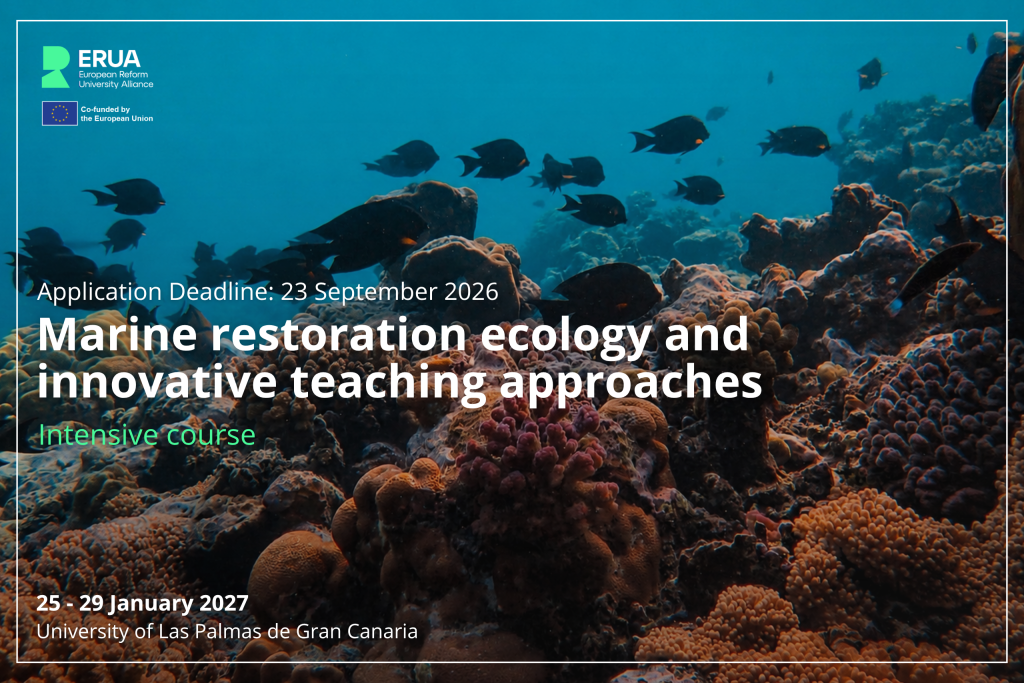
The University of Las Palmas de Gran Canaria is organising the intensive course ‘Marine Restoration Ecology and Innovative Teaching Approaches: Seagrass Meadows, Rocky Shores and Mesophotic Coral Ecosystems’, aimed at undergraduate, master’s and PhD students from ERUA universities who are interested in the conservation and restoration of marine ecosystems.
The course combines scientific content on restoration ecology with innovative teaching methodologies, offering a learning experience based on collaborative work, field activities and solving real-world problems related to marine conservation.
Course content
Over the course of five days, students will explore topics relating to the restoration of coastal ecosystems and the conservation of marine biodiversity, including:
- Marine and coastal ecosystems and the main pressures caused by human activity
- Marine biodiversity conservation and relevant international agreements
- Restoration ecology and ecosystem resilience
- The impact of climate change on marine biodiversity
- Restoration of temperate reefs, rocky shores, seagrass meadows and mesophotic coral ecosystems
- Ecological restoration techniques and ecological engineering
- Biodiversity monitoring and assessment of ecosystem resilience
The programme also includes practical laboratory activities and field trips, including biodiversity studies in intertidal zones, habitat characterisation, species identification and a visit to the IU-ECOAQUA facilities in Taliarte.
Methodology and learning outcomes
The course combines various teaching methodologies, such as the flipped classroom, project-based and problem-based learning, cooperative learning and practical fieldwork.
By the end of the course, participants will have developed the necessary skills to:
- Analyse the processes of degradation and recovery of marine ecosystems
- Compare different ecological restoration methodologies
- Apply biodiversity and resilience indicators
- Design restoration and ecological monitoring strategies
- Incorporate innovative teaching methodologies into the field of marine sciences
- Develop collaborative educational activities based on fieldwork
Assessment will be based on active participation throughout the course and the presentation of a final group project.
Target audience
The activity is aimed at undergraduate, Master’s and PhD students at universities belonging to the ERUA alliance.
The activity is open to students from a range of disciplines, with a particular focus on those studying degree programmes related to:
- Marine Sciences
- Biology
- Environmental Science
- Environmental Engineering
- Marine Sciences
- Sustainability and Conservation of the Marine Environment
- Other related degree programmes
Registration
To register for this activity, please email the following documents to eruatec2@ulpgc.es:
- Curriculum vitae (CV)
- Letter of motivation (maximum 200 words)
- Proof of English language proficiency
The deadline for submitting the documents is 23 September 2026.
More information
For any academic enquiries, please contact the course coordinator, Rodrigo Riera Elena, by email at rodrigo.riera@ulpgc.es.
For enquiries regarding participation, please contact the local ERUA team at erua@ulpgc.es.