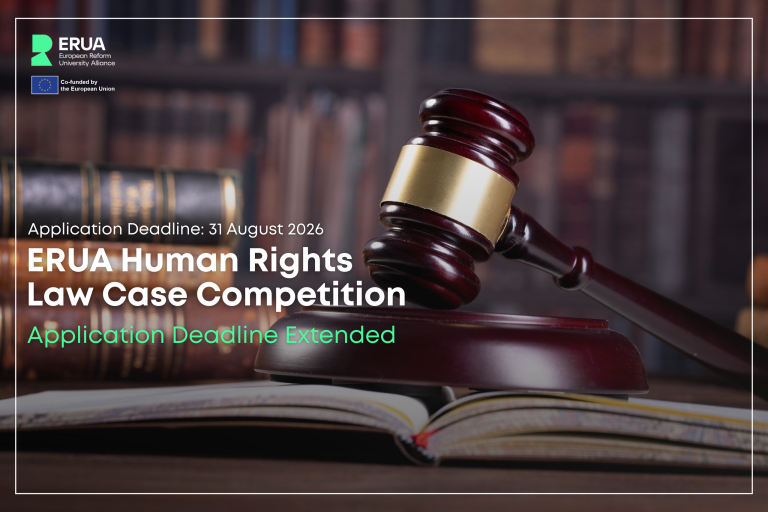
Calling all law students with an interest in human rights and international cooperation. The ERUA Human Rights Law Case Competition invites you to test your skills, work alongside peers from across Europe, and present original legal analysis within the ERUA Consortium.
Who can apply? The competition is open to Bachelor’s, Master’s, and equivalent law students at ERUA partner universities. You can enter on your own or in a team of up to five.
How to apply? One team representative completes the official application form and submits a short abstract of your proposed case analysis.
What’s at stake? Winning teams will present their work in a dedicated session at the ERUA Summit in November. Selected participants may also receive ERUA mobility funding to attend the Summit in Sofia.
Taking part means you’ll:
- sharpen practical legal skills,
- collaborate with students across Europe,
- build international academic experience,
- and put your ideas in front of an audience at the ERUA Summit.
Deadline: 31 August 2026
Application form: Submit your abstract
Engage with the human rights questions that matter on an international stage.
ERUA Human Rights Law Case Competition – The Details
This year’s theme The role of courts in combating discrimination at the national level.
Your abstract Outline the facts of the case, the relevant human rights framework, the key legal questions, and your proposed analytical approach. Only the abstract is needed at this stage, not a full presentation. Upload it through the form as a separate file.
Format:
- maximum 300 words,
- English,
- PDF,
- Times New Roman, size 12,
- 5 line spacing,
- standard 2.5 cm margins.
The presentation round, Shortlisted teams present their legal analysis online before the Jury: a 15-minute presentation, then up to 10 minutes of questions. Identify one central theme and frame it with up to three guiding questions. Cover the facts, the applicable international or European human rights framework, the key legal issues, and your reasoning and conclusions. Slides are optional.
How you’ll be judged:
- depth and quality of legal analysis,
- application of national and European human rights standards,
- coherence and structure of argument,
- originality and critical perspective,
- use of relevant sources and case law,
- creativity of the idea and presentation.
The Jury’s decision is final.
The final at the ERUA Summit The top team from each institution qualifies for the final in Sofia (20–21 November). Finalists give a 15-minute presentation followed by an open discussion, and lead a student workshop in the SHE (Shared Humanity Experience) format, a student-led exchange exploring the human and ethical dimensions of the case. Mobility funding may cover travel and accommodation, subject to available funds and your home institution’s rules.
Using AI AI tools are allowed only for language editing, formatting, preliminary research, or translation, never for the substantive legal analysis, argument, or conclusions, which must be your own work. Any use must be disclosed in a short statement attached to your submission.
Good to know
- One entry per person or team.
- All work must be original; plagiarism means disqualification.
- You keep the rights to your work; ERUA gets a non-exclusive license to publish, present, and archive it for academic and promotional purposes.
- Winning submissions may be published in ERUA materials, and finalists receive a certificate of academic distinction.