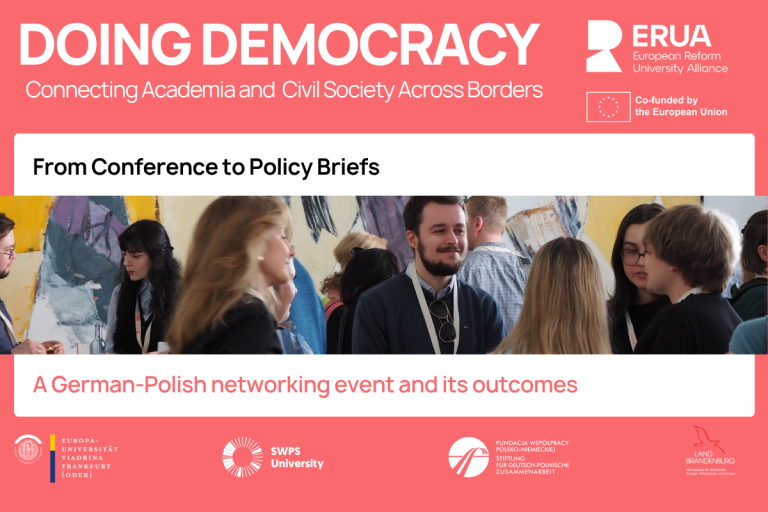
Three blog posts published in July on the Entanglements blog return to the German-Polish networking event Doing Democracy of April 2026 — and show what happens when a conference is designed to produce something beyond the conference itself.
On 23 and 24 April 2026, the European University Viadrina in Frankfurt (Oder) and SWPS University in Warsaw brought around 40 representatives of German and Polish NGOs and civic initiatives, some 40 researchers and students, and 25 regional stakeholders from politics and urban society into the same rooms in Frankfurt (Oder) and at the Collegium Polonicum in Słubice. DOING DEMOCRACY: Connecting Academia and Civil Society Across Borders was organised within ERUA’s Work Package 5 on achieving social change in local communities and regions and hosted on the ERUA Collaborative Open Space (ECOS), developed and supported by the University of the Aegean. It was also a contribution to the 35th anniversary of the German-Polish Treaty on Good Neighbourship and Friendly Cooperation.
The format was deliberately unfinished. Posters submitted in advance became the basis for five thematic working groups — on youth and civic education in an age of multimedia (dis-)information, on dialogue and local participation, on countering hate speech and right-wing extremism, on empowerment and community building, and on protecting queer and minority rights. What the groups produced was carried into a Future Lab on the second day, into student policy briefs, and into a series of blog posts.
Those posts appeared in July on Entanglements, the blog of the Viadrina Center of Polish and Ukrainian Studies (VCPU). Three of them look back at the conference from very different angles.
The ambivalence of civic participation
In the opening post (1 July), Anja Hennig, postdoctoral researcher and lecturer at the Viadrina’s Chair of European Studies and one of the conference organisers, takes up a theme that ran through the second working group and the evening panel at Frankfurt (Oder) Town Hall: participation is a core democratic value that frequently fails to deliver what it promises.
Her argument is that participatory formats do not strengthen democratic resilience automatically. They depend on transparent procedures, on issues that have not already been fully politicised, on municipal budgets that are under pressure everywhere, and above all on whether anything visible actually follows. Several civil society representatives at the conference described their contributions disappearing into the “black box” of public administration.
The numbers she cites point the same way. Reading the Bertelsmann Democracy Monitor 2026, she sets 79 percent of Germans who treat participation as a central democratic value against the 15 percent who are satisfied with how it is actually implemented — one instance of a gap the study finds in all eight areas of democratic life it examines. Krzysztof Izdebski of the Stefan Batory Foundation reported comparable frustration in Poland, where around 80 percent of participants say their involvement produces little or no visible effect.
That gap is not neutral ground. Hennig notes that far-right actors are actively occupying it — the AfD branch in Frankfurt (Oder) has called for “real participation”, and AfD representatives organise citizen dialogues in municipalities where, as one local observer put it, someone finally listens. Her conclusion is uncomfortable and precise: participation is an ambivalent instrument, and illiberal participation is on the rise. Read the post at the Entanglements blog.
A bridge made of mistakes, barbed wire, and chronic pain
The second post (15 July) is by Artur Koldomasov, PhD student at SWPS University and President of the Board of the Warsaw NGO Alliance 24/08, who co-organised the conference on the SWPS side. He holds the German-Polish border up against the one his organisation actually works on, the Polish-Ukrainian, and says plainly where the comparison breaks down: two prosperous EU member states, 35 years into a settled peace, are no template for a host country and a country still at war.
What carries over, he argues, comes in three images:
- Mistakes are historical wrongs a state has formally named and closed, so that they can no longer serve as ammunition. Poland and Ukraine have no such settlement, and what reopens old injuries is less often a campaign than editorial habit — reports leading with the Ukrainian nationality of criminal suspects where it has no bearing on the offence. Alliance 24/08 took three such TVP Info items to Poland’s Media Ethics Council, which upheld the complaint in part; the headlines were later reworded.
- Barbed wire is division that is manufactured rather than ambient. It works without persuading anyone: it only has to make holding a pro-solidarity position in public costly enough that people quietly disengage.
- Chronic pain is the reflex that expects catastrophe from borders and flares at present-day pressures unrelated to the original wound — the wartime past resurfacing whenever the costs of hosting refugees rise.
His recommendation matches the conference’s own vocabulary of resilience as maintenance work: fund the unglamorous daily work of civil society organisations, and fund research able to trace a disinformation operation to its source quickly enough to matter. Neither, he writes, works without the other. Read the post at the Entanglements blog.
Democracy under pressure at the local level: five student policy briefs
The series closes on 22 July with an editorial by Anja Hennig presenting the work of fourteen master’s students, mainly from the European Studies programme, who attended the conference as part of an accompanying course. Each took part in one of the five working groups, identified a concrete policy problem from the discussions there, and worked in small teams on an evidence-based brief addressed to public authorities or university decision-makers.
The five executive summaries cover political education and far-right extremism among young people in rural Brandenburg; how the city of Frankfurt (Oder) could make participation outcomes binding rather than advisory; how municipal administrations might publicly back civil society organisations facing delegitimisation; how the Viadrina could build reliable channels for cooperation with civil society; and how Brandenburg could give structural rather than project-based protection to gender equality work under anti-feminist pressure.
The full policy briefs are available in German on the Doing Democracy website. Read the post on the Entanglements blog.
Taken together, the three posts trace the movement ERUA is trying to make routine: from an in-person encounter, to analysis, to recommendations aimed at people who can act on them. Recordings of the public panels, the working group results and the policy briefs are collected at ecos.erua-eui.eu/info/doing-democracy. The full blog series is at entanglements.hypotheses.org.