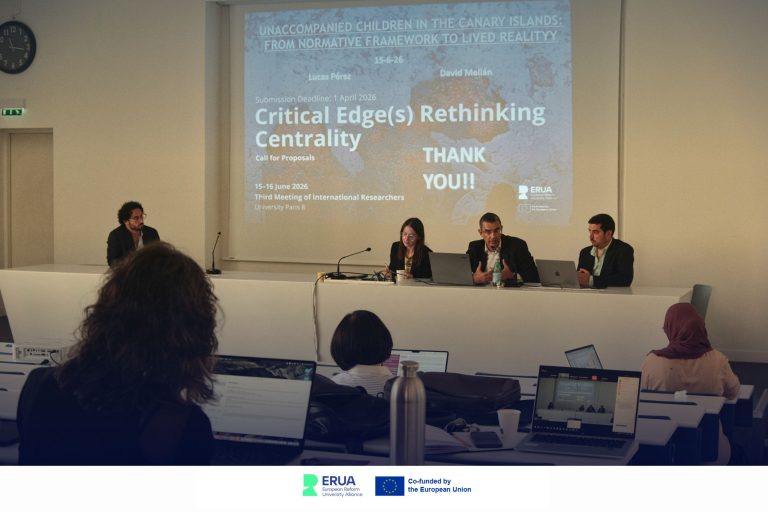
On 15–16 June 2026, Université Paris 8 welcomed researchers from across the European Reform University Alliance (ERUA) for the Third International Researchers’ Days, bringing together early career and academics to exchange ideas, strengthen collaborations and reflect collectively on the future of research within the Alliance.
As part of Hospitality and Freedom of Research Protection Month, Université Paris 8 organised an event to highlight its longstanding commitment to supporting researchers at risk, defending academic freedom and promoting an open, inclusive and international research environment. This framework lent particular significance to this year’s theme: ‘Critical Edge(s)’. Rethinking the Centre: Exploring Borders, Margins and Peripheries’, inviting participants to consider the political, cultural, social and academic dimensions of critical edges in all their theoretical richness.
This third edition marked an important milestone by expanding the event from the international research community of Université Paris 8 to the wider ERUA community, bringing together more than 34 researchers from ERUA member universities. Over the course of two days of truly interdisciplinary and cross-cutting exchanges, the event reinforced its role as a shared space for networking, integration, and collaboration across the Alliance.
As a result, the International Researchers’ Days have become a dedicated platform for supporting international early-career researchers, enabling them to engage with one another beyond institutional and disciplinary boundaries. By fostering connections across universities, research fields, and career stages, the event strengthens the links between the research community and ERUA’s identity as an Alliance founded on academic freedom, critical thinking, and societal engagement.
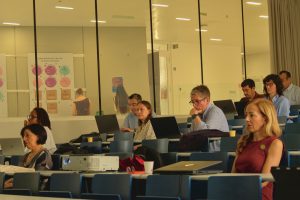
Across nine thematic panels—three of which were entirely organized by ERUA research clusters—participants collectively explored the concepts of borders, margins, and reform through four major areas of reflection: migration, democracy, the state of the social sciences and humanities, and artistic practices and experimentation. The diversity of contributions highlighted the value of interdisciplinary approaches while fostering a genuinely transversal and horizontal dialogue among researchers from across the Alliance.
A particular highlight of this edition was the round-table discussion “Critical Edge(s) and Reform in the Heart of ERUA”, which brought together the entire research community to collectively reflect on the concepts of reform and critical edges as key dimensions of ERUA’s future. The discussion featured Jin Taira, Vice-President for International Relations at Universidad de Las Palmas de Gran Canaria, Sandra Evans, ERUA Coordinator at the European University Viadrina Frankfurt (Oder), Cynthia Dahome-Monk, Senior Policy Officer for ERUA and Juan-Pablo Yáñez from our WP3 (Université Paris 8), with the participation of researchers from across the Alliance. The exchange demonstrated the fundamental place of the research community in shaping the Alliance’s collective reflection on its identity, illustrating how dialogue between researchers and institutional representatives can actively contribute to ERUA’s development.
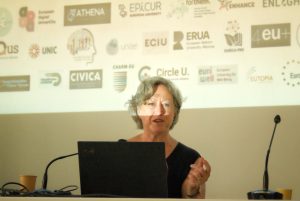
Another key moment was the Annual Networking Fair for Researchers, organised within the framework of the ERUA Research Support Network. Dedicated to funding opportunities and international research cooperation, the fair reflected ERUA’s strong commitment to supporting early-career researchers as they navigate the challenges of building their academic careers after the PhD. Participants exchanged with experts on European and national funding schemes and met representatives of the Franco-German University (DFH-UFA), an associated partner of ERUA. Prof. Dr. Andrea von Hülsen-Esch, Vice-President of the Franco-German University, presented opportunities supporting Franco-German academic cooperation and collaborative research projects, highlighting the importance of connecting researchers with concrete career development opportunities across Europe.
By combining scientific exchange, institutional dialogue and professional networking, the Third International Researchers’ Days once again demonstrated ERUA’s commitment to building an inclusive, collaborative and interconnected European research community. More than a scientific conference, the event embodies the Alliance’s vision of research as a collective endeavor, where early-career researchers play a central role in shaping both the future of European research and the evolving identity of ERUA itself.