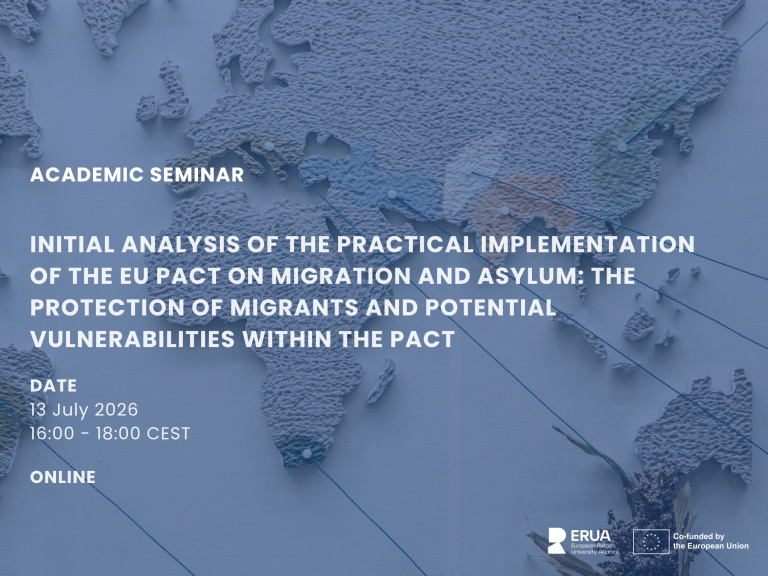
Date: 13 July 2026
Time: 16:00 – 18:00 (CEST)
Format: Online
The ERUA Alliance’s Borders, Bordering and the (Re)Production of Vulnerability research cluster is organising the international academic seminar Initial Analysis of the Practical Implementation of the EU Pact on Migration and Asylum: The Protection of Migrants and Potential Vulnerabilities within the Pact, an event that will bring together researchers and representatives to analyse the initial effects of the entry into force of the new European Pact on Migration and Asylum.
The event will take place online on 13 July, just one month after the new European framework came into force on 12 June 2026, with the aim of sharing an initial assessment of its implementation across various Member States of the European Union and discussing the potential challenges it poses for the protection of migrants’ rights.
Seminar programme
The seminar will bring together researchers from various universities within the ERUA alliance, who will share their initial assessment of the practical implementation of the European Pact on Migration and Asylum in their respective countries.
Confirmed participants:
- Moderator: Lucas Andrés Pérez Martín (University of Las Palmas de Gran Canaria, Spain).
- Germany: Marija Grujić, Kira Kosnic and Mouna Maaroufi (European University Viadrina).
- Bulgaria: Ildiko Otova (New Bulgarian University).
- Spain: Lucas Andrés Pérez Martín (University of Las Palmas de Gran Canaria).
- France: Laura Odasso (University of Paris 8).
- Greece: Nikos Nagopoulos (University of the Aegean).
- Italy: Fabrizio Marongui (University of Macerata).
- Poland: Olena Styslavska-Doliwa (SWPS University).
During the session, the following issues, amongst others, will be addressed:
- The practical application of the new European Pact on Migration and Asylum.
- The main legal, social and political challenges arising from its implementation.
- Potential situations of vulnerability that may affect migrants.
- Proposals and measures to strengthen the protection of human rights in the context of migration.
In addition to research staff, the seminar will be attended by representatives from public institutions and civil society organisations working in the field of migration and human rights. From Spain, Luis Padilla, General Director for Relations with Africa of the Government of the Canary Islands, Luis Padilla, and the Spanish Commission for Refugee Aid, is expected to attend. Furthermore, organisations and institutions from the various participating countries have been invited to enrich the debate with complementary experiences and perspectives.
Who can participate
The seminar is open to the entire university community and to members of the public interested in issues relating to migration, borders, human rights and European asylum policies.
The session will be held in English and will combine presentations by experts with an open discussion among participants, in line with the principles of dialogue, responsible participation and interdisciplinary exchange promoted by the ERUA alliance.
Registration
Participation is free of charge and open to anyone interested.
Further information
For enquiries regarding the academic content of the seminar, please contact the event coordinator, Lucas Andrés Pérez Martín, by email at lucas.perez@ulpgc.es.
For matters relating to the event, please contact the ERUA team at the ULPGC by emailing erua@ulpgc.es.