The ERUA intensive course “Coastal Ecology and Advanced Strategies for Climate Change Mitigation and Reversibility” was successfully held in Lesvos, from 1 to 6 June 2026, jointly organised by the University of Las Palmas de Gran Canaria (ULPGC) and the University of the Aegean.
The programme brought together students and researchers from both institutions to explore the impacts of climate change on coastal ecosystems and to develop science-based approaches to mitigation, restoration, and sustainable coastal management.
Interdisciplinary training on coastal change
The course provided advanced training in coastal ecology, combining lectures, fieldwork, and collaborative group work. Key topics included biodiversity loss, habitat fragmentation, ocean warming, marine pollution, ecosystem resilience, nature-based solutions, and coastal governance.
A strong emphasis was placed on translating scientific knowledge into applied strategies for climate adaptation and coastal management.
The academic programme was delivered by an international team of experts:
University of Las Palmas de Gran Canaria: Prof. Rodrigo Riera Elena, Prof. Ricardo J. Haroun, Prof. May Gómez Cabrera, Prof. Francisco Otero Ferrer, Prof. Joana Vasconcelos
University of the Aegean : Prof. Thanasis Kizos, Prof. Drosos Koutsoubas, Prof. Stelios Katsanevakis, Prof. Giorgos Tsirtsis, Prof. Evangelia Krasakopoulou, Assoc. Prof. Dimitra Kitsiou, Assoc. Prof. Kostantinos Topouzelis, Assoc. Prof. Elina Tragou, Assoc. Prof. Gianis Androulidakis, Ass. Prof. Alexandra Meziti, and Dr. Olympos Andreadis
Field-based learning
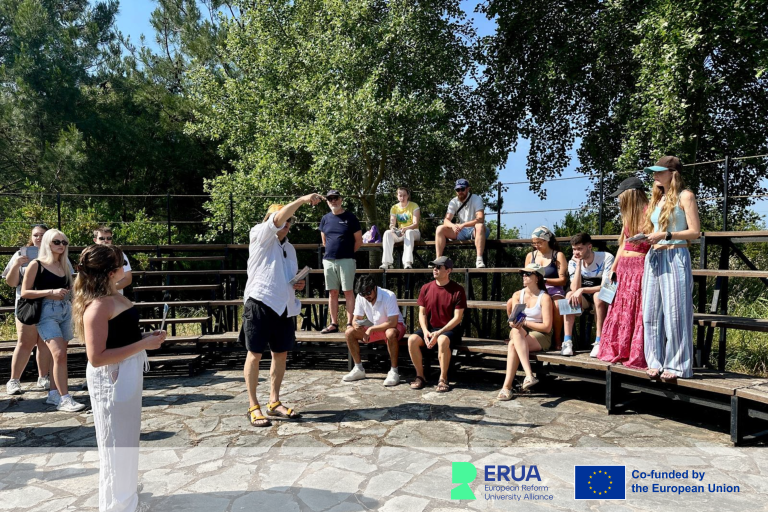
Participants engaged in fieldwork across coastal environments in Lesvos, including the Kalloni Gulf, combining ecological observation with applied coastal assessment. Activities included habitat analysis, biodiversity monitoring, and coastal survey techniques.
These field sessions enabled students to directly link theoretical concepts with real-world ecosystem dynamics.
Outputs
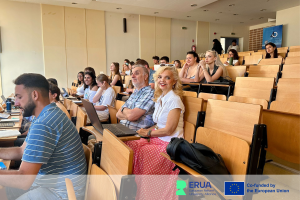
Working in interdisciplinary groups, students developed applied coastal management proposals addressing biodiversity conservation, fisheries sustainability, climate adaptation, pollution, and marine spatial planning.
Each group presented a policy brief, translating scientific analysis into actionable recommendations for environmental decision-makers. The course concluded with student presentations and scientific discussion on habitat restoration and future directions in coastal ecology.
The initiative strengthened interdisciplinary learning, research collaboration, and science-policy engagement, reflecting ERUA’s commitment to addressing environmental challenges through European academic cooperation.