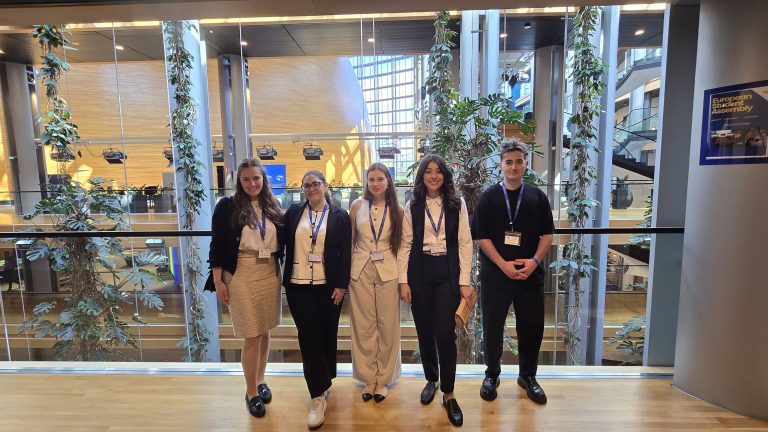
This April, students from across the European Reform University Alliance took part in the European Student Assembly 2026, contributing to one of Europe’s largest student-led policy initiatives.
20–23 April 2026 | European Parliament, Strasbourg
Bringing together 250 selected participants from 2,889 applicants representing 54 European University Alliances, the Assembly provided a unique opportunity for students to engage directly in European policymaking processes.
Held at the European Parliament from 20–23 April, ESA 2026 challenged students to work in international and interdisciplinary panels focused on some of Europe’s most pressing societal issues. Through months of preparation, research, debate, and collaboration, participants developed policy recommendations that were later discussed and voted on in the Hemicycle of the European Parliament.
Boryana Stefanova from New Bulgarian University served as Team Leader within Panel 2: Scaling the Circular Economy. Together with her team, she contributed to one of the panel’s most supported proposals, focusing on the strategic reuse of abandoned and underutilized buildings as community assets and resources during natural disasters through circular economy principles.
Sara Parazi from the University of Macerata worked on topics related to intergenerational solidarity. Through training sessions, group meetings, legislative research, and collaborative drafting, she gained deeper insight into European policymaking. The experience, she noted, was both intellectually stimulating and personally enriching.
Vangelis Zaftis from the University of the Aegean participated in Panel 3: Aligning Budget with Impact, contributing to discussions on the future of EU budget allocation and funding mechanisms. For him, ESA was an opportunity to engage with European governance and deepen his understanding of how EU-level decisions are shaped and contested.
Olha Taushan from Mykolas Romeris University took part in Panel 5: Unlocking Digital Potential, where students explored how Europe can remain digitally innovative while ensuring safety, inclusiveness, and resilience. She contributed to policy recommendations addressing AI governance, digital literacy, cybersecurity, misinformation, and protection against synthetic abuse and deepfakes, including proposals aimed at preserving critical thinking in increasingly AI-driven environments.
ERUA’s participation in ESA reflects the alliance’s commitment to meaningful student engagement and active citizenship. By bringing together students from different countries, disciplines, and experiences, the Assembly creates a space where ideas are challenged, perspectives broadened, and solutions co-created. It demonstrates how students can move beyond being observers of European affairs and become active contributors to shaping the future of Europe.