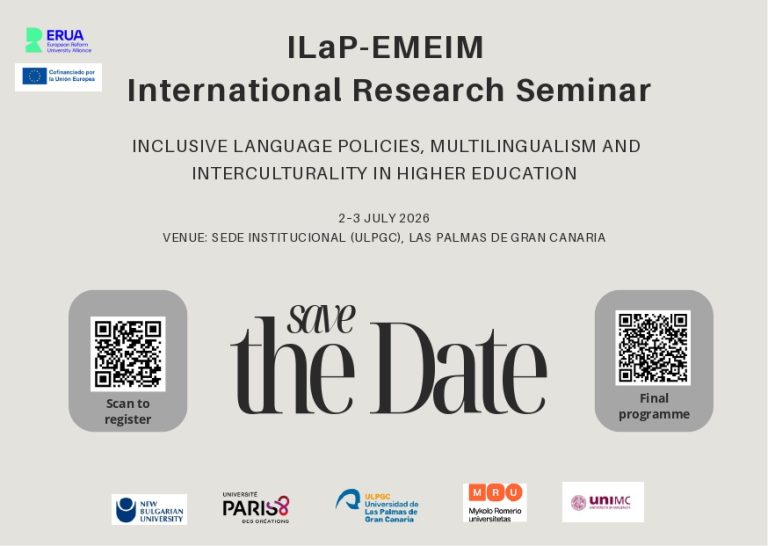
Dates: 2 and 3 July 2026
Venue: University of Las Palmas de Gran Canaria (ULPGC) / Online
Registration: link
On 2 and 3 July, the University of Las Palmas de Gran Canaria will host the Seminar on Multilingualism and Language Policies, an event organised by ERUA’s ILaP-EMEIM Research Cluster as part of the Task Force on Multilingualism, jointly led by the ULPGC and the Université Paris 8.
The event will bring together researchers, lecturers and professionals interested in the study of multilingualism, language policies and the role of languages in educational, social and intercultural contexts. Through presentations, debates and opportunities for discussion, the seminar will address some of the key challenges and opportunities posed by linguistic diversity in higher education and contemporary societies.
As well as providing a forum for academic exchange, the seminar is one of the key initiatives organised by the ERUA Task Force on Multilingualism, reinforcing the alliance’s commitment to promoting linguistic and cultural diversity as a key element in building a more inclusive European university.
The event will be held in a hybrid format, allowing for onsite and online participation to facilitate attendance by members of the ERUA community and those interested in the topic.
This activity is one of the initiatives promoted by the ERUA ILaP-EMEIM Research Cluster, which focuses on areas related to interculturality, multilingualism and languages in contexts of mobility and inclusion spaces for interdisciplinary collaboration. Additionally, this initiative intends to foster joint research and the exchange of knowledge among the alliance’s universities.
ERUA fomenta el debate sobre el multilingüismo y las políticas lingüísticas en el seminario internacional ILaP-EMEIM de la ULPGC
Fechas: 2 y 3 de julio de 2026
Lugar: Universidad de Las Palmas de Gran Canaria (ULPGC) / En línea
Inscripción: formulario de inscripción
Los días 2 y 3 de julio, la Universidad de Las Palmas de Gran Canaria acogerá el Seminario sobre Multilingüismo y Políticas Lingüísticas, un evento organizado por el Grupo de Investigación ILaP-EMEIM de ERUA en el marco del Grupo de Trabajo sobre Multilingüismo, dirigido conjuntamente por la ULPGC y la Université Paris 8.
El evento reunirá a investigadores, docentes y profesionales interesados en el estudio del multilingüismo, las políticas lingüísticas y el papel de las lenguas en los contextos educativos, sociales e interculturales. A través de ponencias, debates y espacios de discusión, el seminario abordará algunos de los principales retos y oportunidades que plantea la diversidad lingüística en la educación superior y en las sociedades contemporáneas.
Además de constituir un foro para el intercambio académico, el seminario es una de las iniciativas clave organizadas por el Grupo de Trabajo sobre Multilingüismo de ERUA, lo que refuerza el compromiso de la alianza con la promoción de la diversidad lingüística y cultural como elemento fundamental para construir una universidad europea más inclusiva.
El evento se celebrará en formato híbrido, lo que permitirá la participación tanto presencial como en línea para facilitar la asistencia de los miembros de la comunidad de ERUA y de todas aquellas personas interesadas en el tema.
Esta actividad es una de las iniciativas promovidas por el Grupo de Investigación ILaP-EMEIM de ERUA, que se centra en áreas relacionadas con la interculturalidad, el multilingüismo y las lenguas en contextos de movilidad y espacios de inclusión para la colaboración interdisciplinaria. Además, esta iniciativa pretende fomentar la investigación conjunta y el intercambio de conocimientos entre las universidades de la alianza.