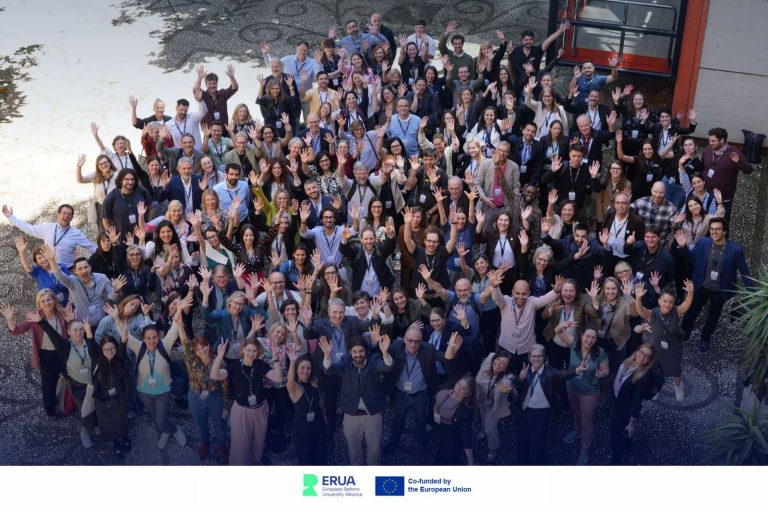
On April 15–17, 2026, representatives of the European Reform University Alliance (ERUA), Maxime Cacciuloto Heidel and Jolanta Bieliauskaitė, took part in the FOREU4ALL Management & Impact Workshop, hosted by the University of Granada within the Arqus European University Alliance. The high-level event brought together European University Alliances (EUAs), policymakers, and experts to explore how project management and impact assessment can jointly strengthen transformation across European higher education.
Under the theme “Aligning Project Management and Impact: A Practical and Strategic Dialogue for European University Alliances”, the workshop focused on moving EUAs beyond coordination towards becoming true drivers of systemic change. Discussions highlighted how evidence-based impact, strategic management, and trust-based governance are essential for the long-term sustainability and credibility of the European Universities Initiative.
Why Management and Impact Matter
The opening keynote panel addressed the strategic importance of management and impact for the future of European universities. Caroline Censier Calmus, Senior Advisor for European Universities at the French Ministry of Higher Education, Research and Innovation, underlined that effective alliances rely on people knowing and trusting each other, supported by strong leadership and meaningful self assessment practices. She stressed that existing experiences in impact assessment, such as those developed within FOREU4ALL, offer valuable models that individual universities and alliances can adapt and scale.
Jan Palmowski, Secretary General of The Guild of European Research Intensive Universities, emphasized that EUAs are not merely platforms for collaboration, but instruments of profound institutional transformation. He highlighted the need to foster universities’ capacity to make strategic choices, move from consensus based decision making towards trust based governance models, and better integrate alliances into national higher education systems. Such integration, he noted, is critical for demonstrating the added value of EUAs to ministries and funders, particularly as alliances often act as agile “laboratories of change” in contrast to slower policy environments.
Offering a research perspective, Antonin Charret from the University of Oxford reflected on the role of EUAs in strengthening European identity, especially in the post Brexit context. He described impact as something that emerges from communities of practice, where trust among academics, staff, and students is fundamental. He also pointed to the rise of new professional roles within alliances, calling for greater investment in training and capacity building for alliance managers and impact professionals.
ERUA Contributions to Key Challenges
During the interactive workshop on challenges in aligning project management and impact, ERUA representatives contributed directly to sessions addressing some of the most pressing issues facing alliances.
Jolanta Bieliauskaitė participated in discussions on data collection and analysis, focusing on how alliances can better align and combine diverse data streams. She highlighted the importance of moving from purely KPI driven reporting towards evidence based assessment, where quantitative indicators are complemented by qualitative insights that capture real institutional and societal change.
Maxime Cacciuloto Heidel contributed to the challenge of aligning projects with alliance logics, addressing how individual work packages and projects can better reflect overarching alliance strategies and values. The discussion underscored the need for management approaches that support long term transformation rather than short term compliance.
Both representatives emphasized that effective management and impact frameworks must inform strategic decision making, help anticipate desired and undesired effects, and strengthen alliances’ accountability to society and policymakers alike.
Strengthening Impact Literacy Through Storytelling
As part of the Raising Literacy Sessions, Jolanta Bieliauskaitė attended the session “The Power of Storytelling: Reporting and Communicating our Alliance Achievements.” Led by communication and impact leaders from Arqus, EUTOPIA, and UNA EUROPA, the session explored how storytelling can make alliance achievements more visible, relatable, and credible—especially when grounded in robust evidence. Participants agreed that narratives, when supported by data, are powerful tools for demonstrating value to students, staff, policymakers, and the wider public.
Maxime Cacciutolo Heidel attended the session “embedding impact in the everyday project management“, which outlined that impact management should be embedded into everyday project management by focusing not only on activities and outputs, but also on the real changes generated for stakeholders. It highlighted the importance of defining a clear Theory of Change, identifying key stakeholders, and using meaningful indicators—both objective and subjective—to measure outcomes such as skills, motivation, collaboration, and social engagement. Impact measurement is not just for reporting purposes, but a strategic tool for learning, improving decision-making, strengthening credibility, and demonstrating value to funders, partners, and the wider community.
Looking Ahead: Evidence, Trust, and People
The concluding session reinforced the importance of translating alliance experiences back to the wider higher education sector. Iwona Jablonska of the European Commission’s EACEA stressed that alliances must work in synergy across competencies and provide solid evidence to inform policy development. She highlighted that storytelling becomes significantly more impactful when underpinned by strong data, and reaffirmed the Commission’s support for alliances as long term drivers of change.
Closing reflections from Antonin Charret returned to two recurring themes of the workshop: trust and people. EUAs, he noted, are distinctive not only because of their structures, but because they bring together groups of people who genuinely enjoy working together—creating fertile ground for experimentation, learning, and innovation.
ERUA’s Continued Engagement
ERUA’s participation in the FOREU4ALL Management & Impact Workshop reaffirmed its commitment to strengthening impact oriented project management, investing in people, and contributing to a shared European learning community. Insights gained in Granada will inform ERUA’s ongoing work on evidence based assessment, strategic alignment, and meaningful communication of alliance impact.
As EUAs evolve, ERUA will continue to engage actively in cross alliance dialogues that help shape the next decades of European higher education—grounded in trust, collaboration, and demonstrable societal value.
Records to share:
FOREU4ALL Workshop 2: Aligning Project Management and Impact. 16 April: https://www.youtube.com/watch?v=HADDvfd8zfU
FOREU4ALL Workshop 2: Aligning Project Management and Impact. 17 April. Recap first day: https://www.youtube.com/watch?v=9XwWi8teDnk
FOREU4ALL Workshop 2: Aligning Project Management and Impact. 17 April. Conclusions: https://www.youtube.com/watch?v=pQ8Z-mYPArs