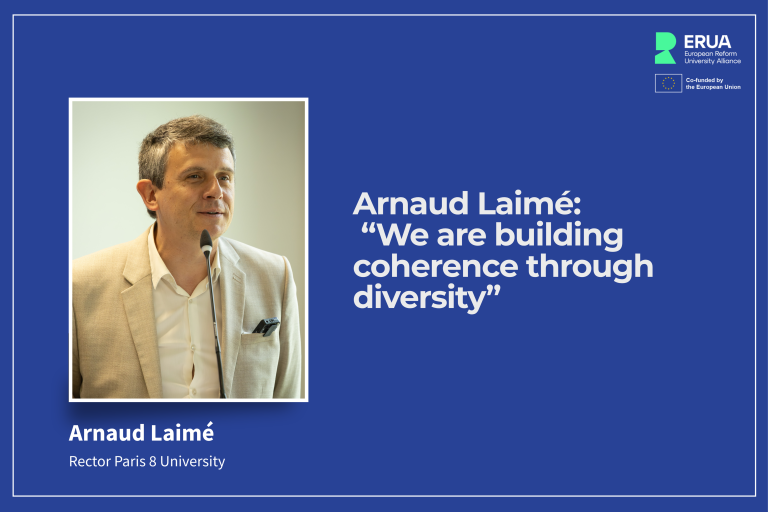
Speech by President Arnaud Laimé
at the signing ceremony of the ERUA Legal Entity
12 MAY 2026 | BRUSSELS
“Dear representatives of public authorities, colleagues, friends, and members of the European Reform University Alliance,
Dear distinguished guests,
We meet today at a defining moment.
A moment that invites us not only to look back with pride, but to look forward with clarity and determination.
This moment is more than a milestone. It is a mirror that reflects what we have built together, and asks us what kind of future we are ready to shape.
The European Reform University Alliance was born in 2020 within the European Universities Initiative of the European Commission.
But from the beginning, ERUA was more than a programme. It was a conviction.
We chose the word Reform not as a topic, but as an identity.
Because reform, for us, means rethinking what a university is: a transmitter of knowledge obviously, but also a living space of experimentation, participation, and transformation.
In the past two years, ERUA has moved from vision to implementation through concrete achievements.
We have:
- Expanded innovative teaching initiatives, with 71 winter schools, summer schools, travelling seminars, and intensive courses
- Strengthened mobility opportunities, reaching almost 1,000 mobilities, with the ambition of 2,400 by the end of 2027
These are not just numbers. They represent growing connections between people, disciplines, and institutions.
We have also taken a decisive step toward true academic integration.
ERUA has developed a structured framework for joint degrees leading to three diplomas, with the first programmes launching next academic year.
These joint programmes will cover:
- Forced Migration
- Human Rights and Technology
- Psychology of Climate Action
They embody what ERUA stands for: interdisciplinarity, social relevance, and shared European education.
ERUA has also invested in linking research and education with real societal challenges.
We have designed a comprehensive report on key social challenges and opportunities, based on insights from 200 interviewed experts across Europe.
From this work emerged an online course on social entrepreneurship, which has:
- Welcomed 76 students
- Led to 45 certifications
- Engaged 20 lecturers
This is what it means to turn knowledge into action, and reflection into impact.
Perhaps one of the most important transformations lies in governance.
ERUA has made student engagement and leadership a reality, not a principle.
Students are no longer only participants.
They are:
- contributors to decision-making
- co-creators of initiatives
- and initiators of their own projects within the alliance
This is a fundamental shift: from consultation to co-creation, from involvement to shared responsibility.
Across all these developments, ERUA connects universities from different parts of Europe: East and West, North and South, insular and continental institutions.
Together, we form what we call a critical edge: a space where disciplines meet, where differences become strengths, and where innovation emerges from diversity.
We are not building uniformity. We are building coherence through diversity.
Reform is not cosmetic. It is structural and cultural.
It is the courage to ask: Does what we do still serve the future we want to build? If not, we change it.
In this sense, ERUA is not a finished model. It is an evolving experiment: an alliance that learns from itself, transforms itself, and constantly reimagines itself.
In that sense, ERUA is not simply an alliance of universities.
It is a shared commitment to a different idea of higher education in Europe: one that is open, critical, inclusive, and transformative.
We have shown that reform is not an event. It is a practice. Not a destination. But a movement.
And ultimately, not just a word in our name, but the way we choose to work together. Because to reform, in the ERUA sense, is to care enough about the future to build it together.
Thank you.
As I said at the beginning, we are now at a defining moment. The mid-term evaluation has shown that ERUA is on track. It highlighted the project’s overall positive progress, with most objectives achieved and some even ahead of schedule. It highlighted strong governance and management, with the active participation of staff and students as key strengths – in other words, the commitment of our communities, which is so valuable and so essential to our success.
Today we are strengthening the institutionalisation of the alliance, and we are doing so through the ERUA 2030 roadmap, through the long-term strategy and, today, through the creation of our joint legal entity.
This should enable us to become more efficient and sustainable: a concern I believe is widely shared, while remaining faithful to the original project, which is its unique and genuine strength: to create a European community (a very small one) that brings about reform. Institutionalise, yes, but so that we remain free to innovate, to devise responses to the quest for meaning among our students, who are being battered by a world at war, in democracies under threat, in societies where social, cultural and epistemic rights are increasingly undermined, and all against a backdrop of a full-blown environmental crisis. Our students, even more so children of Europe than we are ourselves, expect this legal entity not to be a mere reproduction of what already exists. They want it to be a space where they can embody their commitment and imagine a future of peace and equity, where ethics is defined by a holistic approach to living beings, respectful of their specificities, their vulnerabilities and their cultures: to build a community far less narrow, far less divisive than those we have created to date. We older people may not have the words for it today. May their aspirations inspire us and unfailingly drive Erua forward in the future.”