
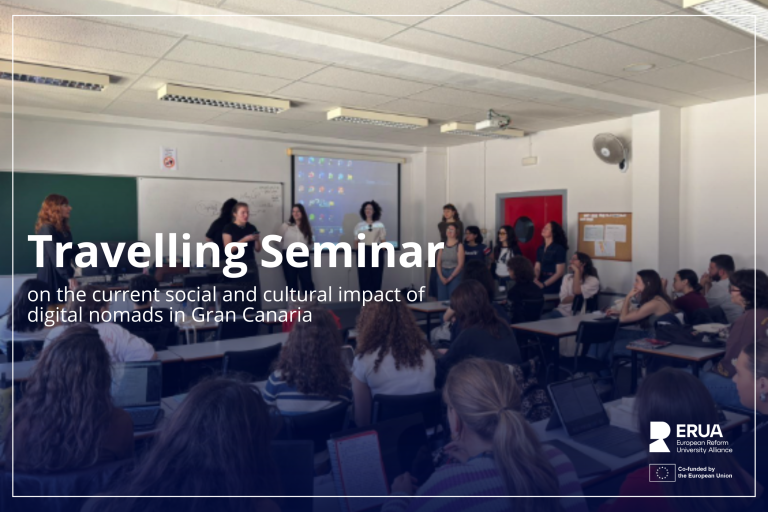
Students from the ULPGC and Paris 8 take part in a Travelling Seminar on the current social and cultural impact of digital nomads in Gran Canaria
The University of Las Palmas de Gran Canaria, in collaboration with the Université Paris 8 Vincennes–Saint-Denis, recently hosted a Travelling Seminar, an initiative developed within the framework of the ERUA alliance.
The event, organised by the Directorate of Language Policy and the Vice-Rectorate for Continuing Education and Employability, enabled students to take part in a project focusing on shared memory, interculturality and the creation of digital content through the podcast format.
This Travelling Seminar forms part of a European academic initiative that examines the impact of new work dynamics—particularly in the context of digitalisation—on host regions and communities. During their stay in Gran Canaria, the eight students from the Master’s programmes (“Digital Communication and Project Management” and “Media Studies, Cultural Studies and Foreign Languages”) and three lecturers from Paris 8 carried out research focusing on the social and territorial transformations associated with these processes.
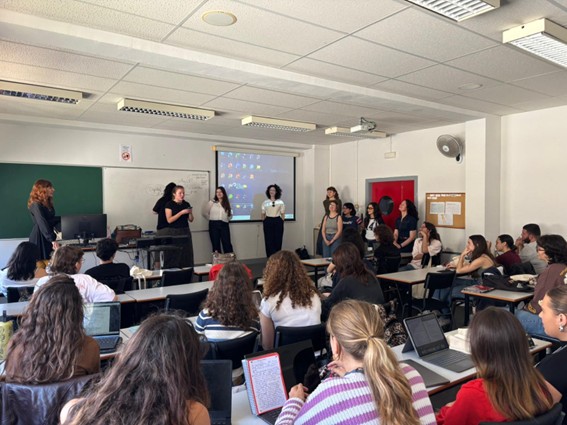
Photo 1: Debate between students from Paris 8 and the ULPGC
Among the activities undertaken, the group was received by the Tourism Analysis and Connectivity Unit of the Cabildo de Gran Canaria, which enabled the students to gain first-hand insight into the reality of the destination and enrich their analysis with an applied perspective.
They also took part in a discussion with first-year students on the Bachelor’s degree in Modern Languages at the Faculty of Philology, as part of the module ‘Audiovisual Narrative: Film and Television’, involving a collaborative project in English and Spanish. The topic of the debate was the digital nomad. Following a series of questions raised by the students from Paris 8 on this issue, a lively discussion ensued on the positive and negative consequences of living alongside digital nomads in our city and on our island. After the debate with the whole group, each student from the French university sat down with a small group from the class to discuss a topic also related to the figure of the digital nomad.
As a result of the seminar, the students produced a range of podcast content based on interviews with a diverse range of individuals, including local residents, professionals from the tourism sector, people involved in remote working, and representatives from the academic world. The director of web services at the ULPGC, José Miguel Santos, was interviewed specifically. These productions, which complement a previous data collection exercise in 2025, offer a multifaceted view of the status of digital nomads interacting within globalised and digital economies, reflecting current social changes.

Photo 1. Interview with Fernando Díaz, tourism analyst at the Gran Canaria Island Council
The seminar also provided a valuable opportunity to strengthen collaboration between the two universities and to foster academic and cultural exchange among students, in line with the objectives of the European Reform University Alliance.
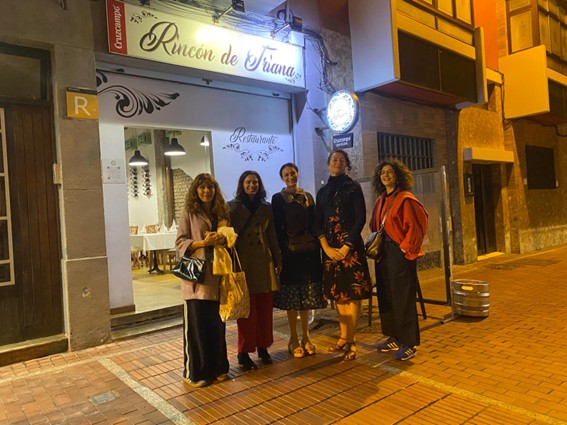
Photo 3. A meeting between Claire Bourhis, Marie Chagnoux and Yasmina Benbekai, lecturers at Paris 8, Carmen Luján, Director of Language Policy at the ULPGC, and Professor Margarita Sánchez.
Estudiantes de la ULPGC y Paris 8 participan en un Travelling Seminar sobre el actual impacto social y cultural de los nómadas digitales en Gran Canaria
La Universidad de Las Palmas de Gran Canaria, en colaboración con la Université Paris 8 Vincennes–Saint-Denis, ha acogido recientemente un Travelling Seminar, una iniciativa desarrollada en el marco de la alianza ERUA.
La actividad, impulsada desde la Dirección de Política Lingüística y el Vicerrectorado de Formación Permanente y Empleabilidad, ha permitido al estudiantado participar en un proyecto centrado en la memoria compartida, la interculturalidad y la creación de contenidos digitales a través del formato podcast.
Este Travelling Seminar forma parte de una iniciativa académica de carácter europeo que analiza el impacto de las nuevas dinámicas del trabajo, especialmente en contextos de digitalización sobre los territorios y las comunidades de acogida. Durante su estancia en Gran Canaria, las 8 estudiantes de los programas de Master (“Digital Communication and Project Management” y “Media Studies, Cultural Studies and Foreign Languages”) y 3 profesoras de Paris 8 desarrollaron un trabajo de investigación enfocado en las transformaciones sociales y territoriales asociadas a estos procesos.
Entre las actividades realizadas, el grupo fue recibido por la Unidad de Análisis Turístico y Conectividad de Turismo del Cabildo de Gran Canaria, lo que permitió al alumnado conocer de primera mano la realidad del destino y enriquecer su análisis con una perspectiva aplicada.
Asimismo, participaron en un debate con estudiantes de 1º del Grado en Lenguas Modernas en la Facultad de Filología, dentro del marco de la asignatura de “Narrativa Audiovisual: cine y televisión”, con un trabajo colaborativo en inglés y español. El tema del debate fue el del nómada digital. A partir de algunas preguntas que introdujeron las estudiantes de Paris 8 sobre esta cuestión, se estableció una animada charla sobre las consecuencias positivas y negativas de la convivencia con los nómadas digitales en nuestra ciudad y nuestra isla. Tras el debate con el gran grupo, cada estudiante de la universidad francesa se sentó con un pequeño grupo de la clase para hablar de un tema relacionado también con la figura del nómada digital.
Como resultado del seminario, los estudiantes elaboraron diversos contenidos en formato podcast a partir de entrevistas a perfiles variados, entre ellos residentes locales, profesionales del sector turístico, personas vinculadas al trabajo remoto y representantes del ámbito académico. Se entrevistó específicamente al director de servicios web de la ULPGC, José Miguel Santos. Estas producciones, que vienen a complementar una anterior recogida de datos en 2025, ofrecen una visión plural sobre el estatus de los nómadas digitales que interactúan en las economías globalizadas y digitales, reflejando cambios sociales actuales.
El seminario ha supuesto, además, una valiosa oportunidad para reforzar la colaboración entre ambas universidades y fomentar el intercambio académico y cultural entre el estudiantado, en línea con los objetivos de la European Reform University Alliance.