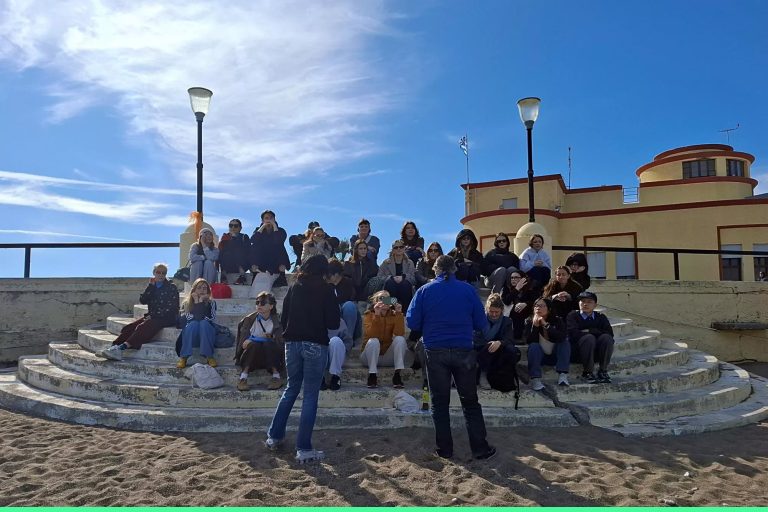
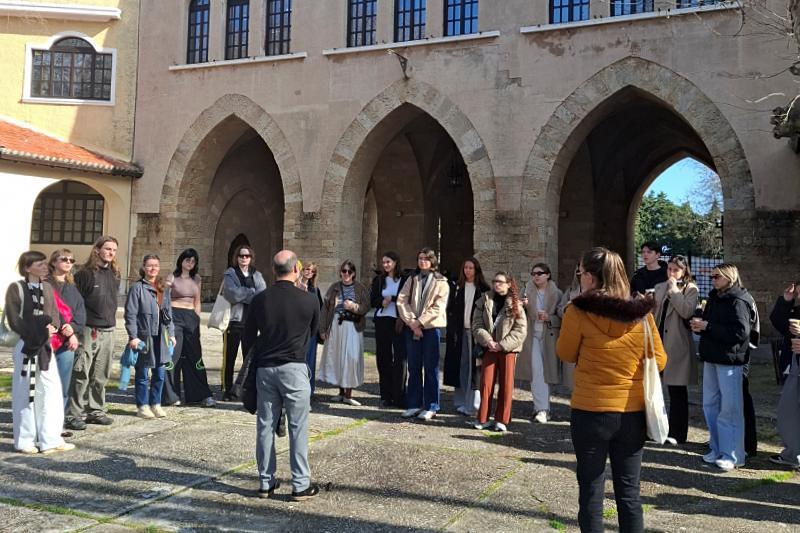
In late February, a group of 14 students from the Faculty of Design at SWPS University’s School of Form (SOF) participated in artistic research workshops on the island of Rhodes, in Greece. The travelling seminar was organized as part of the Innovative Teaching Initiatives program, coordinated by the European Reform University Alliance (ERUA). The project was the result of a collaboration between academics from SWPS University and the University of the Aegean (UAEGEAN).
International Collaboration: Bridging Research and Art
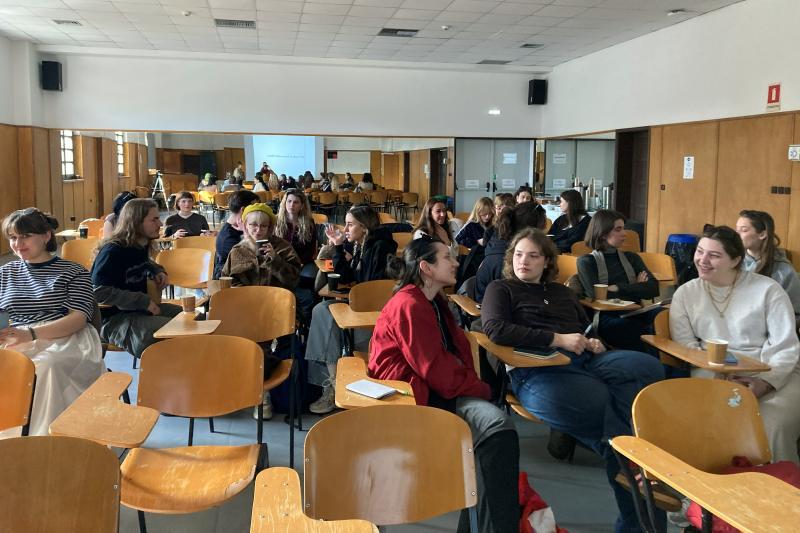
The workshops were held from February 23–27 at the University of the Aegean’s Laboratory of Research on Practical Philosophy. Professor Elena Theodoropoulou served as the project’s scientific coordinator, while the SWPS University (USWPS) delegation was led by Monika Rosińska, Ph.D., and Jolanta Starzak, M.Eng. Arch., from the Faculty of Design. Under the title “Practical Philosophy Seized by Arts & Vice Versa”, the program explored the intersection of philosophical inquiry, artistic practice, and contemporary urban studies.
This year’s session was tied to the broader project “Where Elements Meet – Artistic Research on City, Human and More-than-Human”. The participants used the investigation of urban boundaries and the relationship between human and non-human entities as their starting point. Students analyzed the various touchpoints within the urban ecosystem — mapping the connections between people, institutions, nature, and memory, as well as physical forces like light, air, water, and the moving bodies that inhabit the city.
The Four Elements as Research Tools
A defining feature of the workshop was the use of the four elements as cognitive tools. Rather than viewing gravity, water, wind, and light simply as physical phenomena, the group treated them as analytical lenses through which to re-examine architecture and human experience. This methodology drew inspiration from the research notebooks of the Warsaw-based design studio Centrala.
The program kicked off with a “Philosophical Objects” workshop. Under Professor Theodoropoulou’s guidance, students examined how everyday items can trigger deep philosophical reflection, exploring how physical matter can help us conceptualize the ties between humanity, space, and the senses.
The City as a Laboratory: Walks and Performances
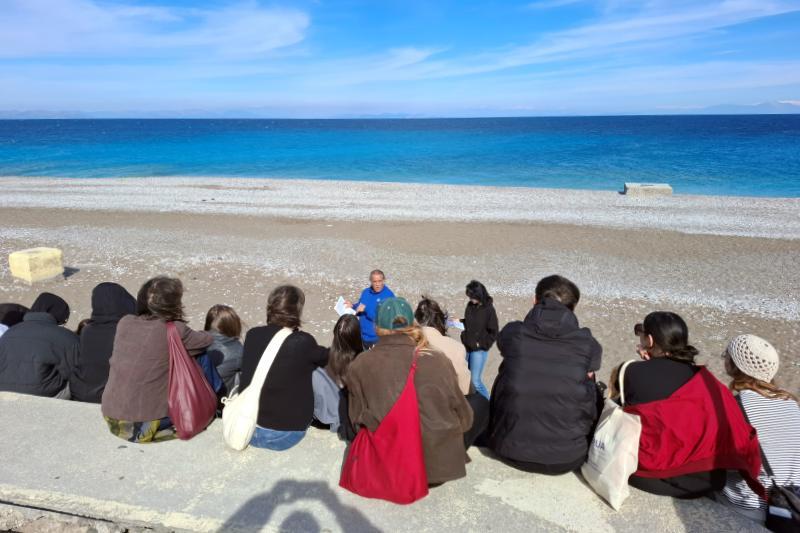
The experimental curriculum prioritized work in international teams. Central to this approach were walking workshops — guided explorations of Rhodes. These walks served as a primary method of “embodied cognition”:
- Sensory Mapping: Participants tuned into the city’s soundscape, gathered “found objects,” and produced “on-the-fly” sketches and field notes.
- Embodied Presence: During the “Shadowing the Shadow” and “Suspiria” workshops — led by Professor Wendy Wen-Shu Lai and artists Yu-Hsien Wu and Hao-Jen Chiang — students explored the body’s presence in space through movement and shadow play.
The group also took inspiration from the Fluxus movement, which seeks to erase the boundaries between art and daily life. Using the “One Minute Sculptures” method, students created fleeting, ephemeral sculptures using their own bodies and random objects, challenging them to break away from habitual ways of interacting with their surroundings.
From Land to Urban Voids
The academic program was structured into three thematic blocks, each supported by expert lectures:
- Between Water and Land: an exploration of the vital relationship between land and sea inherent to island life, led by Nikolaos Koumnakis
- Between Walls and Voids: an analysis of the tension between man-made architecture and urban “voids,” and how this dynamic shapes our perception of the environment, led by Professor Spyros Syropoulos
- Finding Meaning Through Objects: focus on objects as vessels of history and traces of human presence.
The intensive week concluded with a study visit to the Archaeological Museum of Rhodes. Using ancient sculptures as case studies, students analyzed how gravity and light dictate our perception of form and the relationship between an object and the space it occupies.
Looking Ahead: Publication and Lectures
A permanent record of the workshop is currently being developed: a unique, silkscreen-printed zine. This publication will feature a curated collection of objects, notes, and artistic traces documenting the entire research process.
In March 2026, Professor Elena Theodoropoulou will lead two sessions focused on expanding the concept of the “philosophical object,” specifically in relation to the students’ workshop findings and their work with One Minute Sculptures.
Funding
- European Reform University Alliance
The project is co-funded by the European Union.