
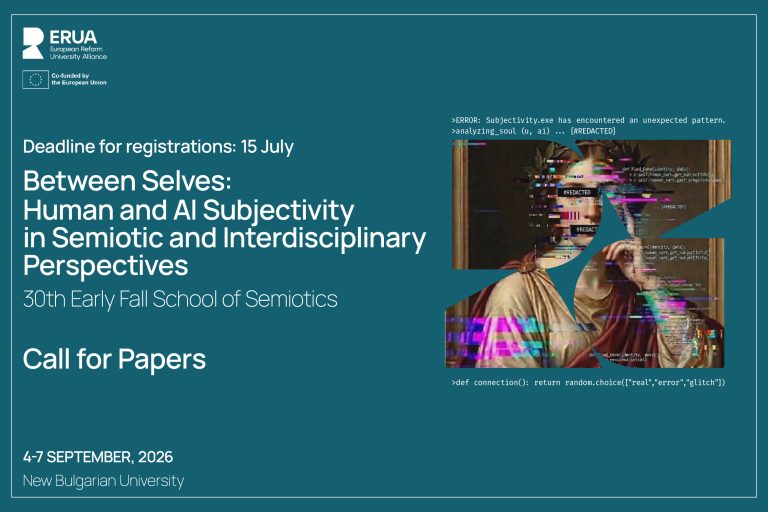
Dates: 4-7 September, 2026
Location: Sozopol, Bulgaria
The Southeast European Centre for Semiotic Studies and the New Bulgarian University invites you to take part in the 30th Early Fall School of Semiotics, to be held under the framework of WP3 of the European Reform University Alliance (ERUA2), and with the support of the STRATEGIC DEVELOPMENT FUND of New Bulgarian University.
The XXX edition of the Early Fall School of Semiotics (EFSS) is themed “Between Selves: Human and AI Subjectivity in Semiotic and Interdisciplinary Perspectives”. This year’s event will take place from 4th to the 7th September 2026 traditionally in Sozopol, Bulgaria.
The theme of the event is a continuation of the activities of the ERUA Research cluster “Artificial Intelligence and Creative Industry Employment Disruption (AICIED)”, but it’s open to participants from all partner universities, independently if they are part of this or other clusters, or work packages. It’s important that the researchers, PhDs and students are interested in exploring the evolving landscape of creativity and creative labor in the age of Artificial Intelligence.
Recent developments in generative artificial intelligence have reopened a fundamental question for semiotics, social sciences and the humanities: what does it mean to be a subject in a world where machines produce discourse, images, and narratives?
In his recent work Nati cyborg (2025), Claudio Paolucci argues that generative AI does not simply challenge human intelligence but rather reveals something essential about it. From a semiotic perspective, subjectivity emerges not as a stable inner property but as an effect of enunciation, produced through the assemblage of heterogeneous discursive instances—norms, stereotypes, institutional voices, and previously articulated statements. Generative AI systems appear capable of performing similar operations, assembling fragments of discourse in ways that produce the effect of a speaking subject, even in the absence of intentional consciousness.
Taking these insights as a starting point, this conference seeks to move the discussion beyond the now familiar debates about whether AI “understands” or “thinks.” Instead, we invite scholars to explore the liminal zones of interaction between human and artificial subjectivities, particularly those emerging in creative, playful, and unexpected generative performances.
Indeed, contemporary generative systems increasingly produce outputs that appear to transcend purely instrumental communication: visual artworks, fictional narratives, stylistic imitations, humorous exchanges, ironic commentary, speculative personas, or even simulated psychotherapeutic dialogues. These phenomena raise new semiotic questions about creativity, authorship, voice, and subjectivity in hybrid human–machine environments.
The organizers propose that such boundary cases of generative creativity may provide unprecedented opportunities for understanding both natural and artificial creativity. By examining how AI participates in processes traditionally associated with human subjectivity -imagination, narrative construction, aesthetic experimentation, irony, or introspective simulation, we may gain deeper insights into the semiotic mechanisms that underpin creativity itself.
This conference therefore invites contributions from semiotics, media studies, anthropology, cognitive science, law, psychology, digital humanities, AI studies, art theory, economics and creative business professionals, etc.
Possible topics include (but are not limited to):
- Semiotic theories of human and artificial subjectivity
- Enunciation and agency in generative AI systems
- AI and the semiotics of creativity
- Visual generativity and machine-produced imagery
- Narrative generation and artificial storytelling
- Stylistic imitation and “writing as someone else”
- AI humor, irony, and self-reflexive discourse
- Simulated personalities and psychotherapeutic dialogue with AI
- AI and the semiotics of imagination and fiction
- Hybrid creativity in human–AI collaboration
- Synthetic media and cultural production
- Business and copyright implications of artificial creativity
By focusing on creative, playful, and experimental uses of generative AI, the conference aims to illuminate a crucial question:
If subjectivity is a semiotic effect emerging from complex assemblages of voices, practices, and technologies, what new forms of subjectivity might emerge in the expanding space between human and artificial selves?
We welcome theoretical, methodological, and empirical contributions that explore these questions and help advance a new semiotics of hybrid creativity.
Selected papers will be published in the 10th issue of the journal Digital Age in Semiotics and Communication (ISSN, DOI, CEEOL)
Application
If you are interested fill in the Registration form
Deadline for registrations: 15 July
Registration fee: 40 Euro (50 for non IASS members, Free for participants from ERUA partner universities). All payments are made before the school or at the registration in cash. The fee includes:
- access to all lectures, workshops, seminars and round tables,
- badge and materials,
- 5-6 coffee breaks,
- A welcoming reception on 5 September
EFSS 2026 is organized by the Southeast European Center for Semiotic Studies and the NBU team of WP3 of European Reform University Alliance (ERUA2), with the support of the STRATEGIC DEVELOPMENT FUND of New Bulgarian University
Funding:
ERUA participants can receive travelling and accommodation funding from their home universities! For more information related to traveling and funding opportunities contact your local ERUA coordinator.