
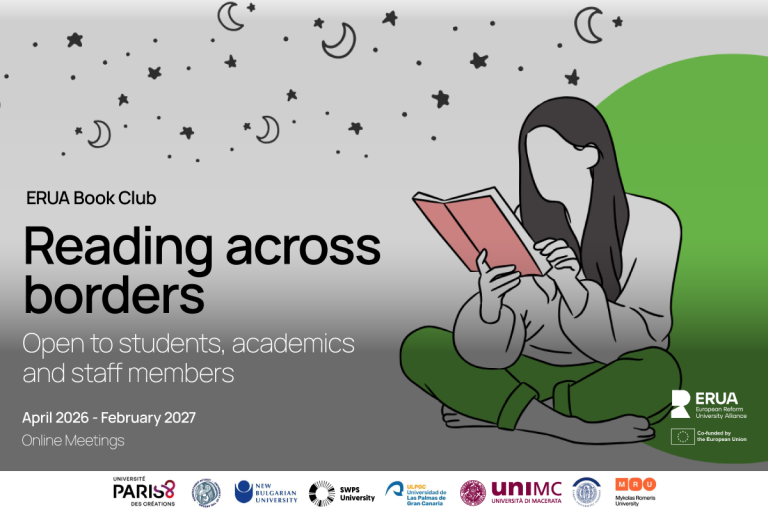
ERUA is launching a new student-led initiative, the ERUA Book Club “Reading Across Borders” (EURAB).
This idea was born from an informal ERUA event where students gathered and discussed their personal interests and hobbies. The wish for a place to bond, exchange opinions and have fun together through literature and culture was strong and students from Macerata, joined and helped by their colleagues from the other Universities of the Alliance, made it happen.
Through the virtual space of EURAB, ERUA fosters intercultural dialogue, critical thinking and collaborative learning across European Universities. Students, academics and staff members from all partner Universities are invited to join and engage in meaningful discussions about literature, culture and contemporary issues through the shared experience of reading. The participants will read one book chosen by each ERUA member University taking part in the project and discuss together once finished reading the book. The books can be read in English or, if available, in the preferred language.
The calendar of the ERUA Book Club is as follows:
- 1st meeting in April: “The Enchanted April” by Elizabeth Von Arnim (UniMC)
- 2nd meeting in May: “Time Shelter” by Georgi Gospodinov (NBU)
- 3rd meeting in July: “The Pull of the Stars” by Emma Donoghue (EUV)
- 4th meeting in September: “My Life on the Road” by Gloria Steinem (UAEGEAN)
- 5th meeting in November: “As Long As the Lemon Trees Grow” by Zoulfa Katouh (UP8)
- 6th meeting in December: “1984” by George Orwell (MRU)
- 7th meeting in February 2027: “The Book Thief” by Marcus Zusak (UPLGC)
Specific meeting dates and times will be shared with the participants throughout the year.
If you want to join fellow students, academics and staff members from all over ERUA in this adventure through the world of literature, sign up here!