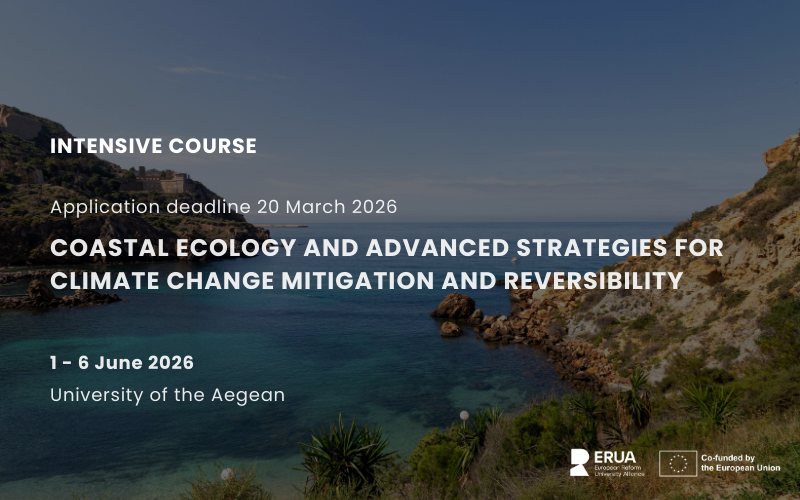
The University of Las Palmas de Gran Canaria (ULPGC) in collaboration with the University of the Aegean (UAegean) is organizing an Intensive Course under the title “Coastal Ecology and Advanced Strategies for Climate Change Mitigation and Reversibility”.
It will focus on the current coastal ecosystem challenging with regards to climate change.The course is aimed at any university student in the fields of ecology, sustainability, climate change or environmental governance.
The course is coordinated by Professor Rodrigo Riera Elena and the research group BIOCON (ULPGC). It will take place from 1st to 6th June 2026 in Lesvos (Greece) and will combine advanced scientific training with fieldwork oriented to decision-making and coastal management.
Course Content
During five days (5 – 6 daily hours), the programme will intensely delve into the littoral ecosystems’ transformation, directly impacted by global changes. It will also explore both fundamental ecological processes and innovative strategies for mitigation and restoring.
The course is structured into five main topics:
- Ecological transformations and turning points in coastal ecosystems
- Nature-based strategies for climate mitigation
- Ecological restoring and the reversibility of impacts
- Resilience and multi-level governance
- Drafting of applied proposals through policy briefs
By attending interactive sessions, analysing cases in the Mediterranean, participating in collaborative workshops and doing field trips in Lesvos, participants will engage in international teams to develop proposals based on scientific evidence in order to tackle real challenges in coastal management.
As a final assessment, each group will present a policy brief where they will address specific recommendations to policymakers and environmental managers.
Learning Outcomes
Following completion of the course, students will:
- Analyse from a critical perspective scientific literature specialized in coastal ecology.
- Identify ecological thresholds and apply resilience indicators
- Design mitigation and restoring strategies adapted to local circumstances
- Work effectively in international groups
- Present scientific results formatted for public policymakers.
Apart from developing these advanced scientific skills, the course fosters soft skills such as critical thinking, collaborative work and science-policy communication.
Methodology and assessment
The methodology is based upon the learning by doing approach, hence including:
- Interactive sessions
- Analysis of real cases
- Collaborative design workshops
- Guided debates and simulations
The assessment will be based on active engagement and participation, meaningful contribution to workshops and the drafting of policy brief, along with the final presentation.
Who Can Apply
The course is aimed at any university student in the fields of ecology, sustainability, climate change or environmental governance.
Total number of places: 30 students
- 20 UAegean students
- 10 students from other ERUA institutions
How to apply:
Applicants should submit to islands@ulpgc.es:
• Short motivation letter (max. 200 words)
• Confirmation of student status
• Short CV
ERUA students can receive travelling and accommodation funding from their home universities! For more information related to traveling and funding opportunities contact your local ERUA coordinator.
Course Coordination