Course description
During this intensive course students will be introduced to Italian 19th and 20th century main historical events and main cultural themes through an interactive and somehow non-conventional comparison between three “pairs” of outstanding Italian authors:
- Giacomo Leopardi versus Alessandro Manzoni (early 19th century);
- Luigi Pirandello versus Italo Svevo (late 19th and early 20th century);
- Giuseppe Ungaretti versus Eugenio Montale (first and second half of the 20th century).
The course is organized around 4×2 hour morning sessions and 4×3 hour afternoon sessions.
The 4th, 5th and 6th May morning sessions will be focused on a non-conventional introduction to these three “pairs” of authors and their involvement with Italian history, culture and society.
Each respective afternoon will be focused on an interactive analysis of a selection of their texts (English translation) on a project-based learning where students will share their point of view on a “if I were…” basis.
Since these authors lived in many different cities/towns and areas of Italy, while following their literary paths, students will get a substantial glimpse into the varied Italian regional reality.
The last morning session (7th May) will be dedicated to a guided tour of Macerata where we will look for traces of 19th and 20th century literary and historical events (in order to reduce carbon footprint, this will be a walking tour. In case of mobility issues, the itinerary will be suitable for wheelchairs/walking aids).
On the last afternoon session (7th May) we will review short group power-point presentations made by students and focused on chosen topics concerning this course.
Individual support will be ensured for students with disabilities in collaboration with the services for inclusion and the right to education of the University of Macerata.
The lessons are scheduled as follow:
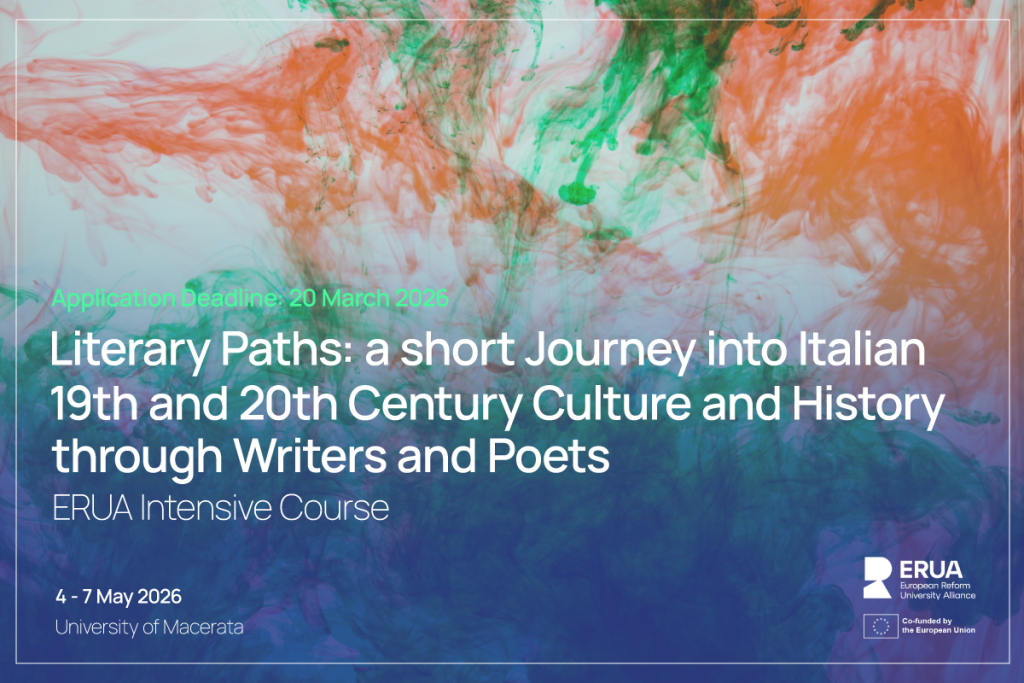
- Monday 4th of May 2026: 10:00-12:00; 14:00-17:00 (CET);
- Tuesday 5th of May 2026: 10:00-12:00; 14:00-17:00 (CET);
- Wednesday 6th of May 2026: 10:00-12:00; 14:00-17:00 (CET);
- Thursday 7th of May 2026: 10:00-12:00; 14:00-17:00 (CET).
Learning outcomes
Students from ERUA Universities will bring to this initiative their cultural heritage, their point of view on Italy, their curiosity to get to know Italian history, culture and literature, their opinion on the interaction between Italy and other European cultures.
We aim to develop the students’ knowledge of Italy on a no stereotyped and no conventional basis and to make them understand the role of 19th and 20th century Italian literature and history into a wider European context. We also aim to talk about lesser-known facts concerning Italy, so that, through their participation, students will enrich and maybe partially change their point of view on Italy.
Assessment methods
Short presentation of group works on a chosen course topic.
Who can apply?
The course is open to 25 Bachelor and Master students from ERUA universities. Applicants should have a good level of English (B2).
A general knowledge of European modern and contemporary history and culture are appreciated as it is appreciated an interest in European literature.
How to apply
Apply by 20th March 2026, filling in the following form: https://docs.google.com/forms/d/e/1FAIpQLSdrUtUPR0BzwTinwgfxXOoObWtqnY4LLyFJun0vNxdFL0Gg0g/viewform?usp=header
For any further info, please contact: tobia.ciarrocchi@unimc.it