Course Description
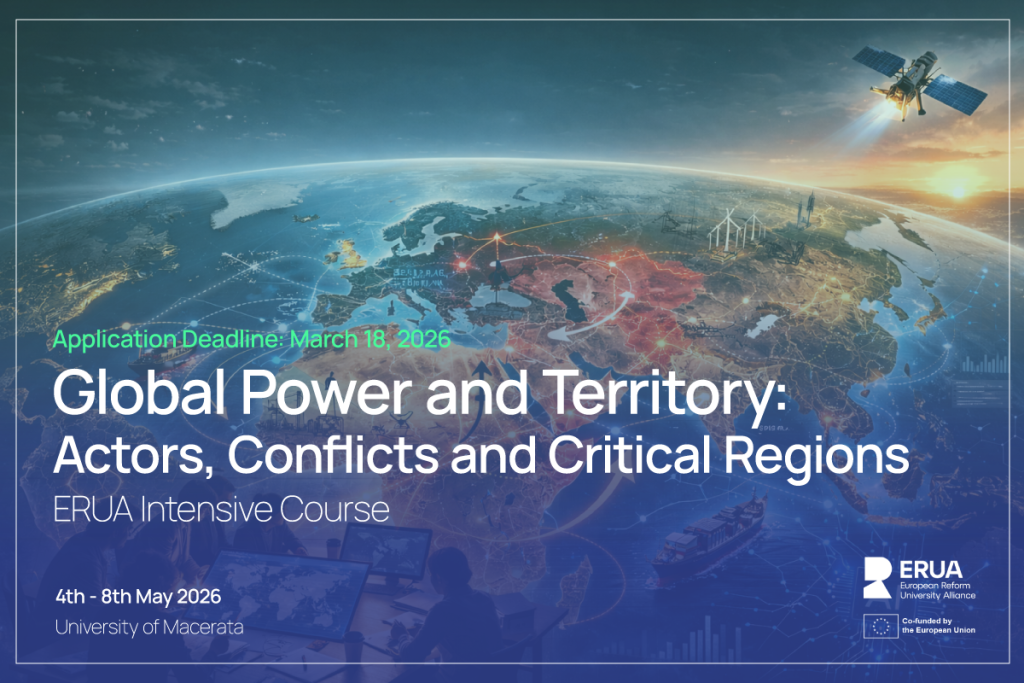
This ERUA Intensive Module investigates the geopolitical transformations shaping today’s world through a spatial, territorial and comparative perspective. It analyses how global and regional powers interact across key critical regions — including Eastern Europe, the Mediterranean, the Middle East, the Sahel, and the Indo-Pacific — and how borders, resources, infrastructures, and strategic corridors structure global competition. Alongside traditional geopolitical approaches, the module integrates an applied AI component, offering students a non-technical introduction to how artificial intelligence is increasingly used in geopolitical analysis, conflict prediction, crisis monitoring, risk assessment, resource mapping, and foresight studies. The AI section enhances critical thinking rather than focusing on technical skills, helping students understand opportunities, limitations, and biases of AI-driven geopolitical tools.
The learning experience combines lectures, interactive discussions, thematic case studies, simulations of diplomatic negotiation, scenario-building exercises, and an applied Geopolitical Policy Lab. Students from different ERUA universities collaborate in mixed groups, promoting intercultural dialogue and cross-national perspectives.
Programme- 5 Days
Day 1 (Monday 4th of May)– Power, Territory and the Foundations of Geopolitics
- Theoretical foundations: classical and critical geopolitics
- Territory, sovereignty, networks, multipolarity
- Introduction to AI for geopolitical analysis: concepts, limits, opportunities
- Workshop: mapping global power configurations
- Group formation
Day 2 (Tuesday 5th of May) – Borders, Conflicts and Regional Competition
- Geopolitical borders: interfaces, frontiers, buffer zones
- Regional security architectures: EU, NATO, Russia, Eurasia
- Case study: the Ukraine conflict and European security
- Applied AI: indicators of instability and conflict risk
- Simulation: negotiating contested border regions
Day 3 (Wednesday 6th of May) – Resources, Energy and Strategic Infrastructures
- Geopolitics of energy, rare materials, and critical resources
- Infrastructure power: ports, corridors, choke points
- Competing routes: IMEC, BRI, Arctic passages, Indo-Pacific
- Workshop: geoeconomic and geospatial mapping tools
- Applied AI: analysing resource and infrastructure datasets
Day 4 (Thursday 7th of May) – Mediterranean and Middle Eastern Power Shifts
- Strategic importance of the Mediterranean
- Actors: EU, Turkey, Israel, Egypt, Gulf states, North Africa
- Migration geopolitics and crisis regimes
- Water politics, climate security, and environmental stress
- AI-supported scenario lab: forecasting regional outcomes
Day 5 (Friday 8th of May) – Geopolitical Policy Lab (Capstone Project)
- Mixed-group work: regional policy brief
- AI-assisted scenario development (comparative strategies)
- Group presentations and peer feedback
- Final reflection and conclusions
- Certificate ceremony
Learning outcomes
By the end of the module, students will be able to:
- Analyse geopolitical dynamics through territorial and spatial frameworks
- Interpret current conflicts and power shifts across critical regions
- Assess how resources, infrastructures and corridors shape global strategies
- Understand how AI tools contribute to geopolitical analysis and foresight
- Evaluate benefits, risks and biases associated with AI-based geopolitical indicators
- Produce a concise, evidence-based geopolitical policy brief
- Work collaboratively in international and interdisciplinary teams
- Communicate geopolitical findings through oral and written formats
Assessment methods
Active participation (20%)
Group geopolitical policy brief (50%)
Oral presentation (30%)
Who can apply?
Will be given priority to Master’s students with a background in Geography, Political Science, International Relations or a related discipline. Students should meet the following requirements:
- English proficiency B1/B2;
- Background in geography, political science, IR, area studies, environmental studies, or related fields;
- Motivation to work in international and interdisciplinary teams.
No technical knowledge of AI required (AI tools are introduced at an accessible level)
How to apply
Apply by 18th March 2026, filling in the form at the following link: https://docs.google.com/forms/d/e/1FAIpQLSesn6as-PeZzZVB1SucjdbBzjdn2R9UbMXD7Alr-N8ESTjqqA/viewform?usp=header