What does a professionally investigated crime scene look like? How should evidence be properly collected, documented, and preserved to ensure it is admissible in court?
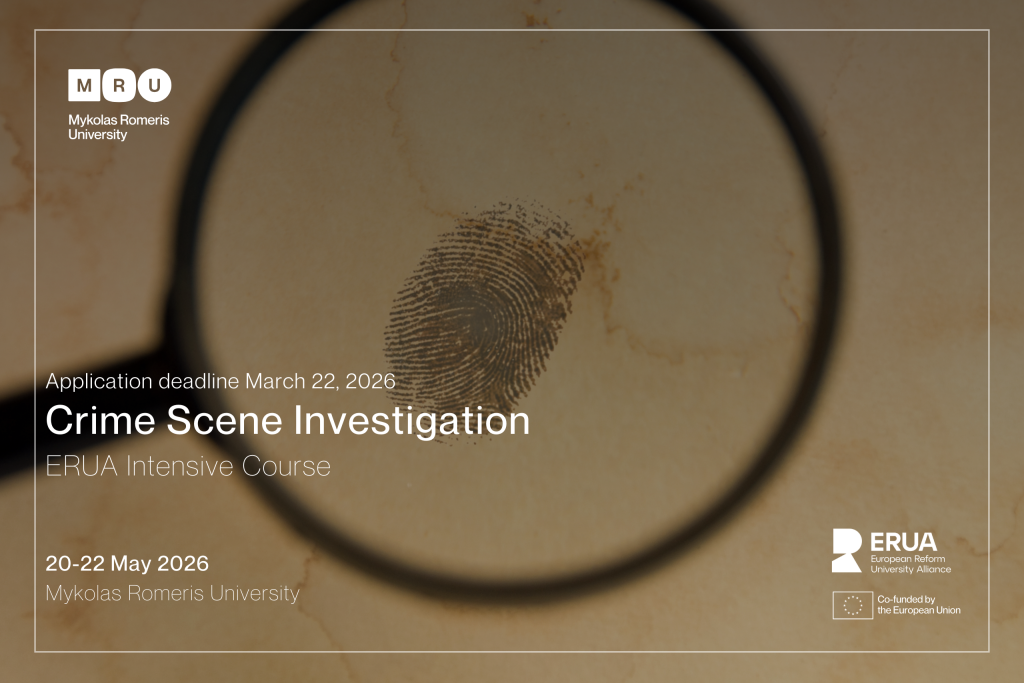
The Public Security Academy of Mykolas Romeris University (MRU) invites Bachelor’s and Master’s students from ERUA partner universities to participate in the international intensive course “Crime Scene Investigation”, which will take place from 6 to 22 May 2026.
This practice-based course offers not only theoretical foundations of crime scene investigation but also hands-on experience with a simulated crime scene, allowing participants to collect evidence and prepare a professional crime scene photo report.
The course will be delivered in a hybrid format, combining online lectures with on-site practical activities in Vilnius.
Course Dates and Structure
Online Component (6–8 May 2026)
- 6 May (up to 2 hours) – Introductory meeting: presentation of ERUA partners, course aims, and assignments.
- 7 May (up to 2 hours) – Lecture: “History of Criminalistics and Crime Scene Investigation”.
- 8 May (up to 4 hours) – Lecture: “Criminalistic Photography at Crime Scene” and an individual independent assignment.
On-site Component (20–22 May 2026)
- Day 1
Evidence search and preservation at the crime scene: fingerprints, shoeprints, break-in traces, odorological and biological traces. Video recording at the crime scene. - Day 2
Investigation of a simulated crime scene. Students will work in groups of four. Each group will investigate a prepared simulated crime scene: collect, document, and preserve evidence, take photographs, and prepare a crime scene photo report and presentation. - Day 3
Final group presentations. Evaluation of whether evidence was collected and packaged according to procedural rules, followed by discussions, feedback, and final assessment.
Course Content
The course is designed to provide and deepen knowledge of crime scene investigation: searching, collecting, documenting, and analysing different types of evidence (fingerprints, shoeprints, break-in traces, biological and other traces).
The following aspects will be explored:
- Protecting the crime scene;
- Recording and detailed examination of the scene;
- Initial evidence collection and packaging;
- Processing the scene for latent prints;
- Maintaining the chain-of-custody;
- Development of investigative versions.
The course will be led by experienced lecturers who will share practical insights and support students in developing professional skills for a future career in criminal justice.
Learning Outcomes
Participants will:
- Learn the basic principles of crime scene investigation;
- Develop a deeper understanding of the importance of crime scene security and prevention of biological contamination;
- Be able to use forensic science tools and technologies applied in crime scene investigation;
- Carry out a proper examination of a crime scene independently and as part of a team, and solve problems related to trace recovery;
- Understand the importance of cooperation between a crime scene investigator and a pre-trial investigator.
Assessment and Credits
The course awards 3 ECTS credits.
Assessment is based on formative feedback from teachers and peers.
Final assessment consists of:
- Individual presentation of a theft scene photo report – 30%;
- Final group presentation – 70% (quality of evidence packaging and the presented crime scene photo report).
Target Group
BA and MA students in law, criminal justice, criminology, public security, forensic psychology, and related fields.
Requirement: English language level B2 or higher.
Number of places for ERUA students: 16.
Registration is open until 22 March 2026. A motivation letter (up to 300 words) must be submitted as part of the registration process.
Apply via the ERUA application system here.
Please follow the official MRU application instructions for ERUA Short Programmes here.
Selection will be based on academic background, motivation, and demonstrated interest in crime investigation and criminal justice.
Selected participants will be informed by the end of April.
Participation is open to ERUA students only. Travel and accommodation costs may be funded by the student’s home university.
Contact Person
For further information, please contact the course coordinator:
Assoc. Prof. Dr. Janina Juškevičiūtė, janina@mruni.eu