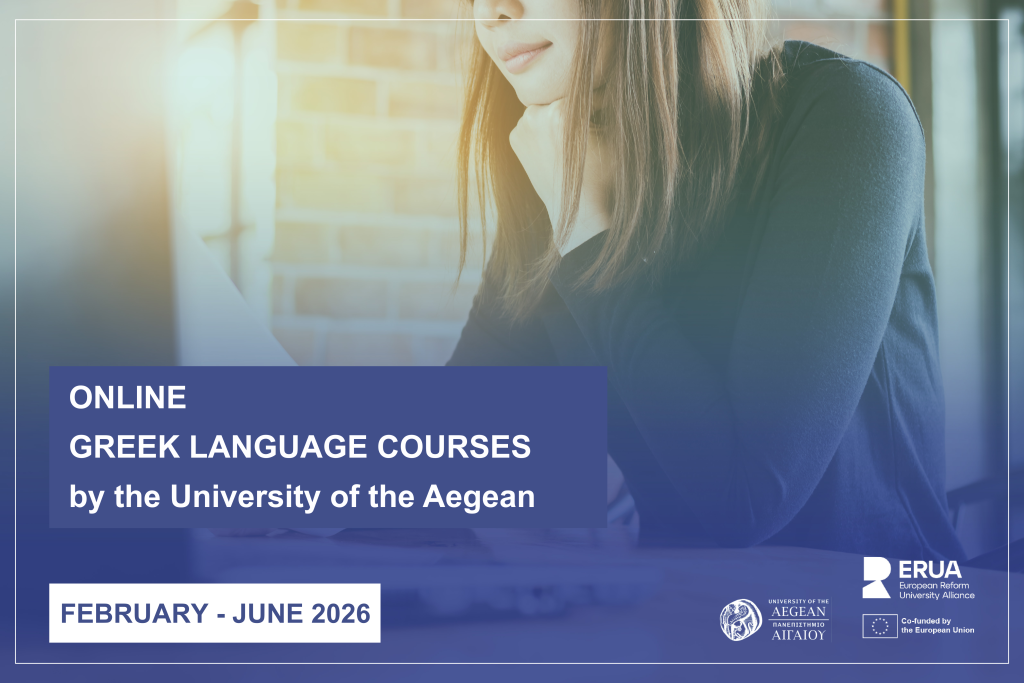
The University of the Aegean, through its Centre for Lifelong Learning (K.E.DI.VI.M.), announces a new cycle of the programme “Learning Greek at the University of the Aegean”.
Designed primarily for incoming Erasmus students, and piloted for additional participants who wish to learn Greek as a foreign language, at beginner level (A0–A1), the programme offers a structured and intercultural introduction to modern Greek language and culture. Upon completion of the programme, learners will understand the basic structures of Modern Greek, recognise and use the Greek alphabet, and apply fundamental conventions of written Greek. They will be able to communicate in simple everyday situations, ask and answer basic questions, form short and simple sentences, and understand brief spoken and written texts such as announcements, signs, and short messages. At the same time, participants will develop a positive attitude towards the Greek language and culture, while enhancing their intercultural awareness and appreciation of multilingualism.
Overview | Download Course Schedule | Apply here!
- Duration: February – June 2026
- Total workload: 100 hours
- Credits: 4 ECTS
- Cost: Free of charge
- Delivery mode: Online (asynchronous material via Moodle & synchronous online sessions)
Course Structure
The programme includes five thematic units, each combining study materials, practical activities, and one live teleconference session. Educational materials are uploaded regularly to the Moodle platform and include structured study texts, PowerPoint presentations, grammar and vocabulary guides, online quizzes, and short assignments covering all four language skills.
Thematic areas:
1.Introduction to Modern Greek
Greek alphabet and key elements of the language’s history
2.Me and Others
Introductions, family, studies, professions
3.Daily Activities
Transport, weather, cafés, shopping
4.Social Organisation
University life, public and health services
5.Modern Greek Culture
The Aegean islands, cultural events and artistic activities
Assessment & Certification
Assessment is based on online quizzes, self-assessment activities, active participation in live sessions, and short assignments covering the four core language skills (speaking, writing, listening, and reading). Participants who successfully complete the programme will receive a Certificate of Training worth 4 ECTS credits.
Technical Requirements
To participate in the programme, learners are required to have a modern computer equipped with a microphone, speakers or headphones, and a camera, as well as a stable internet connection, with a minimum recommended speed of 4 Mbps.
Elibility & Applications
Any member of the ERUA universities (Students, Researchers, Teaching & Administrative Staff) can participate in this language course. There are up to 15 spots reserved for ERUA members. To join the course, please submit your interest by filling in the online form you will find here.
For further information, please contact Iliana Papatheodorou at papatheodorou@aegean.gr
This initiative contributes directly to the multilingualism objectives of the European Reform University Alliance (ERUA), reinforcing the alliance’s commitment to linguistic diversity, intercultural dialogue, and inclusive academic mobility. By expanding access to Greek as a second/foreign language, the programme supports ERUA’s vision of a genuinely multilingual European Higher Education Area, where language learning serves as a catalyst for deeper cultural understanding, equitable participation, and stronger collaboration across partner universities.