Rhetoric is not just an ancient philosophical topic: it is the art of persuasion and the crafting of speeches that can shape reality. Starting with Plato’s dialogues (especially Gorgias and Menexenus) this course explores the origins of the debate on rhetoric, emphasising that the issues raised by Greek philosophers – such as the relationship between truth and persuasion, and between ethics and language – remain highly relevant today.
In a world dominated by digital communication, social networks and storytelling, Plato’s questions are still valid:
- Where does informing end and manipulating begin?
- How can an effective speech be constructed without compromising the truth?
- How can rhetoric be used as a tool for civic and professional responsibility?
Course organisation
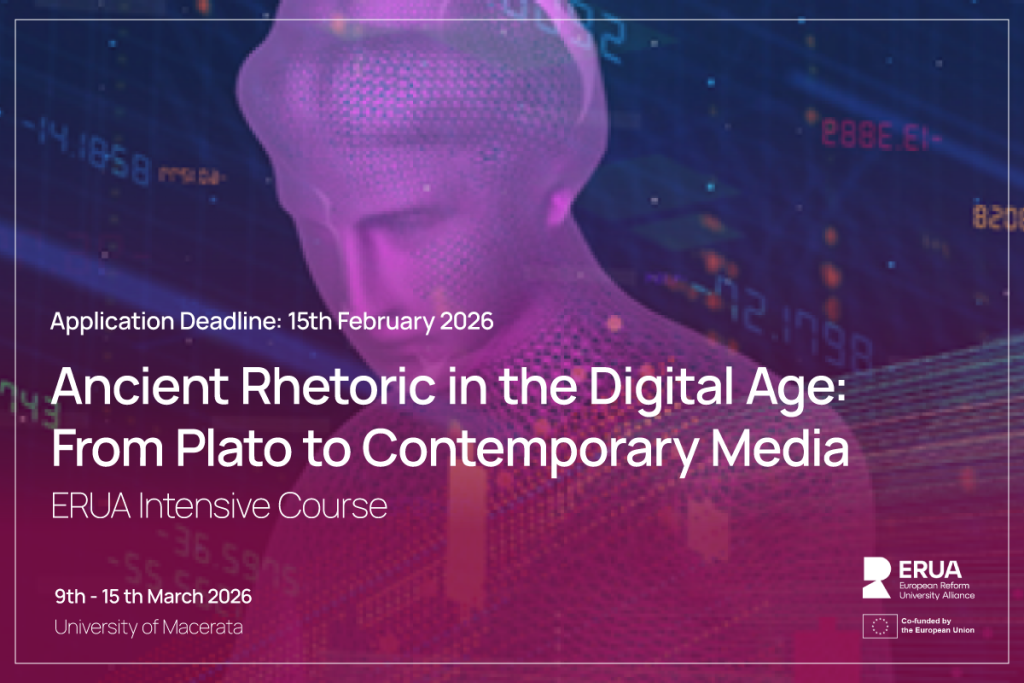
The course will last one week (from 9 to 15 March 2026) and will be structured as follow:
- 8h classes,
- 8h workshop,
- 2h sharing of the workshop results;
- 7h guided tour of Macerata’s historical centre, with its highlights (such as the Sferisterio Arena and the Civic Tower) and museums (such as he Civic Museums of Palazzo Buonaccorsi and the Palazzo Ricci Museum – Italian Art of the Twentieth Century).
Lectures: This intensive course begins with a series of lectures (both in person and online). These are part of two courses within the Bachelor’s degree in Philosophy: “History of Ancient Thought”, focusing on Plato’s Gorgias, by Dr Lucia Palpacelli, and the seminar “Barbarians and Foreigners in the Ancient Greek World: A Historical-Philosophical Perspective”, by Dr Federica Piangerelli. The lectures will provide students with a theoretical exploration of fundamental ancient rhetorical texts and concepts, with a particular look at Plato’s Gorgias and Menexenus.
Workshop: This intensive course also includes a workshop section. Attendance in person is required. Following on from Plato’s thoughts on rhetoric, students will compose hypothetical public speeches on contemporary issues such as democracy and human rights, inclusion and gender equality, and migration, exile and refugees. One group will be tasked with developing an example of “noble rhetoric”, combining communicative effectiveness with ethical value. Another group will engage with “base rhetoric” to understand the mechanisms of manipulation and learn to recognise them. Thanks to this intertwining of theory and practice, studying ancient texts also provides an opportunity to reflect on dynamics that are still relevant in contemporary communication, as well as offering hands-on experience in analysing and composing public discourse.
The course includes a guided tour of Macerata. Attendance is compulsory.
Learning outcomes
The course provides the theoretical and practical tools needed to understand and apply the rhetorical tradition to today’s communication challenges, ranging from public speaking and marketing to politics and digital media.
Key knowledge, skills and competences provided by students:
- Cultural and social knowledge across different countries, enabling comparative perspectives on key contemporary issues such as democracy, human rights, inclusion, gender equality, and migration.
- Ability to read and understand complex texts in English.
- Ability to communicate effectively in writing and orally in international contexts.
- Ability to work collaboratively within an intercultural team.
- Interest in ethical and persuasive communication
- Critical thinking and an openness to diverse cultural and social perspectives.
Main learning outcomes:
- Deepened knowledge of Plato’s rhetorical theories (focus on Gorgias and Menexenus) and their relevance to contemporary public discourse.
- Provide the critical tools needed to interpret the present by relating classical debates to contemporary communication dynamics.
- Develop the ability to analyse and produce public discourse and learn to distinguish between ethical and manipulative communication practices.
- Increase awareness of language as a tool for social responsibility that is valuable in both civic life and communication-related professions.
- Improved intercultural communication and teamwork skills in the context of public speaking and debate.
- Practical experience in analysing, debating, and presenting complex ideas in public settings.
Assessment methods
Oral exam
Who can apply
The course is open to 21 ERUA Bachelor students. Is requested a basic knowledge of ancient philosophy.
How to apply
Apply by 15th February 2026, filling in the form.