
Good morning to everyone across our eight partner universities,
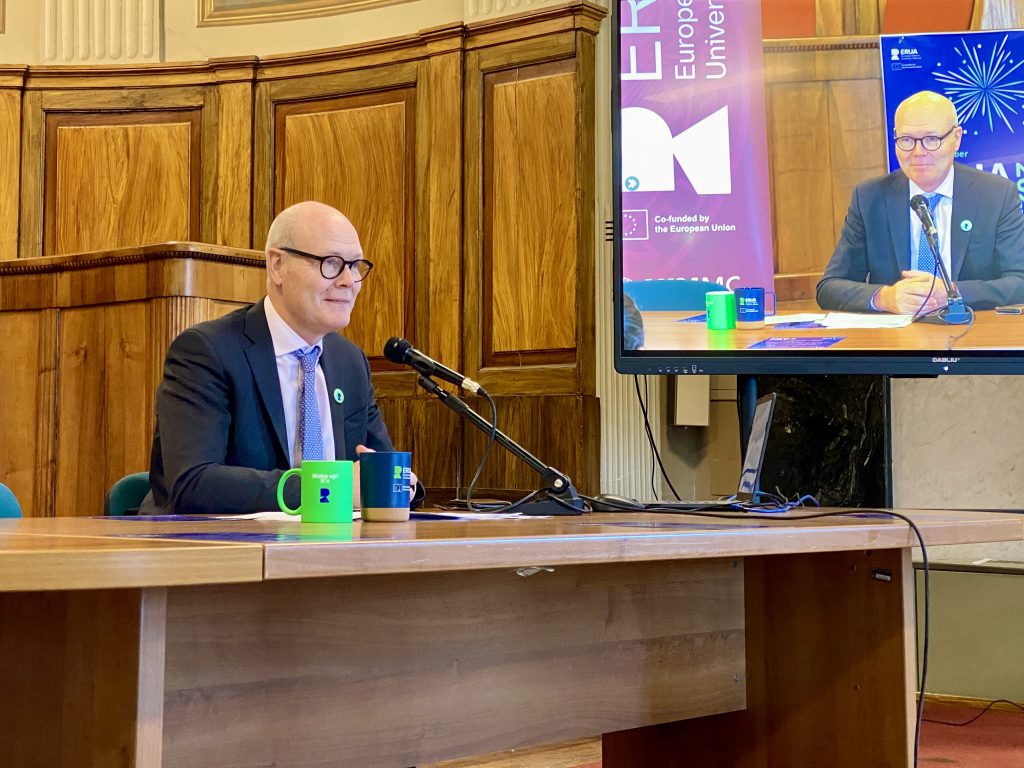
From Macerata—one of Europe’s oldest university cities—I wish to send you a warm greeting on this our second official ERUA day. Even though we are in different places, speak different languages, live in different time zones, and experience different daily realities, we are connected right now by something very European: the choice to build together.
As President of the ERUA alliance, I am proud to speak to you today not only about what we have done, but about what ERUA represents—and why it matters.
ERUA was created with a clear conviction: that Europe is not built only in treaties and institutions, but also in classrooms, libraries, laboratories, theatres, city squares, and in the relationships we form when we listen and learn from one another. Europe is not only built outwards from the centre but to cohere must be built also from the edges. We are eight universities, mostly dotted around the edges of Europe, with different histories and profiles, yet united by a common mission: to put our students at the centre of education and research, and to put dialogue at the centre of our European identity.
In a time when many forces push societies to close in on themselves, to erect barriers—when polarisation grows, when mistrust spreads easily, when the future can feel uncertain—ERUA stands for the opposite movement. We stand for opening. For bridge building. For listening. For collaboration. For the patient work of understanding.
And we are not only speaking these values; we are turning them into reality.
Over these 2 years, ERUA2 has made important steps forward. We have become much more than a label or a project. We have become a community. We have built a shared space where students, teachers, researchers, and professional staff can move—intellectually and physically—across borders. We are creating new opportunities for learning and teaching together: joint courses, shared programmes, innovative teaching programmes, and blended formats that make international experience more accessible.
We have developed collaboration that goes beyond mobility. We are strengthening research networks, connecting teams and ideas, and encouraging interdisciplinary approaches—because the challenges Europe faces do not come in neat academic categories. Climate transitions – as highlighted in the recent student manifesto, migration, digital transformation, democratic resilience, social inclusion, cultural heritage: these demand that we think across fields and across countries.
We have also learned something essential: that alliances like ours thrive when they connect not only universities to universities, but universities to society. ERUA’s work has reached outward—toward cities and regions, toward cultural institutions, schools, enterprises, public administrations, and civil society.
Most of all, we have created trust. And this trust has also produced something less visible and even more valuable: a shared mindset. A shared European academic culture based on cooperation rather than competition, on solidarity rather than isolation.
This is why ERUA matters.
Because Europe is built not only through large structures, but through small building blocks—strong, connected, resilient units that can hold weight. ERUA is one of those building blocks.
We are “small” in the best sense: close enough to remain human, agile enough to innovate, and diverse enough to be truly European. We can test new ideas, create models, share solutions, and show that European integration can be concrete—felt in the everyday life of our students and colleagues. That is why we are the Alliance that puts REFORM at the centre of its collective mission.
The next phase of ERUA is not simply “more activities.” It is deeper integration and greater impact.
It means making the European experience a normal part of the lives of our students. It means strengthening the quality and recognition of what we do together, so that learning across ERUA is seamless, valued, and transformative.
To the students who may hear this, let me say: ERUA is not only for you; it is also yours. You are not simply participants; you are co-creators. When you study in another ERUA university, when you join a joint project, when you work with peers from other countries, you are doing something powerful: you are practicing Europe.
And to our colleagues—faculty, researchers, and staff—thank you. ERUA exists because of your efforts, your professionalism, your belief that collaboration is worth it. Many of you have gone beyond your job descriptions, and you have done so with generosity. Not least, in recent months and weeks, to make sure that the mid-term report was completed.
Europe is often described as an “idea.” But ideas need homes. ERUA is one of those homes—built room by room, relationship by relationship, project by project. It is not finished, it is a valuable work in progress.
Italians often use the phrase “Se vuoi andare veloce, vai da solo; se vuoi andare lontano, vai insieme.” “If you want to go fast, go alone; if you want to go far, go together.” That is what we have chosen to do. And we will go far – together.
Let’s all stay committed as we say goodbye to 2025 and look to further important steps forward in the New Year.
Happy Erua day!