
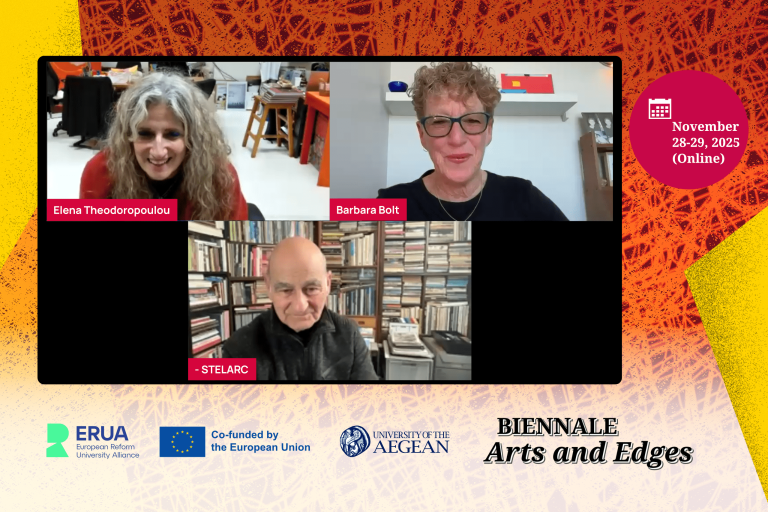
The University of the Aegean successfully hosted online the first ERUA Biennale “Arts & Edges”, on 28–29 November 2025. The event highlighted the UAegean’s and ERUA’s central role as a hub for interdisciplinary research, creative expression, and meaningful connections between academic knowledge and both local and international communities.
The Biennale showcased the many ways in which art and academic research can interact productively, addressing themes such as migration, borders, ecological transition, democracy and its vulnerabilities, inclusion and accessibility, multilingualism, and interculturality. Furthermore, it cultivated a substantive framework for dialogue, one that enables participants to move beyond established boundaries and explore new forms of collaboration among universities, artists, researchers, and social actors.
Through the organization of the Biennale, the University of the Aegean emphasized its identity as an institution operating at both a geographical and symbolic “edge”. Its location at the borders of Europe positions UAegean at the heart of discussions on the notion of the periphery, enabling it to act as a bridge between different experiences, narratives, and scholarly approaches.
Over two days, the Biennale presented a rich programme of talks, workshops, presentations, and discussions, gathering more than 100 active participants from across Europe and beyond. The active involvement of distinguished scholars, artists, and researchers underscored the high quality of the event and strengthened ERUA’s academic and artistic mission.
Professor Elena Theodoropoulou, Chair of the Scientific and Organising Committee, noted that the Biennale evolved into a vibrant new space for theoretical, artistic, and research exchange, a place where ideas can be co-shaped, interact, and grow.
The 2025 Online Biennale serves as a prelude to the in-person “Arts & Edges” Biennale that will take place in 2027. The upcoming edition will build on this year’s achievements, placing even greater emphasis on collaboration, creativity, inclusion, and experiential engagement, drawing on the insular aspect as a living example of both the challenges and opportunities inherent in concepts of “edges” and “peripheries”.