
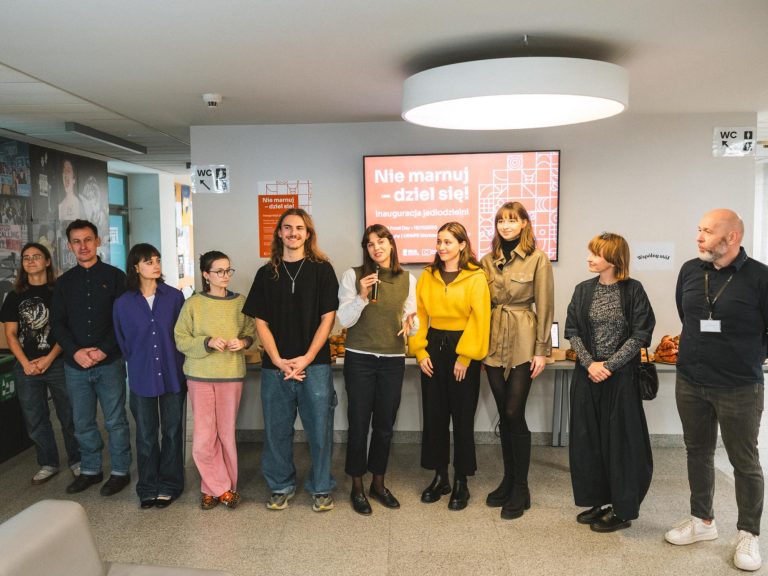
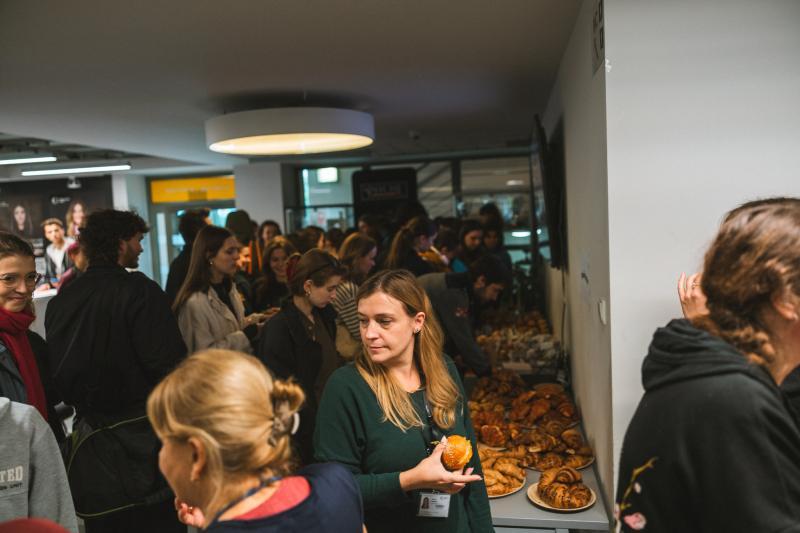
Sustainable development and caring about the natural environment are part of the European Reform University Alliance’s (ERUA) ethos, which SWPS University as a member of ERUA, adheres to. In October 2025, on our Warsaw campus, we launched a new initiative — Food Sharing Corner — which embodies the ERUA values. Caring about the environment and the local community, sharing the bounty and working together to improve the quality of life are the values, which sparked the idea of the Food Sharing Corner.
Many hands make for light work
The Food Sharing Corner is a place where food finds new consumers. The initiative arose from a belief that food should not be wasted. If one person has too much of a food item or they do not need it, they should not waste it, because it may still feed another person. It is a practical solution to a global problem of food waste, which occurs everywhere, regardless of the economic status.
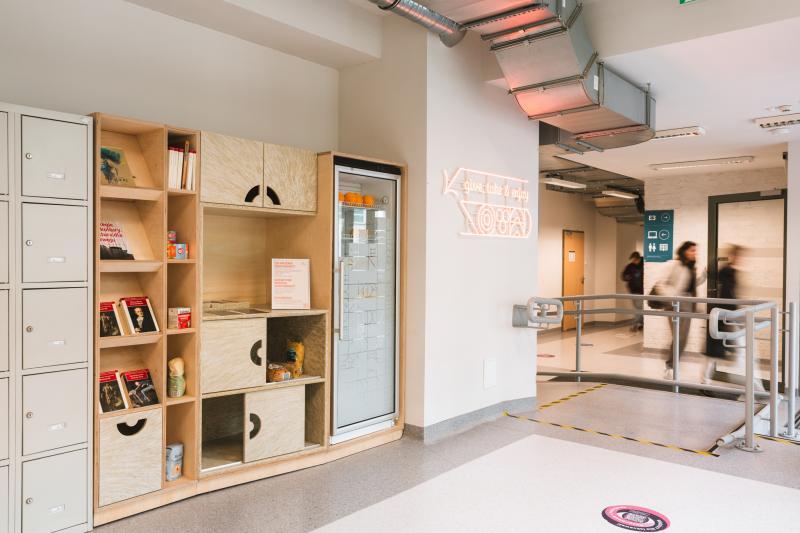
The story of our Food Sharing Corner shows the strength of collaboration in pursuit of common goals. The project has been developed and delivered by students and employees of SWPS University, from research, through concept development, design and construction. It was the students of our Design Program — School of Form — who developed the concept and design, while the students of the Graphic Design program created the visual identification. They collaborated with the Office for Sustainable Development, Facilities Management, and their academic teachers. Thanks to the combined energy, know-how, and experience of many people, we were able to turn an idea into reality and create the Food Sharing Corner that is visible and accessible to everyone.
The project is aligned with the idea of sustainable development, reflected not only in the idea of food sharing, but also in the choice of materials selected to build the Corner and its deliberate design. The use of recycled boards, transparent construction solutions, and open forms make the Food Sharing Corner not only functional, but also symbolic — it conveys a message that sharing and caring for the environment can become an integral part of our everyday lives.
Inclusive space for the whole community
It must be emphasized that our Food Sharing Corner is addressed not only to people who might find themselves in difficult circumstances. It is a space for everyone — students, academics, administrative staff and the local community. The idea is to share surplus food so that everyone can make use of it freely and without stigma. The goal is to develop a sense of responsibility in the local community that cares about each other and the planet.
Give, take & enjoy! is the motto that best conveys the message behind the Food Sharing Corner. The Corner is for everyone and thanks to this idea, everyone can easily contribute to the building of a responsible and united community.
The making of the Food Sharing Corner
The whole area of the Food Sharing Corner, from the design, through the furniture production, and visual communication has been developed by our Design Students from the School of Form. The team of designers included Helena Zdrojewska, Łukasz Machnowski, Michalina Kaczmarek, and Olga Plewnicka. They tell the story of making the Food Sharing Corner at SWPS University:
For us, the whole process of designing and producing the Food Sharing Corner was a great experience of team work. For several months we were working together creating the design and visualizations, and choosing the best materials that would reflect the idea of sustainable development.
It was very important to build not only a functional space, but one that would be aligned with its surrounding environment of our university campus. While we were designing the Food Sharing Corner, we realized that we could add a Book Crossing section as well to expand on the community sharing and recycling idea.
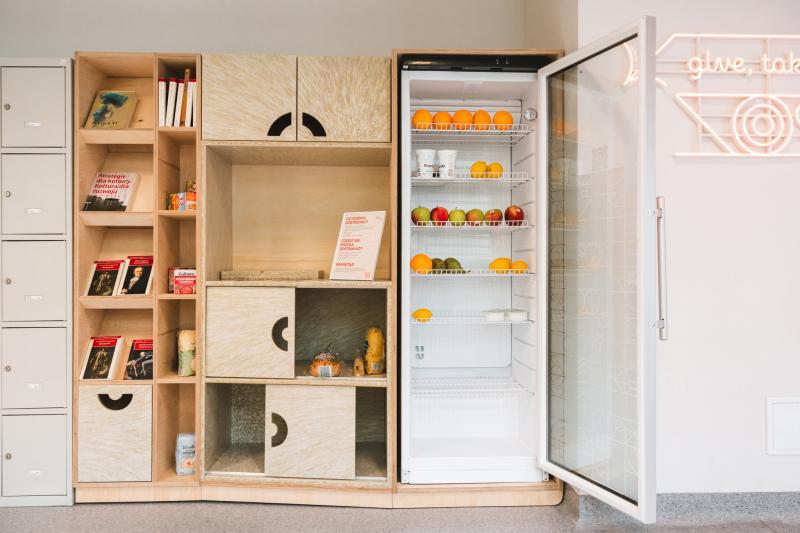
Our pre-design research indicated that most of the community food sharing stations were rather closed in their form, which did not encourage users to reach for the available items. Additionally, research carried out by students from SWPS University’s School of Ideas program confirmed that using food sharing stations was not free from some concerns regarding food safety and unpredictability of what one would find behind closed doors on pantry shelves and in the fridge. To solve these problems, we decided to incorporate sliding cupboard fronts, large cutouts in the doors, and a glass door fridge — solutions that would allow users to easily see inside without worrying about any unsavory surprises lurking there, which could discourage them from using the Food Sharing Corner.
Circular economy was one of the ideas that we wanted to stay true in our design of the Food Sharing Corner. Therefore, to make the furniture, we used the Boomplastic board, which is a 100% recyclable product. All Boomplastic boards are made of a single material, which allows for their easy recycling.
Help, guidance and support
The project could not be realized without daily support of our Woodworking Workshop that is managed by Szymon Pasierb and Zosia Parzych. Thanks to their expertise, we were able to overcome all our construction and esthetic challenges and produce a sturdy and pleasing to the eye Food Sharing Corner, which, we hope, will serve not only SWPS University students and employees, but also the local community of Kamionek, for many years.
Read more about the design process behind SWPS University’s Food Sharing Corner →
Visual identification
Wiktoria Kurzawa, the designer behind the visual identification of the Food Sharing Corner told us what inspired her design.
The name — Food Sharing Corner — contains an important element, i.e., the word “sharing”, which became the starting point for the whole system of visual communication for this space. The idea of sharing is the main theme of the project and has been reflected in the shapes that are associated with this idea. Furthermore, the food aspect present in the name of the space, was translated into other visual forms used in the system design. The users of the Food Sharing Corner are also an important element of the space, therefore they are presented on posters that adorn the space. All elements are attractive, coherent and hint at the general idea of food sharing.
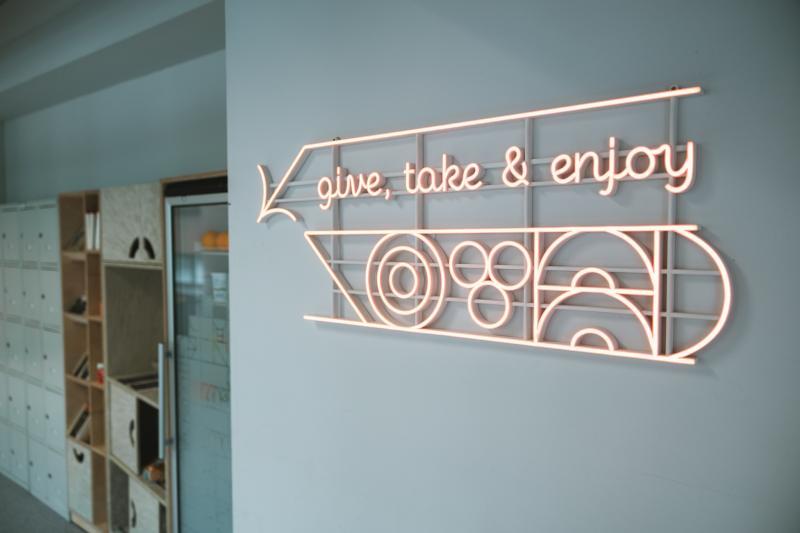
The slogan in English — Give, take & enjoy! — reflects the international character of SWPS University, which is a university of choice for many international students. The slogan directly reflects the idea of food sharing.
The Food Sharing Corner is also aligned with ERUA’s value of fostering sustainability, which drives us to place the future of our planet and that of humanity at the heart of everything we do, to move away from classical indicators of growth towards a new vision of individual, societal and global wellbeing.
The team behind the Food Sharing Corner at SWPS University
The building of the Food Sharing corner was a team effort that came to fruition thanks the following persons:
Design and build — Students form School of Form
- Michalina Kaczmarek
- Łukasz Machnowski
- Olga Plewnicka
- Helena Zdrojewska
Collaborating woodworking experts and supervisors: Szymon Pasierb and Zofia Parzych.
Visual identification
- Wiktoria Kurzawa, student of the Graphic Design program at SWPS University in Wrocław
Animation
- Julia Danielska, student of the Graphic Design program at SWPS University in Wrocław
Preliminary research and project assessment
- Students from the School of Ideas program
- Lecturers: Michał Szewczyk and Grzegorz Młynarski
Project management
- Zuzanna Jakubik – Sustainability Manager
- Rafał Furtak – Director of the Facilities Management
- Jolanta Starzak – Coordinator of the Design program at School of Form
- Anna Krudowska – Sustainable Development Specialist
- Martyna Obarska – Coordinator of the School of Ideas program