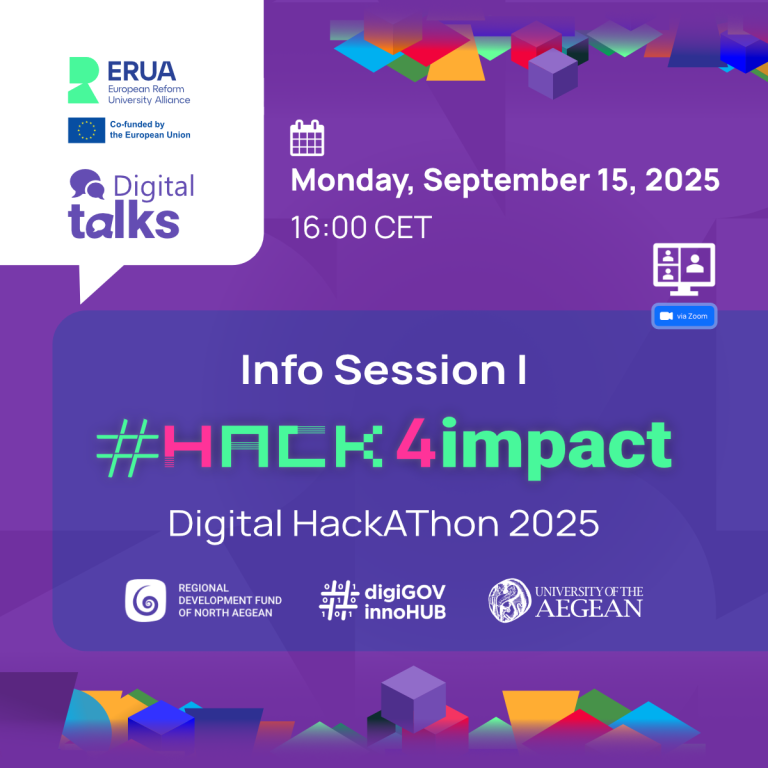
Learn more about Hack4impact by participating in this DigiTalk – Info Session!
Monday, September 15, 2025 | 16:00 to 17:00 CEST | Register now!
Hack4impact is a Digital Hackathon that connects entrepreneurship (including social) with digital public sector reforms, skills and alignment with the SDGs (Sustainable Development Goals). This approach showcases a unique initiative of the University of the Aegean, first-of-its-kind collaboration among the European Reform University Alliance (ERUA), the North Aegean Regional Development Fund and GR digiGOV-innoHUB.
Registration
Register here to attend the DigiTalk-Info Session online: https://aegean-gr.zoom.us/meeting/register/On9ioRC1SwWWzXDeNZ-uYg#/registration
Who could attend?
We welcome:
- Participants from the ERUA community
- Individuals & technology start ups
- Teams and individuals from the #ERUAiDeaThon2024 and the Social Entrepreneurship Course
- Local stakeholders, social innovators and entrepreneurs from all ERUA regions
Hack4impact Challenges are linked to:
- Regional needs (digital transformation, emerging skills’ needs & inclusive growth)
- ERUA’s core goals (university-led reforms, social entrepreneurship)
- EU priorities (public sector reform, digital transition, SDGs, creative and interregional knowledge communities)
- And ERUA thematic areas:
- Environmental Transition
- Democracy and Human Rights
- Interculturality and Multilingualism
- Migration
- Arts & Edges
Read the official Hackathon Call for more information on its framework!
Speakers – Panellists
- Haris Alexopoulos, DigiGov InnoHub
- Katerina Taka, ERUA University of the Aegean
- Alejandros Melidis, Open Technologies Alliance (GFOSS)
Learn more about Hack4impact here: https://hack4impact.digigov.innohub.gr/ !