About the program
Our intensive course seeks to deepen participants’ awareness of justice not only as a normative ideal but also as a lived and contested reality. By engaging with diverse perspectives, the program encourages critical reflection on the social foundations of law and its role in contemporary political orders.
Theoretical background
Eugen Ehrlich, one of the founding figures of the sociology of law, proposed a now-classic thesis: for law to be effective, it must not only be codified in legal statutes but also socially recognized and accepted. In other words, legal norms must resonate with the values and expectations of the community they aim to regulate.
Ehrlich’s insights were grounded in his empirical research in Austrian Bukovina, where he observed that even among largely illiterate rural communities, a distinct and functional understanding of core legal concepts, such as contracts, debt, and inheritance, existed. Although these interpretations frequently diverged from the formal doctrines of the Austrian Civil Code, they nonetheless guided daily life. Ehrlich argued that the source of these norms was not state-imposed law, but a shared sense of justice embedded in social practices—what he termed the “living law.”
According to Ehrlich, legal norms are truly effective only when they align with a society’s moral and normative order. Law’s legitimacy and enforceability thus depend not solely on institutional authority, but on collective recognition and social relevance. More than a century later, the question of law’s societal embeddedness remains a central concern in legal theory and political philosophy. As Martin Krygier has observed, “in a well-functioning rule-of-law system, the law must rule.” Yet the rule of law cannot prevail unless legal norms are perceived as just and legitimate by the communities they govern. Social and economic fairness, public trust, and cultural narratives continue to shape the conditions under which legal systems function.
What will you learn:
Through an interdisciplinary lens, the program will explore legal and extra-legal dimensions that shape collective understandings of justice. Topic will include:
- Constitutionalism and the formation of political communities
- Influence of historical memory
- Moral values
- Economic relations
- Competing narratives of legitimacy in liberal-democratic societies.
If you are interested in law not merely as a set of rules, but as a dynamic institution embedded in society, this intensive course offers a unique opportunity to engage with cutting-edge scholarship at the intersection of law, politics, and justice.
Application Process
Before you start your application process, please prepare the following documents:
- Curriculum Vitae (max. 2 pages)
- An essay on why justice is important to you, especially from an interdisciplinary perspective (max. 1,000 characters)
- CEFR B2 English proficiency certificate, for example, we accept TOEFL, CAE, IELTS, or FCE (B2). Alternatively, a letter confirming your English skills, printed on your home university’s letterhead, signed by one of your university lecturers.
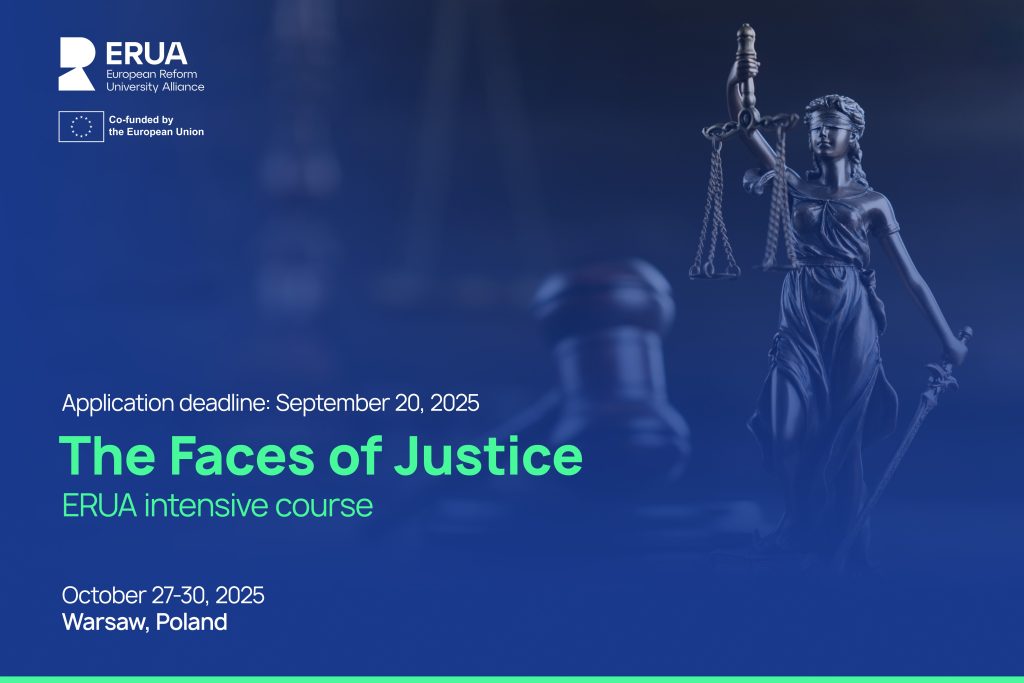
Application deadline: September 20, 2025.
To apply, follow this link ➜
Funding
Students who are accepted to the program, can apply for travel and accommodation funding at their home university’s ERUA Office.
Organizers
- SWPS University
- European Reform University Alliance
The project is co-funded by the European Union.