
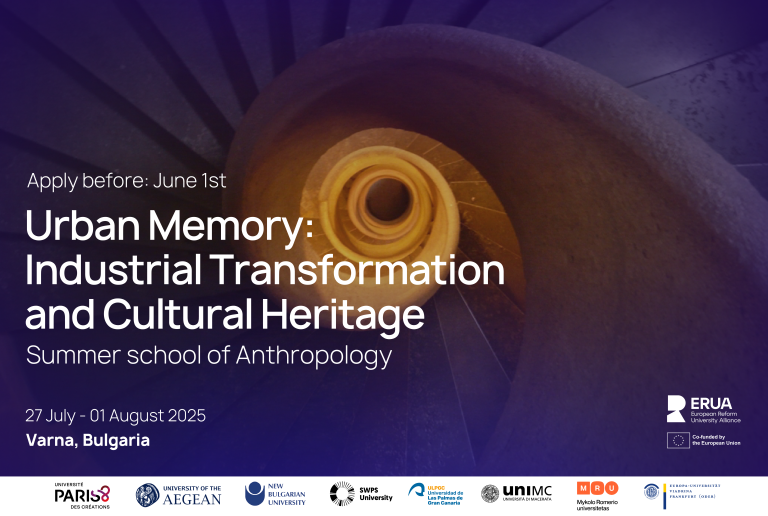
The ERUA Summer School of Anthropology, organized by the Department of Anthropology at New Bulgarian University (NBU), took place in Varna and focused on urban memory, industrial heritage, and cultural transformation.
For more than two decades, the summer school has brought students and researchers together to explore shifting cultural and social landscapes in Bulgaria. This year’s edition, hosted by the Museum of New History in Varna, continued the exploration of industrial heritage—a theme introduced last year that examines how abandoned factories and industrial sites are remembered, forgotten, or reimagined.
Since 2020, the Summer School of Anthropology has also had an international dimension, welcoming students from European partner universities within the ERUA alliance.
Participants visited former industrial landmarks such as the Hristo Botev Cotton Factory, the Glass Museum in Beloslav, the Saltworks in Provadia, as well as the State Archives and the Pencho Slaveykov Regional Library. These excursions offered an opportunity to engage directly with material traces of industrial history, while also collecting testimonies from former workers, museum professionals, and archivists.
Students were interested in discovering people’s attitudes toward industrial heritage. A major research question was about exploring what lenses do we see these landmarks through, today – the lenses of nostalgia, neglect, or potential reuse, explained Senior Assistant Professor Dr. Lyubomira Valcheva-Nandlol, who led the school.
Fieldwork conducted during the program revealed both the decline of many industrial sites and the persistence of collective memory attached to them. A positive example of transformation was noted in Beloslav, where a former glass factory now houses both an active production site and a modern Glass Museum. In contrast, the Hristo Botev Cotton Factory—established in 1882 and once central to Varna’s economy—stands largely abandoned, despite its historical and architectural significance.
For students, the summer school provided hands-on research experience. They analyzed archival documents, interviewed local residents, and developed independent projects that connect Bulgaria’s industrial past to broader European debates on heritage and urban transformation. The format allows students to immerse themselves in fieldwork, while international participants discover new perspectives and draw parallels with their own local contexts. This cross-cultural exchange enriches the research process and fosters collaboration on heritage and memory studies.
The program will conclude with a photographic exhibition which will be displayed at the Museum of New History in Varna, showcasing the sites explored by students and highlighting their significance for local memory and cultural identity.