Dates: 27.01 – 01.02.2026
Format: Hybrid
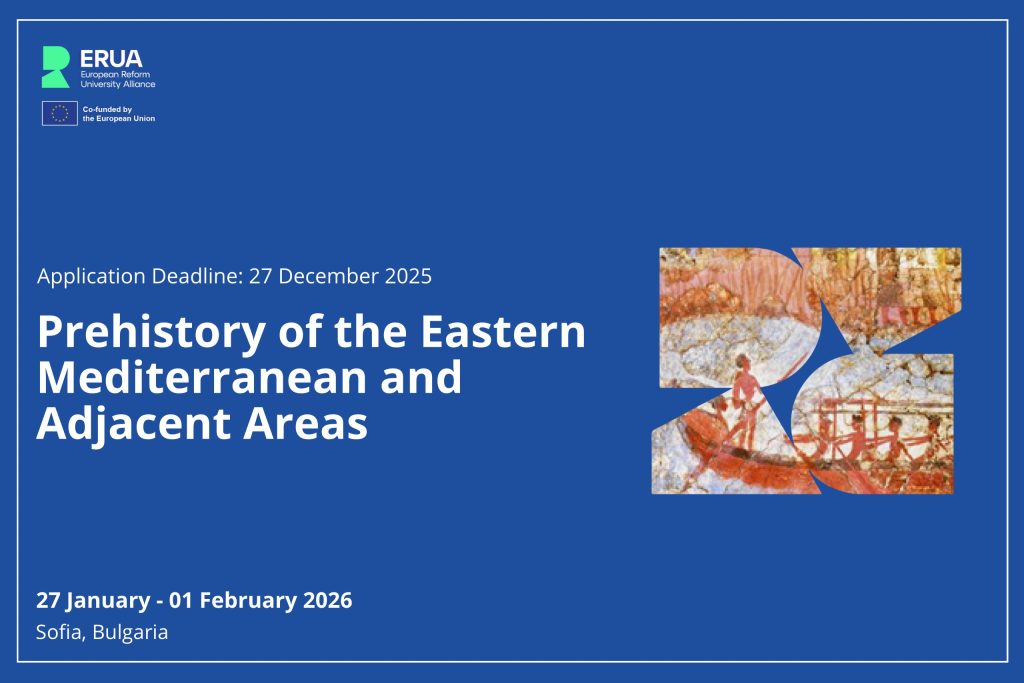
ERUA and New Bulgarian University (NBU) are announcing an intensive course “Prehistory of the Eastern Mediterranean and Adjacent Areas” that will take place at NBU and online, between the 27 of January and the 1st of February 2026. The iintensive hybrid course will consist of
six full day activities in Bulgaria (27 January – 01 February 2026) including arrival and departure time,
plus two online meetings before and after the stay in Sofia.
This course offers a fascinating journey in the prehistory of the Eastern Mediterranean, including the Near East (Mesopotamian) and Continental Europe when a general approach is needed. Participants are not expected to possess any prior knowledge in archaeology. The considerable amount of archaeological data is synthesized by the instructor to allow extensive discussions of topics, which are crucial not only for prehistoric archaeology, but also for present day life. Topics include:
- Migration – Advent of earliest Homo in Europe, the first agriculturalists in the 7th mill BC, the so called “Sea Peoples” at the end of the Bronze Age;
- Technological innovation – Spread of agriculture in Europe, appearance of copper metallurgy and the social and economic consequences as seen in the Copper Age necropolis in Varna, the spread of the bronze alloy etc.;
- Socio-political innovation – Appearance and collapse of Minoan and Mycenaean palaces, state formation and crisis;
- Knowledge transfer, appropriation and rejection – Early trade in the Aegean, appearance and importance of sailing boats, importance and structure of trading networks;
- Local and overregional identities – Cult, figurines, body cultures, food;
- Environmental changes – Sea level, climate, deforestation, soil erosion and settlement patterns etc.
Programme:
21 Jan, Wednesday (online meeting)
General information & introduction to the class/Topic 1. Imagining the Mediterranean
27 January, Tuesday – Arrival in Sofia
28 January, Wednesday (NBU, Sofia)
10.30 “Opening Coffee” at the Bio-Cafe, NBU
11.20-12.50 Topic 2: Paleolithic period around the Mediterranean
13.00-14.00 Lunch
14.00 – 14.30 Tour of the NBU (libraries and campus)
14.40-16.10 Topic 3: Transition to the Neolithic in the Near East
16.20-17.50 Topic 4: Settled Live in Neolithic Near East (Çatalhöyük)
Evening: Welcome drink & food in Sofia’s downtown
29 January, Thursday (NBU, Sofia)
11.20-12.50 Topic 5: The Copper Age in the Eastern Balkans
13.00-14.30 Break for lunch, study & readings
14.40-16.10 Topic 6: Crisis and Collapse. The End of the Copper Age in Southeastern Europe and the ‘Creative’ Fourth Millennium BCE in Mesopotamia and Europe
16.20-17.50 Topic 7: The Early Bronze Age (Third Millennium BC) in the
Eastern Mediterranean. Mobility of Objects, Ideas and P eople
30 January, Friday (NBU, Sofia)
11.20-12.50 Topic 8: Minoan Crete and the Appearance of the First Palaces in the Aegean
13.00-14.30 Break for lunch, study & readings
14.40-16.10 Topic 10: The Shaft Graves in Mycenae and the Origins of Mycenaean
16.20-17.50 Topic 12: Mycenaean Palaces
31 January, Saturday
Venue: National Archaeological Museum in Sofia
11.00-13.00 Topic 13: Cultural encounters – Part 1 (Museum Session, National Archaeological Museum in Sofia)
13-14.30 Lunch break
Venue: National Historical Museum in Sofia
14.30-16.30 Topic 14: Cultural encounters – Part 2 (Museum Session, National Museum of History Sofia)
Evening: Farewell drink & food in Sofia’s downtown
1 February, Sunday Departure from Sofia
4 February, Wednesday (online meeting)
Topic 15 Summary & Conclusions
For any questions, please contact: Dr. Bogdan Athanassov (bo.atana@nbu.bg).
Learning outcomes:
Participants who successfully complete this class will gain an overview of the main topics of Eastern Mediterranean prehistory. They will learn to approach with historical depth concepts such as migration, innovation, knowledge transfer, appropriation, as well as technological, societal, and environmental changes.
Assessment:
The course evaluation will be done via oral presentation, delivered in class.
Upon successful completion, the course will award 3 ECTS.
Who can apply:
We are looking for BA and MA students who are enrolled in ERUA member Universities and who have a good command of the English language. No previous experience with archeology is required.
Place: New Bulgarian University, Sofia, Bulgaria.
Application deadline: 27th of December 2025
Later applications may be accepted depending on availability.
How to apply:
To apply send a short CV and an email expressing your interest to the course coordinator, Assistant Prof. Dr. Bogdan Athanassov, at bo.atana@nbu.bg. The coordinator may propose a short online meeting to discuss course logistics and expectations.
Funding:
ERUA students can receive travel and accommodation funding from their home universities. Please contact your local ERUA coordinators.